
 7 hours ago
21
7 hours ago
21
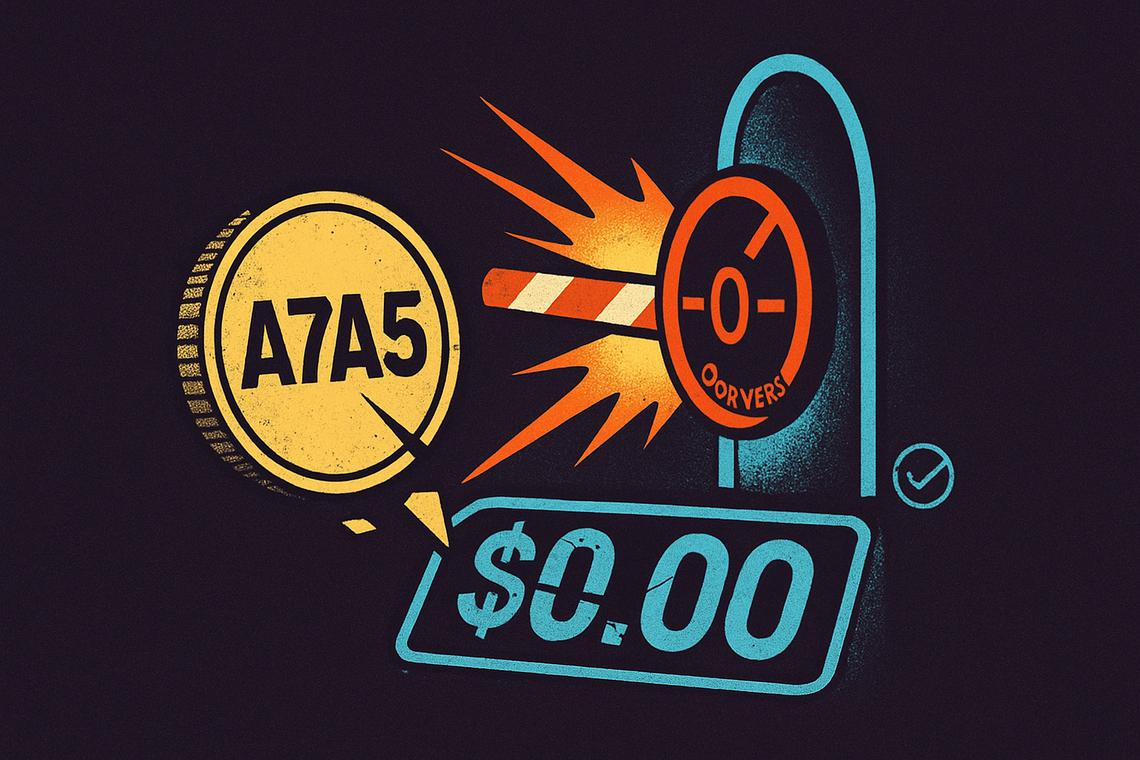
A stablecoin that once processed over $100 billion in transactions in a single year now trades at exactly zero. The A7A5 stablecoin collapse demonstrates what happens when geopolitical sanctions hit a crypto asset at its foundation — not gradually, but all at once.
Key takeaways
- The A7A5 stablecoin, linked to a sanctioned Russian state bank, has lost 96% of its value and currently trades at $0 with no recorded trading volume.
- Its smart contracts remain technically operational, but conversion is fully blocked following sanctions imposed by the U.S., U.K., and E.U.
- The A7 network, on which A7A5 operates, has processed nearly $120 billion to date and was specifically built for Russian sanctions evasion, according to Chainalysis.
- Mainstream exchanges are now actively screening deposits originating from A7A5’s network.
- The EU’s 21st sanctions package directly targets the A7 cross-border payments network and 14 unnamed crypto-related platforms across multiple jurisdictions.
Collapse of the A7A5 Stablecoin Amid Sanctions
The numbers tell a brutal story. A token that once moved capital at scale — reportedly handling more than $100 billion in its first year of operation — has been effectively wiped out. The A7A5 stablecoin collapse has erased 96% of the token’s value, and market data shows it trading at $0 with zero volume recorded in the past 24 hours.
Linkage to a Sanctioned Russian State Bank
A7A5 is a ruble-backed stablecoin tied to a sanctioned Russian state bank, and that connection turned out to be its fatal vulnerability. The token operated within the broader A7 cross-border payments network, which Chainalysis identified as having processed nearly $120 billion to date — a network it described as purposely built for Russia’s sanctions evasion.
The European Union’s 21st sanctions package targeted the A7 network, including its newer connections to Africa. EU High Representative Kaja Kallas described the scope: “We’re hitting over a hundred banks and crypto operators, 40+ vessels in Russia’s shadow fleet, and several oil refineries in Russia and Belarus.”
96% Value Decline and Market Status
When sanctions cut off the conversion pathways that give a stablecoin its practical value, the market reprices fast. A7A5 now trades at $0. No bids. No volume. The peg is gone not because the underlying smart contracts failed, but because the real-world infrastructure needed to actually use the token has been severed.
That distinction matters enormously. A stablecoin with no conversion avenue is functionally worthless, regardless of what the code says it’s worth.
Operational Status and Utility Restrictions
The smart contracts underpinning A7A5 are still running. Technically, the token exists on-chain. But existence on-chain and usability in the real world are two very different things, and A7A5 is now firmly in the first category only.
Smart Contracts Functional but Conversion Blocked
Sanctions imposed by the U.S., U.K., and E.U. have systematically closed off every meaningful conversion pathway. Users holding A7A5 cannot exchange it for other currencies or assets through any compliant venue. The token is stranded — technically alive, economically dead.
This is a critical lesson in how stablecoin risk works differently from traditional crypto volatility. Bitcoin can drop 50% and still be traded globally. A sanctions-hit stablecoin tied to a blocked entity can go from $100 billion in volume to zero trades in a matter of weeks, with no recovery mechanism available while the sanctions hold.
Exchange Measures and Deposit Screening
The compliance wall is hardening in real time. Mainstream exchanges are now screening deposits that originate from A7A5’s network. This kind of proactive filtering — driven by blockchain analytics firms like Elliptic — effectively quarantines the token from the broader crypto ecosystem even beyond what the sanctions themselves mandate.
Once major exchanges flag a network at the deposit level, even users who may not fully understand the sanctions picture find themselves locked out. The practical effect is a total market freeze.
The EU’s 21st Sanctions Package and Its Crypto Reach
The A7A5 situation didn’t happen in a vacuum. It’s the downstream consequence of an escalating sanctions campaign that has grown significantly more sophisticated in its targeting of crypto infrastructure.
The EU’s latest package goes further than any previous action in one important respect: it introduces a legal instrument that could enable a full ban on crypto-asset services used by Russia. This new tool allows the EU to prohibit any transaction between an EU operator and any crypto provider used for Russian purposes — a sweeping potential reach that extends well beyond A7A5 itself.
Alongside the digital asset measures, the EU is freezing assets and blocking transactions for 94 banks and major financial institutions, and extending its transaction ban to 33 additional Russian credit and financial institutions. The 21st package also widens its transaction ban to 14 unnamed crypto-related platforms based in Georgia, Panama, the UAE, the Marshall Islands, Kyrgyzstan, and Belarus.
What the A7A5 Collapse Signals for Stablecoin Regulation
The failure of A7A5 surfaces a question the crypto industry hasn’t fully resolved: how should stablecoins with sovereign or state-adjacent backing be treated under international sanctions law?
Unlike decentralized tokens, stablecoins derive their value from a promise — a backing entity, a peg, a conversion mechanism. When the backing entity is sanctioned, that promise collapses. The A7A5 stablecoin collapse makes the risks of sanctioned cryptocurrencies concrete in a way that abstract regulatory warnings never quite managed.
Calls for enhanced regulatory frameworks around stablecoins are growing louder as a result. The case for clearer rules about what constitutes an acceptable backing entity, and how stablecoin issuers must respond to sanctions on their reserve holders, is now harder to dismiss. Traders operating in this space are being strongly advised to monitor evolving stablecoin regulations closely, as scrutiny on similar assets is likely to intensify.
A7A5 processed more than $100 billion before enforcement caught up. That scale shows just how much capital can flow through a sanctioned network before sanctions take effect — and why regulators on all sides are now treating stablecoin infrastructure as a first-tier geopolitical priority, not an afterthought.
FAQ
What caused the collapse of the A7A5 stablecoin?
The A7A5 stablecoin collapsed primarily due to sanctions imposed by the U.S., U.K., and E.U. targeting the Russian state bank to which it was linked. These sanctions cut off conversion pathways, making the token effectively unusable despite its smart contracts remaining technically operational.
Are the smart contracts of A7A5 still operational?
Yes, the smart contracts behind A7A5 remain operational on-chain. However, the token’s utility has been entirely blocked — users cannot convert it through any compliant exchange or platform, leaving it economically worthless even though it technically still exists on the blockchain.
How has the market responded to A7A5’s collapse?
A7A5 currently trades at $0 with no trading volume recorded in the last 24 hours. Mainstream exchanges have begun screening deposits originating from A7A5’s network, effectively quarantining the token from the broader crypto market.
What does the collapse of A7A5 imply for stablecoin regulation?
The collapse highlights the systemic risks associated with stablecoins backed by sanctioned entities, and has intensified calls for enhanced regulatory frameworks. The EU’s 21st sanctions package introduced a new legal instrument capable of banning any crypto-asset service used by Russia — marking a significant escalation in how Western regulators are approaching crypto and sanctions compliance.
Article produced with the assistance of artificial intelligence and reviewed by the editorial team.




 English (US) ·