
 4 months ago
56
4 months ago
56
Key Takeaways
- Aave witnessed a TVL collapse from approximately $48.5B to $30.7B after the April 18 KelpDAO rsETH bridge security breach
- Bad debt accumulated on the platform ranges between $196M and $280M due to the exploit
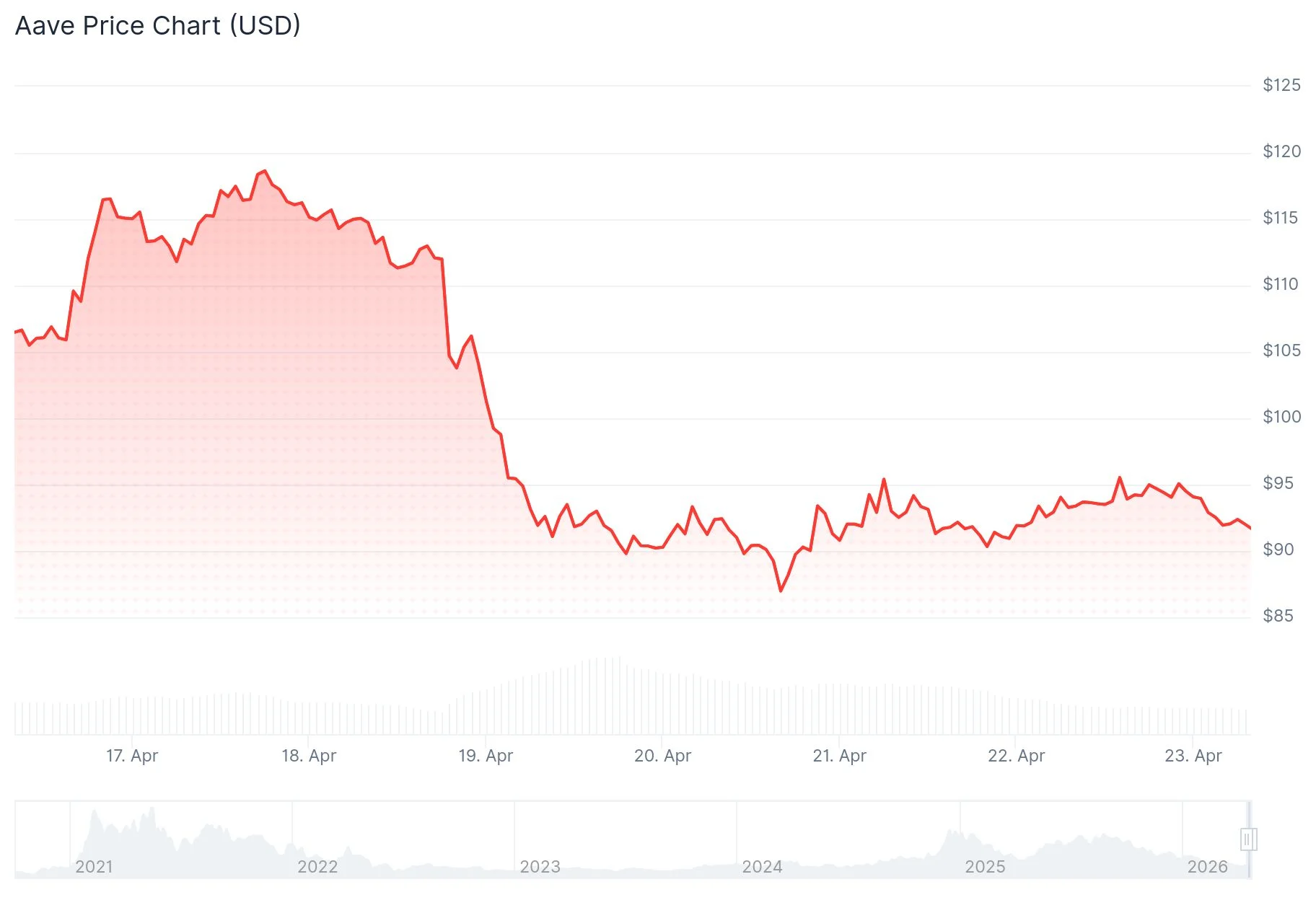
- AAVE token trades near $93, reflecting a 7% weekly decline
- Exchange token reserves jumped to 2.39M, indicating potential selling momentum
- Competitor SparkLend absorbed approximately $1.3B in capital as users fled Aave
The leading DeFi lending protocol Aave experienced a staggering $15 billion reduction in total value locked within just four days following a critical security incident tied to KelpDAO that undermined user confidence throughout the decentralized finance ecosystem.
 AAVE Price
The security breach exploited a vulnerability within KelpDAO’s rsETH bridging infrastructure. The malicious actor leveraged this weakness to create fraudulent collateral tokens, subsequently borrowing legitimate ETH from Aave’s liquidity pools before withdrawing the funds. The resulting bad debt burden facing the protocol is currently estimated at $196 million to $280 million.
Prior to the April 18 security incident, Aave maintained approximately $48.5 billion in aggregate deposits. Within four days, by April 22, that amount had contracted sharply to roughly $30.7 billion. Prominent crypto intelligence account Wu Blockchain highlighted on X that total outflows exceeded $16.2 billion, erasing more than a third of the platform’s deposit base.
Morpho protocol similarly experienced capital flight, with TVL declining from $11.7 billion down to $10.2 billion during the identical timeframe.
SparkLend Emerges as Capital Destination
The exodus from Aave didn’t entirely exit the DeFi sector. SparkLend’s total value locked climbed to $3.2 billion, absorbing roughly $1.3 billion in fresh deposits over the same period. Blockchain analytics indicate users repositioned funds toward platforms perceived as carrying reduced risk exposure.
The AAVE token was changing hands around $93.45 during the analysis period, showing a modest 1.06% gain over 24 hours. Nevertheless, the asset remains down 7.09% across the previous week and approximately 11% throughout the past month.
Whales are accumulating $AAVE while retail exits 
Post KelpDAO exploit:
• ~$196M bad debt
• TVL: $26.3B → $15.6B
• Funds rotating to Spark
Under the hood:
• Whale order size surging
• Sentiment at peak fear$AAVE ~$90–$100 — smart money stepping in.
Not a confirmed… pic.twitter.com/4E0Leexk8a
— Wise Crypto (@WiseCrypto_) April 22, 2026
Technical indicators on the four-hour chart show the MACD histogram turning positive with signs of a potential bullish crossover forming. However, the RSI indicator hovers around 46, positioned just beneath the neutral 50 threshold.
Blockchain Metrics Indicate Distribution Activity
Exchange-held reserves of AAVE tokens surged to nearly 2.39 million units. Historical patterns show that substantial token transfers to centralized exchanges typically precede selling activity.
Active borrowing positions on Aave are stagnating, demand for new loans has weakened, and incoming capital flows have diminished considerably. The divergence between falling TVL and rising exchange inflows creates a pattern that market analysts typically interpret as distribution behavior rather than accumulation.
The token has faced repeated rejections approaching the $100–$105 price zone, establishing this range as immediate overhead resistance. Meanwhile, the $85–$90 corridor represents critical support territory worth monitoring.
Notably, large-wallet addresses have continued accumulating AAVE tokens despite the broader outflow trend. At reporting time, Bitcoin maintained levels above $78,000 while Ethereum held above $2,300, offering a generally supportive macroeconomic environment for crypto assets.
Should buyers successfully breach the $96 level, the subsequent price target becomes $100. A decisive break above $100 would clear the path toward $108. Conversely, failure to maintain $90 support could expose the $88 level, with $84 representing the next significant support zone beneath that.
The post Aave (AAVE) Loses $15B in TVL Following KelpDAO Bridge Exploit and Massive Bad Debt appeared first on Blockonomi.





 English (US) ·