
 4 months ago
57
4 months ago
57
Every major publicly listed Bitcoin (BTC) miner has announced a pivot toward artificial intelligence, triggering a sharp debate over what the shift means for network security.
Charles Edwards, founder of Capriole Investments, published data showing that the average BTC revenue share among top public miners is expected to fall from 90% to roughly 30% within two to three years.
Public Miners Are Betting on AI Over Bitcoin
Tracking roughly a dozen public mining firms, companies targeting 80% or more AI revenue saw stock gains above 500% on average over two years.
Those with lower AI targets posted a fraction of those returns, with several in negative territory.
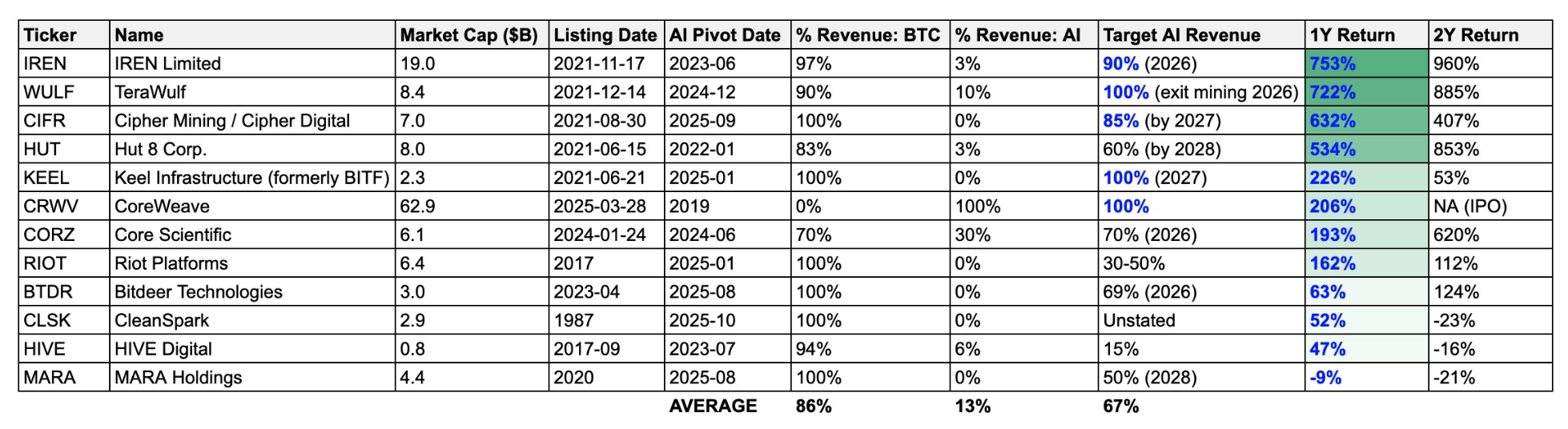 Major public Bitcoin miners. Source: Charles Edwards on X
Many of these firms are not planning to upgrade or replace Bitcoin mining hardware. Instead, they intend to run existing ASICs until end of life while reinvesting only in AI infrastructure.
“If these numbers are even half accurate, and they are based on direct company statements, the energy and commitment to Bitcoin is under significant threat over the next 2-3 years. All while Quantum computing is taking off and poses an existential threat to Bitcoin unless we change the code,” wrote Edwards in the post.
Paul Sztorc, a Bitcoin researcher, echoed the concern. He noted that MinerMag rebranded to “Energy Mag,” the Bitcoin 2026 conference renamed its “Mining Stage” to “Energy Stage,” and MARA Holdings removed Bitcoin references from its site years ago.
Adam Back Sees a Self-Correcting Market
Blockstream CEO Adam Back pushed back on the alarm. He argued that if hashrate falls, profit margins rise for remaining miners. The result is an arbitrage that reaches equilibrium when mining returns match AI workload margins.
“…this is actually good for miners: if Hashrate falls profit margin increases. it’s an arbitrage, with equilibrium when mining margin is the same as ai workloads. Higher profit margin adds to positive reflexivity – miners sell less Bitcoin to cover power, and as price rises,” Back challenged.
Higher margins also mean miners sell less BTC to cover operating costs, which Back described as “positive reflexivity.”
While the margin benefit makes sense, the concern lies in whether the trend is healthy for Bitcoin overall. With 100% of public miners pivoting and energy commitment declining, the network’s security backbone may be weakening at a critical time.
Bitcoin’s mining difficulty already dropped 7.76% in March 2026. The hashrate fell to roughly 870 EH/s from highs near 1 ZH/s earlier this year, reflecting the broader exit of computing power from the network.
The debate arrives weeks before Bitcoin 2026 in Las Vegas, where Sztorc plans to present a proposed solution to the mining exodus on the newly renamed Energy Stage.
The post Adam Back Sees Upside as Bitcoin Miners Shift to AI appeared first on BeInCrypto.




 English (US) ·