
 5 months ago
61
5 months ago
61
Key Takeaways
- Charles Guillemet, CTO at Ledger, reveals AI is dramatically reducing both cost and complexity of cryptocurrency cyberattacks
- Cryptocurrency platforms lost more than $1.4 billion over the last twelve months, with AI accelerating this alarming trend
- Major breaches this year include a $285 million drain from the Drift protocol and $25 million stolen from Resolv
- Enhanced security measures like formal verification, dedicated hardware wallets, and cold storage are critical defenses
- Security experts urge users to operate under the assumption that breaches are inevitable
The cryptocurrency security landscape is facing an unprecedented challenge as artificial intelligence empowers malicious actors with tools that outpace traditional defense mechanisms. According to Ledger’s top technology executive, the barrier to entry for sophisticated cyberattacks has collapsed dramatically.
In a conversation with CoinDesk, Charles Guillemet explained how automation and machine learning are fundamentally reshaping the threat environment. What previously required extensive expertise and substantial time investment can now be accomplished almost instantaneously with AI assistance.
“The process of discovering system weaknesses and weaponizing them has become trivially simple,” Guillemet explained. “We’re witnessing attack costs approach zero.”
His warning comes amid a surge in high-profile breaches. The Drift protocol on Solana suffered a devastating $285 million loss just days ago. Prior to that, the Resolv yield platform was compromised for $25 million.
DefiLlama’s tracking data reveals that cryptocurrency theft and losses exceeded $1.4 billion during the previous twelve-month period. Industry observers anticipate AI will accelerate this troubling trajectory.
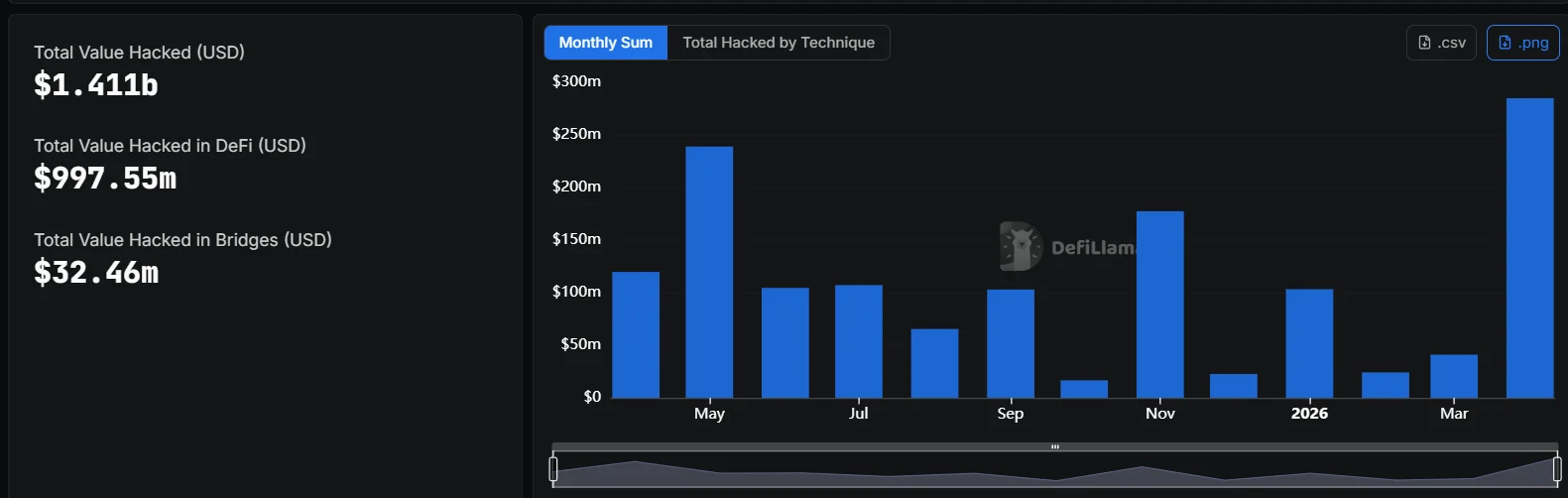 Source: DefiLlama
The fundamental issue stems from changing attack economics. Historically, cybersecurity maintained effectiveness because breach attempts required greater investment than potential gains. Artificial intelligence is dismantling this equilibrium.
Within the cryptocurrency ecosystem—where smart contracts govern substantial capital pools—these dynamics create exceptional vulnerability. As Guillemet emphasized: “There’s zero margin for error.”
AI Code Generation Creates New Attack Surfaces
The security crisis extends beyond external threat actors. Development teams are increasingly incorporating AI-generated code into their systems, potentially introducing flaws that evade initial scrutiny.
“There’s no magical solution for instant security,” Guillemet noted. “We’re creating massive amounts of code with inherent security weaknesses.”
He also highlighted emerging malware variants that actively search compromised mobile devices for wallet recovery phrases. Once located, attackers can silently extract funds without any victim interaction.
This attack vector bypasses conventional protection strategies, including comprehensive code reviews and standard security assessments.
Recommended Defense Strategies
Guillemet advocates for formal verification methodologies as superior alternatives to conventional auditing practices. These techniques employ mathematical validation to ensure code behavior matches specifications, minimizing opportunities for exploitation.
Dedicated hardware wallet devices represent another crucial defensive layer. Maintaining private keys on isolated, internet-disconnected hardware substantially reduces vulnerability to remote attacks.
“Utilizing purpose-built devices that remain permanently offline creates inherently stronger security architecture,” he emphasized.
For individual cryptocurrency holders, his guidance is unambiguous: never presume the platforms you interact with are impenetrable.
“The reality is that most systems cannot be fully trusted,” Guillemet stated.
He anticipates the industry will fracture into two tiers. Wallet providers and established protocols will likely implement robust security enhancements and evolve their defenses. Meanwhile, general-purpose software platforms may struggle to maintain adequate protection.
The recent Drift breach—resulting in $285 million in losses—serves as a sobering reminder of these vulnerabilities, representing one of 2026’s most significant cryptocurrency security failures to date.
The post AI-Powered Hackers Are Making Crypto Wallets Easy Targets — Security Expert Warns appeared first on Blockonomi.





 English (US) ·