
 4 weeks ago
54
4 weeks ago
54
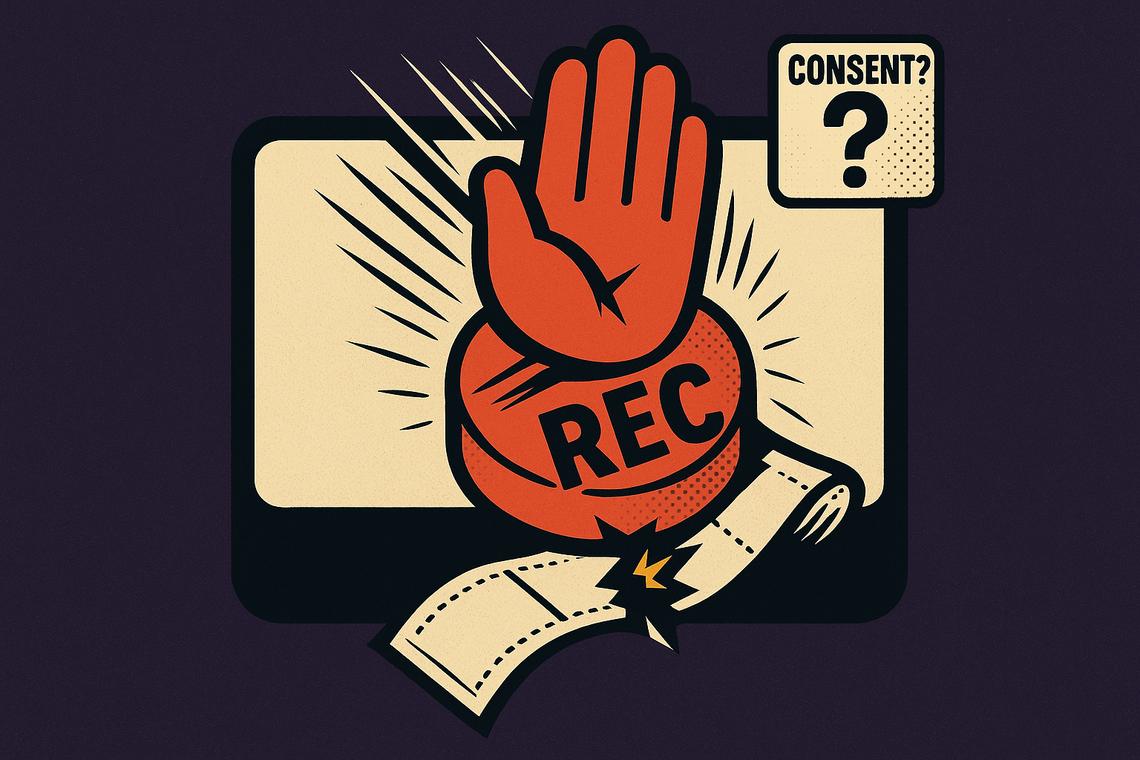
A venture capitalist has found a blunt workaround to one of Silicon Valley’s most quietly contentious habits. On Zoom, Jeremy Levine no longer simply logs in as himself — his display name now reads “Jeremy Levine I do not consent to transcribing or recording.” It’s part protest, part practical shield, and it says something uncomfortable about where Zoom AI transcription and always-on recording have taken us.
Key takeaways
- Venture capitalist Jeremy Levine changed his Zoom display name to formally state his non-consent to recording or transcription.
- VC Eric Bahn now automatically assumes every meeting with a founder will be recorded, even without seeing a device.
- A founder uses the Granola app to record first dates, then feeds transcripts to Claude to analyze her own conversational behavior.
- Always-on recording is described as a legal minefield, raising unresolved questions about consent.
- The sheer volume of auto-generated transcripts is creating a new problem: recordings that no one has time to revisit.
The rise of always-on AI recording
A new Wall Street Journal report captures what many professionals have already started to feel in their bones: the assumption of being recorded has quietly become the default in modern meetings. A growing ecosystem of AI note-taking apps and wearable devices has made continuous transcription not just possible but normal — expected, even.
TechCrunch, which has covered and ranked multiple tools in this space, reported on the trend July 17, 2026. The shift isn’t subtle. VC Eric Bahn told the Wall Street Journal that he now automatically assumes his meetings with founders will be recorded — and that assumption kicks in before anyone even slides a phone across the conference table. The recording is already happening. He just knows it.
That level of ambient awareness marks a real turning point. When a senior investor treats recording as a background constant rather than an active choice by the other party, it signals how thoroughly these tools have normalized surveillance in professional settings.
When AI transcription moves beyond the office
What makes the current moment genuinely strange is how far outside work this behavior has traveled. According to the Wall Street Journal piece, one founder disclosed that she records most of her first dates using the Granola app. After each date, she feeds the transcript to Claude — an AI tool — to assess whether she could have been more “engaging or empathetic,” and to figure out who did most of the talking.
That’s not a productivity workflow. That’s using AI transcription as a personal performance coach for romance.
It’s a vivid example of how tools built for conference rooms are bleeding into the most intimate corners of daily life. And it raises an obvious question that nobody seems to have a clean answer for: does the other person know?
The social and legal fallout nobody wants to talk about
Levine’s Zoom name stunt reads as frustration turned into a public statement. He has called the always-on recording trend “socially unacceptable behavior” that can kill spontaneous conversation entirely. When people know — or simply suspect — that their words are being logged, the texture of interaction changes. The offhand remark, the candid admission, the kind of thinking-out-loud that moves a conversation forward: all of it gets filtered through a new layer of self-censorship.
Beyond the social friction, experts cited in the Wall Street Journal piece describe the legal terrain as a minefield. Recording consent laws vary widely, and the casual deployment of AI transcription apps — often without explicit notification to all parties — sits in genuinely murky legal territory. The gap between what’s technically easy and what’s legally permissible has rarely been this wide.
There’s a strategic dimension here worth examining. Companies building AI note-taking products have strong incentives to make recording as frictionless as possible. Every added consent prompt is a moment of friction that reduces usage. But that same frictionlessness is precisely what creates the legal and social exposure. The easier it becomes to record without thinking, the harder it becomes to argue the recording was meaningfully consented to.
The data overload problem no one anticipated
Even setting aside consent, there’s a practical absurdity beginning to surface. If every meeting, casual conversation, and first date gets auto-transcribed and summarized, who is actually reading any of it?
The honest answer, in most cases, is nobody. Recordings pile up. Summaries go unopened. The initial appeal of having everything captured collides with the reality that human attention is finite. What was supposed to solve information loss ends up creating a different kind of problem: an audio archive of daily life that nobody has the time or energy to process.
This points to a tension at the core of the always-on recording movement. The value proposition assumes that capturing everything preserves value. But captured data without retrieval isn’t memory — it’s just storage. And storage, at scale, becomes its own burden.
Levine’s Zoom name hack won’t stop the trend. But it does put the consent question squarely on the screen, literally, for anyone who joins his calls. The real test isn’t whether individuals can opt out through clever display-name workarounds — it’s whether the companies building these tools will build consent in by default, before regulators force their hand.
FAQ
Why did Jeremy Levine change his Zoom name?
Levine changed his Zoom display name to “Jeremy Levine I do not consent to transcribing or recording” to formally signal his refusal to be recorded or transcribed during video meetings, in response to the widespread use of AI transcription tools.
Are AI transcription apps commonly used in meetings now?
Yes. According to reporting by the Wall Street Journal and TechCrunch, always-on recording has become increasingly ubiquitous, driven by a growing range of AI note-taking apps and devices used across professional and personal settings.
What legal issues does continuous recording raise?
Continuous recording without explicit consent from all parties raises serious legal questions. Sources cited in the Wall Street Journal describe the practice as a legal minefield, though the specific laws involved vary depending on jurisdiction.
How do some individuals use AI transcription in personal contexts?
One founder, as reported by the Wall Street Journal, records most of her first dates using the Granola app, then feeds the resulting transcripts to Claude to evaluate how engaging or empathetic she was and to see how much of the conversation she led.
Article produced with the assistance of artificial intelligence and reviewed by the editorial team.



 English (US) ·