
 6 hours ago
18
6 hours ago
18
Prediction market traders are already throwing enormous sums at the 2028 U.S. presidential race, with JD Vance leading the overall field and Alexandria Ocasio-Cortez (AOC) breaking out as the strongest early Democratic contender. While hundreds of millions are being tossed at these political wagers, there’s still exactly 806 days until the 2028 U.S. presidential election on Nov. 7, 2028.
Key Takeaways
- Polymarket prices JD Vance at 23.4% after its 2028 market topped $692M.
- AOC leads Polymarket Democrats at 20.5% as volume hits $1.27B.
- Kalshi prices Democrats at 58%, with the 2026 midterms looming next.
Traders Hurl Hundreds of Millions at the 2028 Race
Polymarket’s Presidential Election Winner 2028 market has churned through more than $692 million in volume since opening July 11, 2025. Vice President JD Vance leads with an implied probability of 23.4%, followed by Alexandria Ocasio-Cortez (AOC) at 14.1%, Marco Rubio at 10.8%, Jon Ossoff at 9.8% and Gavin Newsom at 8.9%. Those percentages are market prices, not polling results or promises about who wins.
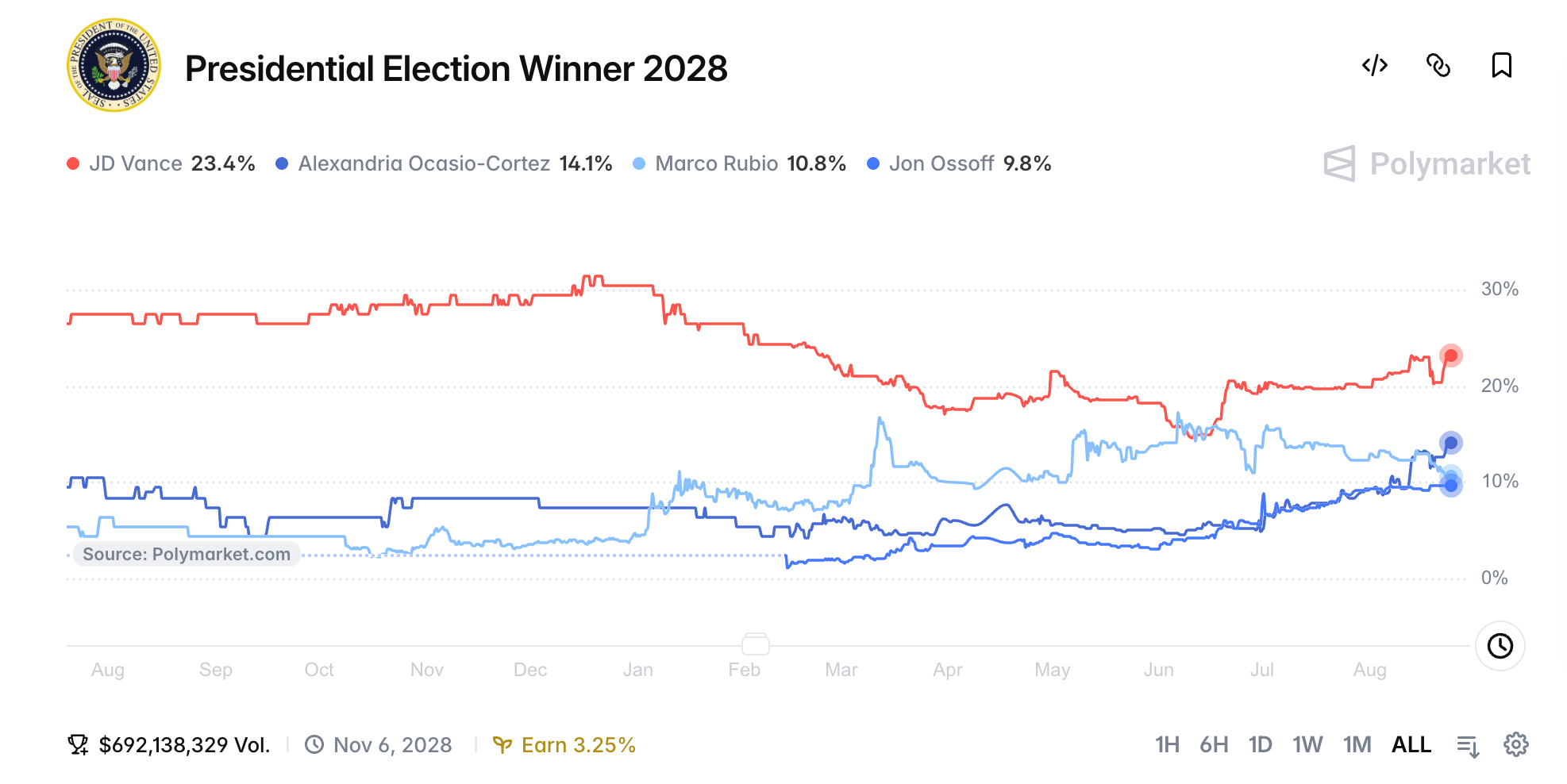 Image source: Polymarket event on Aug. 24, 2026.
Basically, prediction markets let traders buy contracts tied to future events. A “Yes” contract trading at 23.4 cents effectively means the market is pricing roughly a 23.4% probability of that outcome. Prices jump and fall as traders buy and sell, so the scoreboard captures money-driven sentiment at a specific moment rather than a scientific survey of voters.
That difference is impossible to ignore this far from Election Day. The presidential election is scheduled for Nov. 7, 2028, more than two years away, and neither major party has picked its nominee. Political careers, economic shocks, campaigns, scandals, elections and global events can completely scramble the board before voters cast their actual presidential ballots.
Ocasio-Cortez Breaks Free From a Crowded Democratic Pack
So far, the hotter action is on the Democratic side. AOC leads Polymarket’s Democratic Presidential Nominee 2028 market at 20.5%, ahead of Newsom and Ossoff, both sitting around 14.8%. Former Vice President Kamala Harris stands at 7.4%, while Pete Buttigieg and Pennsylvania Gov. Josh Shapiro are each hovering around 5%.
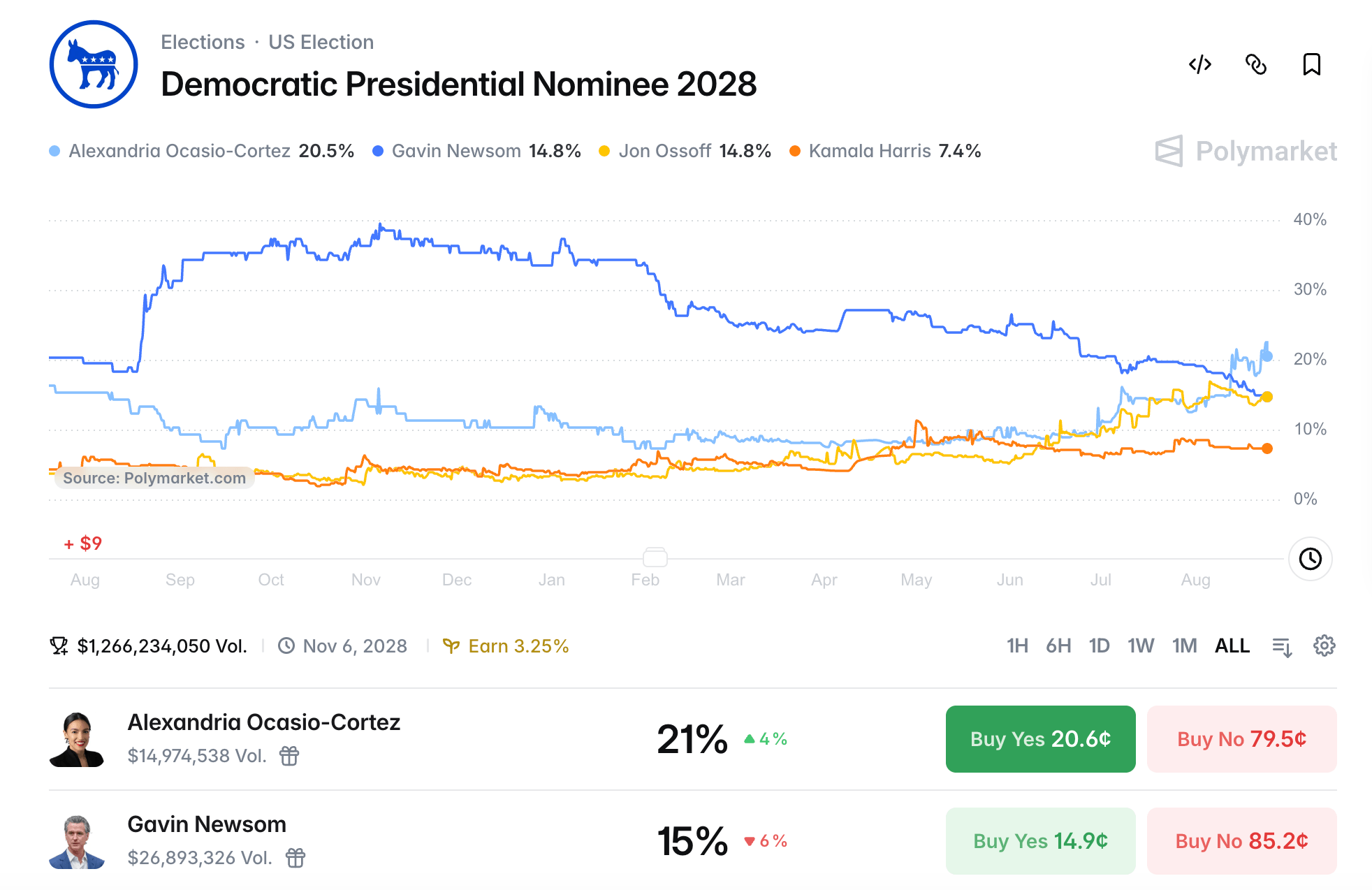 Image source: Polymarket event on Aug. 24, 2026.
That Democratic nomination market has already chewed through roughly $1.27 billion in total volume since opening July 11, 2025. Kalshi tells a similar story, though its prices differ. AOC and Ossoff are both around 18% on Kalshi’s Democratic nomination market, with Newsom at 13%. Kalshi’s market has logged more than $190 million in volume.
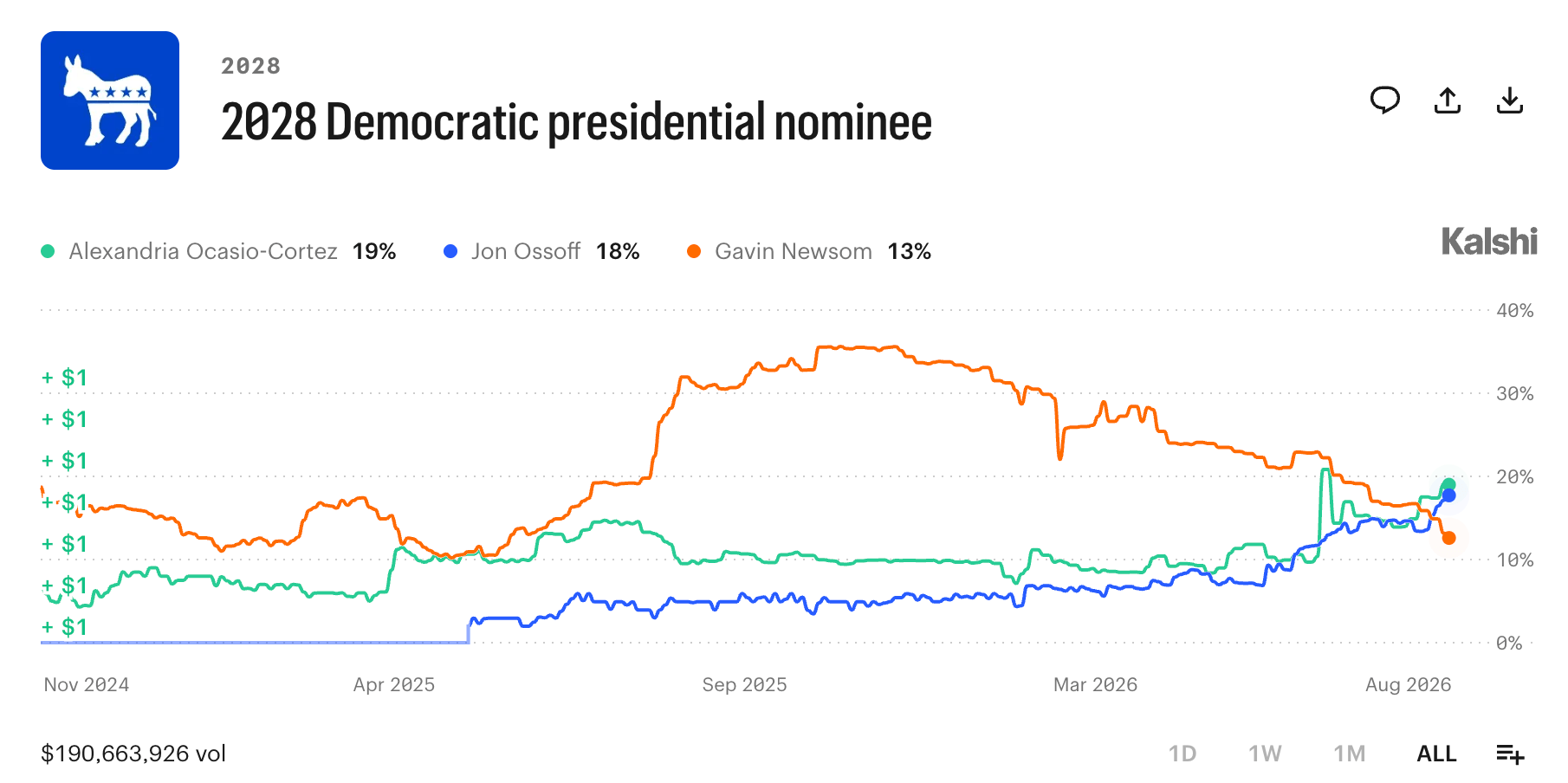 Image source: Kalshi event on Aug. 24, 2026.
AOC’s early strength reflects several advantages that traders are already putting money behind before a formal campaign even exists. She carries national name recognition, a massive online following, and a battle-tested grassroots fundraising network. Meanwhile, potential moderate and establishment Democratic support remains scattered among Newsom, Ossoff, Buttigieg, Shapiro, and other possible contenders.
Early Odds Price Momentum, Not Election Day Reality
Early polling has also poured fuel on interest in AOC, but prediction markets behave differently from traditional surveys. Polls ask voters whom they support when they are questioned. Markets force traders to put money behind what they think eventually happens, factoring in fundraising, endorsements, polls, candidate decisions, and political conditions that have not arrived yet.
The spread between platforms shows why these prices deserve a careful read. Kalshi’s presidential winner market puts Vance at 19%, Ocasio-Cortez at 13% and Rubio at 12%, compared with Polymarket’s 23.4%, 14.1% and 10.8%, respectively. Different traders, liquidity, and contract structures can produce different prices even when money is chasing essentially the same political outcome.
Democrats Grab an Early Edge in the Party Fight
Kalshi’s separate party market throws another number onto the board. Traders currently price the Democratic Party at a 58% probability of winning the presidency in 2028, compared with 42% for the Republican Party. That does not make any individual Democrat the presidential favorite. Democratic probability is scattered across numerous possible nominees, while Vance currently controls a bigger slice of the Republican field.
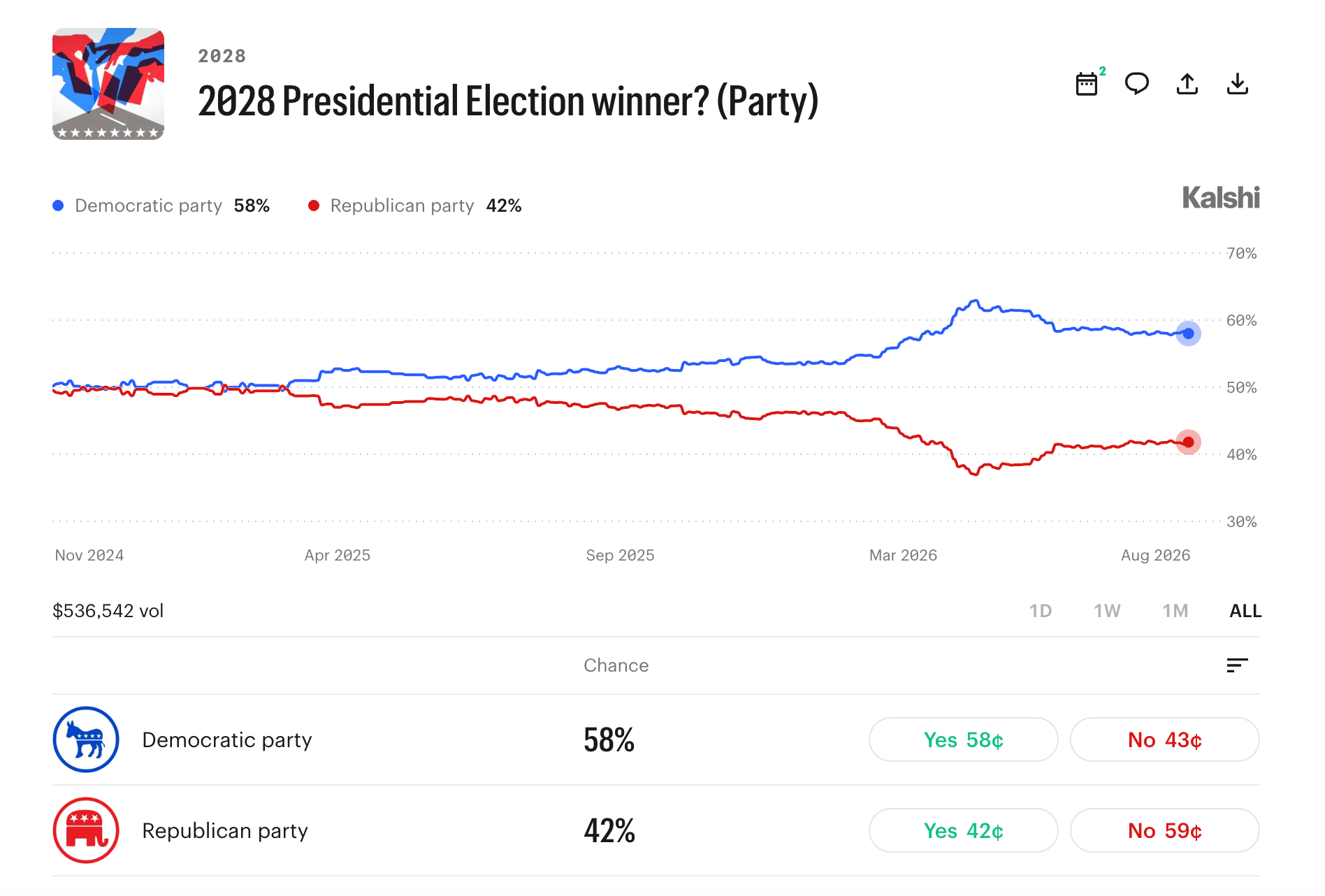 Image source: Kalshi event on Aug. 24, 2026.
The longshot board shows just how speculative this action remains. Polymarket gives the current U.S. President Donald Trump a 2.4% chance of winning in 2028 and Dwayne “The Rock” Johnson 1.6%, while Elon Musk, Jamie Dimon, Michelle Obama and other famous names sit below 1%. Democratic nomination markets reach even deeper with Oprah Winfrey, George Clooney, Kim Kardashian and MrBeast. Huge volume in those contracts does not automatically mean strong odds because volume tracks how much changed hands, not how much money remains riding on one outcome.
Traders Strap In for a Long Ride Before Settlement
Settlement rules also differ across platforms. Polymarket’s presidential winner contract is designed to resolve after the Associated Press, Fox News and NBC call the 2028 election for the same candidate. If that consensus has not arrived by Jan. 20, 2029, the contract falls back to whoever is officially inaugurated. Kalshi’s presidential contract uses official records identifying the president inaugurated for the term beginning in January 2029.
For now, the billions flying through these markets provide a constantly shifting snapshot of political expectations, not an Election Day crystal ball. The next major tests arrive with the 2026 midterm elections, fresh presidential polling, candidate announcements, and the opening rounds of the 2028 primary fight. Until then, Vance and AOC own the early market spotlight, but traders have more than two years for the entire board to get flipped.



 English (US) ·