
 3 months ago
50
3 months ago
50
- Arbitrum freezes 30,766 ETH linked to $292M KelpDAO exploit
- Emergency vote by Security Council prevents funds from leaving L2
- Sparks debate over decentralization vs. real-world intervention
Arbitrum just pulled off something that doesn’t happen often in crypto, and depending on who you ask, maybe shouldn’t. The network’s Security Council stepped in and froze over $71 million worth of ETH tied to the KelpDAO exploit, catching the funds mid-escape before they could be bridged out.
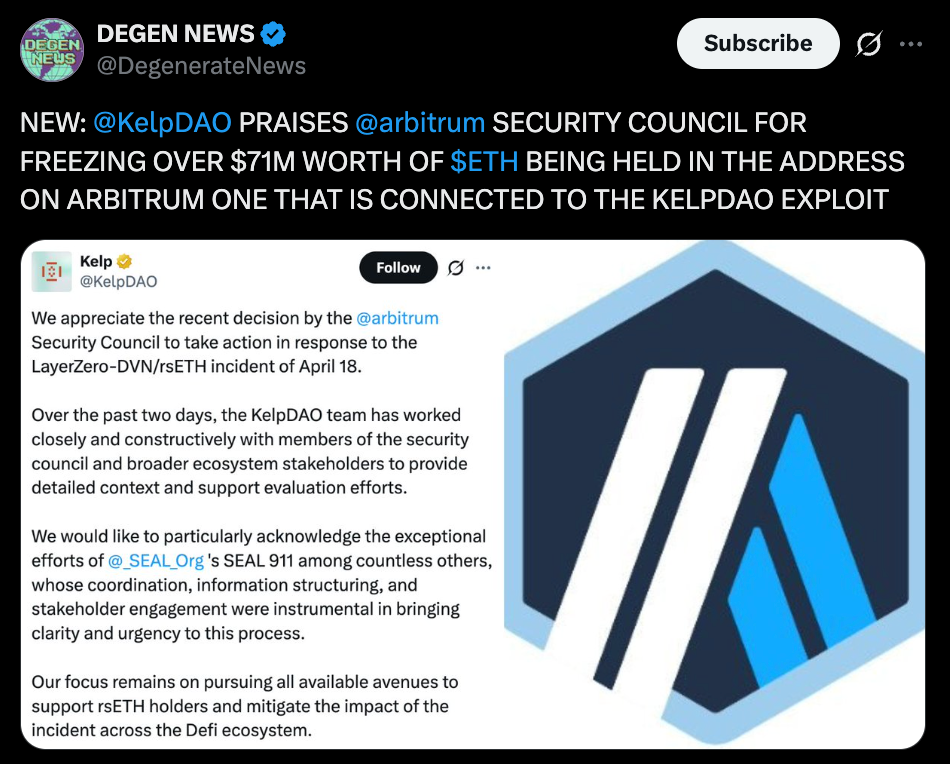
It wasn’t a routine decision either. Nine out of twelve council members had to agree after what was described as hours of debate, technical, ethical, and probably a bit political too. This wasn’t just about code, it was about deciding whether to intervene at all.
A Race Against Time
The timing here mattered more than anything. The attacker had already started moving funds through Arbitrum’s bridge back to Ethereum mainnet, which usually means the window to act is… basically closing fast.
The council managed to freeze 30,766 ETH before the transfer finalized. If they were even a few minutes late, that money would’ve been gone, no pause button, no second chance.
The Bigger Hack Still Looms
This freeze only covers a portion of the total damage. The KelpDAO exploit drained around $292 million in total, meaning roughly a quarter of the stolen funds were caught.
The rest, over $200 million, is still moving across the ecosystem, reportedly being laundered through various channels. So while this is a win, it’s a partial one, not a full recovery by any stretch.
Decentralization vs. Intervention
Naturally, this sparked debate almost instantly. Some argue that freezing funds like this goes against the core idea of decentralization, where no central authority should have that kind of control.

Others point out the obvious, stopping stolen funds, especially those potentially linked to state-backed actors like Lazarus Group, is exactly the kind of action that protects the ecosystem. It’s not a clean debate, and it probably won’t be settled anytime soon.
What Happens Next
For now, the frozen ETH isn’t going anywhere. Any further action will need to go through governance, meaning the community, or at least its representatives, will have to decide what happens to those funds.
That process could take time, and it raises new questions about how similar situations will be handled in the future. If this becomes a precedent, DeFi might start looking a little different.
A Defining Moment for Layer 2 Governance
This situation highlights a shift that’s been building quietly. Decentralized systems are starting to face real-world problems that don’t always have purely decentralized solutions.
Arbitrum’s intervention worked, at least in part. But it also opens the door to bigger conversations about control, responsibility, and what decentralization actually means when millions, or billions, are on the line.
Disclaimer: BlockNews provides independent reporting on crypto, blockchain, and digital finance. All content is for informational purposes only and does not constitute financial advice. Readers should do their own research before making investment decisions. Some articles may use AI tools to assist in drafting, but every piece is reviewed and edited by our editorial team of experienced crypto writers and analysts before publication.








 English (US) ·