
 2 months ago
63
2 months ago
63
- Arthur Hayes warned that financial privacy will become increasingly important in the AI era
- The BitMEX co-founder revealed Zcash is now his second-largest crypto holding
- Growing concerns around surveillance and digital monitoring are reviving interest in privacy coins
Arthur Hayes is once again making a contrarian crypto bet, though this time the focus is not leverage, memecoins, or macro trading. Instead, the BitMEX co-founder says financial privacy itself may become one of the most valuable assets of the next decade as governments, corporations, and artificial intelligence systems gain deeper visibility into human behavior.
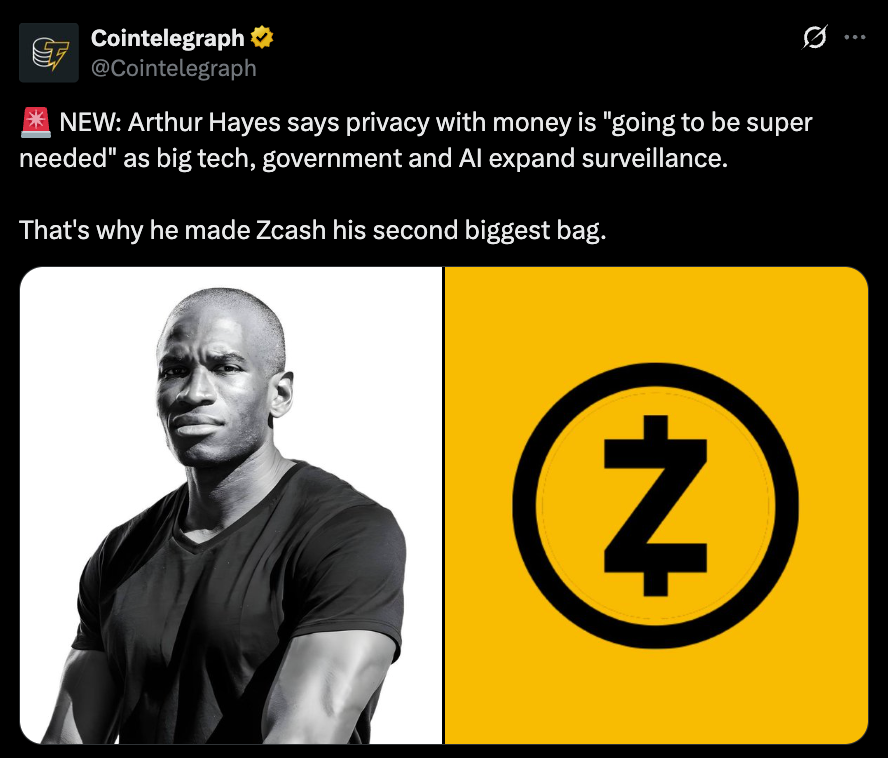
According to Hayes, that concern is a major reason why Zcash has now become his second-largest crypto position. The privacy-focused cryptocurrency, once one of the most discussed projects in the industry, has spent years sitting mostly outside the spotlight while traders chased AI tokens, memecoins, and infrastructure narratives elsewhere.
Now, Hayes appears convinced the market may eventually rotate back toward privacy again.
Hayes Thinks Surveillance Is Becoming The Bigger Story
At the center of Hayes’ argument is the rapid expansion of financial surveillance systems globally. Governments are increasing monitoring requirements, large technology companies continue collecting enormous amounts of behavioral data, and AI systems are making mass-scale analysis dramatically more efficient than ever before.
For privacy advocates, that combination creates a future where almost every purchase, transfer, subscription, or financial interaction could potentially be tracked, analyzed, stored, and monetized indefinitely.
That’s exactly the environment privacy-focused cryptocurrencies like Zcash were originally designed for. Zcash uses zero-knowledge cryptography to allow optional transaction privacy while still operating on a public blockchain network. The technology enables users to shield transaction details without abandoning blockchain infrastructure entirely.
And honestly, the broader conversation around digital privacy feels a lot more relevant now than it did during previous crypto cycles.
Privacy Coins Never Fully Disappeared
While projects like Bitcoin and Ethereum evolved into mainstream institutional assets, privacy coins slowly faded into the background after years of regulatory pressure and exchange delistings. Many governments became uncomfortable with assets capable of obscuring transaction histories, arguing they could facilitate money laundering or illicit financial activity.
As a result, privacy-focused projects like Zcash and Monero lost much of the speculative momentum they once carried during earlier market cycles.
But Hayes’ comments highlight something important. The underlying demand for financial privacy itself never really disappeared, even if market attention shifted elsewhere temporarily. If anything, concerns around surveillance have arguably intensified significantly over the past few years as digital identity systems, AI-powered analytics, and tokenized financial infrastructure continue expanding globally.

AI Is Changing The Privacy Debate
Part of what makes this conversation more urgent now is the role artificial intelligence may play in financial monitoring moving forward. AI systems are becoming increasingly capable of analyzing enormous datasets, identifying behavioral patterns, predicting activity, and linking fragmented information together far more efficiently than traditional monitoring tools ever could.
That creates a scenario where even partially public financial activity may become easier to track and profile at scale. For some crypto users, privacy coins start looking less like niche ideological tools and more like defensive infrastructure against hyper-transparent digital economies.
Of course, regulators remain deeply skeptical of that framing. Privacy coins continue facing scrutiny precisely because authorities worry stronger transaction anonymity could make enforcement more difficult. Crypto has always struggled balancing decentralization and regulatory acceptance comfortably at the same time.
The Market May Eventually Reprice Privacy
Hayes may sound dramatic at times, but the broader thesis isn’t particularly difficult to understand. As financial systems become more digitized and AI-driven, the scarcity value of genuine transactional privacy could rise substantially.
Whether privacy coins fully return to mainstream crypto narratives remains uncertain. Regulatory pressure, exchange restrictions, and institutional reluctance still create major obstacles for widespread adoption. But if concerns around surveillance keep growing, projects built specifically around privacy may eventually start looking a lot more relevant than they do today.
For now, Hayes is clearly betting that the market will eventually rediscover why financial privacy mattered in the first place.
Disclaimer: BlockNews provides independent reporting on crypto, blockchain, and digital finance. All content is for informational purposes only and does not constitute financial advice. Readers should do their own research before making investment decisions. Some articles may use AI tools to assist in drafting, but every piece is reviewed and edited by our editorial team of experienced crypto writers and analysts before publication.








 English (US) ·