
 1 month ago
53
1 month ago
53
- Australia has officially implemented its Crypto Travel Rule, requiring identity information on all regulated crypto transfers regardless of value.
- The new rules take effect alongside Europe’s MiCA deadline, marking a major step toward global crypto regulation.
- Exchanges will require additional sender and recipient information, while self-custody wallet transfers face new verification checks.
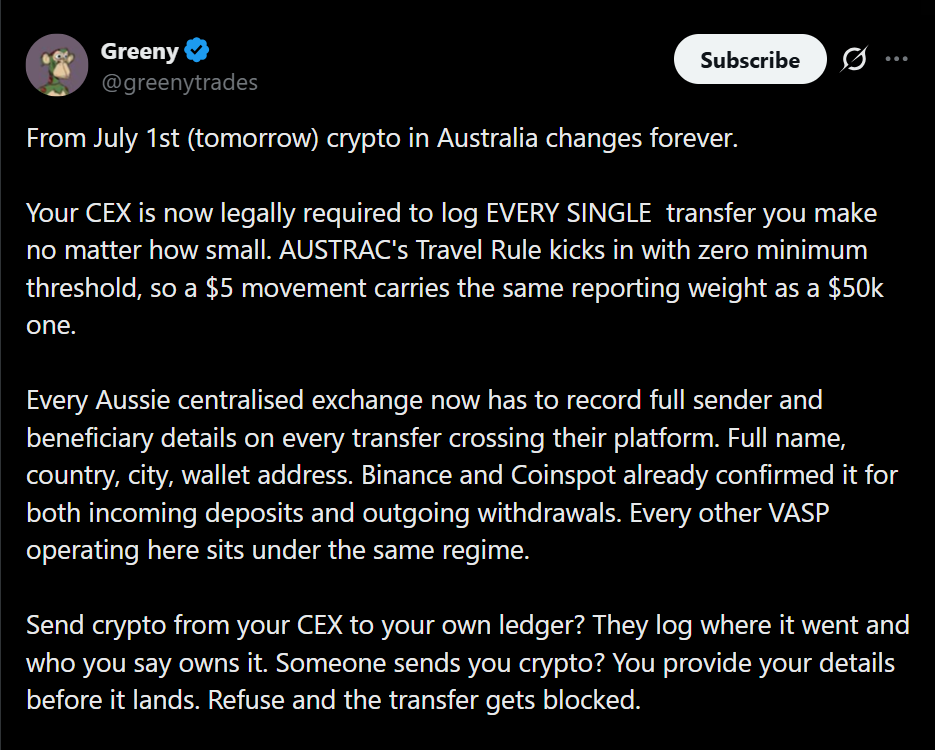
Australia has officially rolled out its long-awaited Crypto Travel Rule, introducing one of the country’s biggest regulatory changes for digital assets. Effective July 1, every regulated cryptocurrency exchange must collect and transmit sender and recipient identity information for all crypto transfers, regardless of transaction size.

The move aligns Australia more closely with international anti-money laundering standards and comes on the same day the European Union’s MiCA transition period officially ends, highlighting a broader global push toward stricter crypto oversight.
What Changes for Australian Crypto Users?
Under the new rules, regulated exchanges must attach identifying information to every incoming and outgoing cryptocurrency transfer. Unlike some jurisdictions that apply minimum reporting thresholds, Australia’s requirements apply to transactions of any value.
When sending or receiving cryptocurrency, users will now encounter additional verification prompts requesting details such as the recipient’s or sender’s name and the exchange involved in the transaction.
To reduce repeated verification requests, exchanges may securely store previously submitted information after the initial verification process.
Self-Custody Wallets Face New Verification
The Travel Rule also affects transfers involving self-custodied wallets.
Users sending crypto to their own private wallets will generally need to confirm they control the destination address before completing the transaction. While this introduces additional verification steps, Australia’s financial intelligence agency, AUSTRAC, has postponed mandatory reporting requirements for unverified self-hosted wallets until March 2029.
Some exchanges implemented these procedures ahead of the official deadline. Kraken, for example, began requiring additional verification for Australian customers transferring assets to private wallets earlier this year.
Australia Strengthens Crypto Oversight
The Travel Rule represents the final phase of Australia’s broader Anti-Money Laundering and Counter-Terrorism Financing (AML/CTF) reforms approved in late 2024.
AUSTRAC, the country’s financial intelligence agency, oversees enforcement and has identified the cryptocurrency sector as a higher-risk area for money laundering. Regulators have also increased supervision of dozens of domestic crypto exchanges as digital asset adoption continues to grow.
Industry surveys estimate that nearly one-third of Australian adults owned cryptocurrency during 2025, making the country one of the more active digital asset markets globally.
Part of a Global Regulatory Shift
Australia‘s implementation mirrors regulations already in force across Europe.
The European Union’s Transfer of Funds Regulation has required sender and recipient information for crypto transfers of any amount since late 2024. Meanwhile, July 1 also marks the end of the EU’s MiCA transition period, after which crypto firms without proper authorization can no longer legally serve European customers.
The simultaneous deadlines underscore how rapidly major jurisdictions are adopting common regulatory standards based on the Financial Action Task Force (FATF) Travel Rule first introduced for digital assets in 2019.
One key difference remains the reporting threshold. While Australia and the European Union require information for every crypto transfer, the United States generally applies similar reporting requirements only to transactions above $3,000.
What It Means for Crypto
Australia’s new framework signals that identity verification is becoming a permanent feature of regulated cryptocurrency markets.
Whether stricter compliance requirements encourage more users to move assets into self-custody or simply become a routine part of digital asset transactions remains to be seen. As more countries adopt similar standards, cross-border crypto transfers are expected to become increasingly standardized under global compliance rules.
Disclaimer: BlockNews provides independent reporting on crypto, blockchain, and digital finance. All content is for informational purposes only and does not constitute financial advice. Readers should do their own research before making investment decisions. Some articles may use AI tools to assist in drafting, but every piece is reviewed and edited by our editorial team of experienced crypto writers and analysts before publication.








 English (US) ·