
 1 month ago
66
1 month ago
66
Key Takeaways
- A new draft proposal, BIP-361, aims to freeze and transfer Bitcoin wallets with public keys vulnerable to quantum computer attacks
- As of March 1, 2026, more than 34% of the entire Bitcoin supply had public keys exposed on the blockchain
- Implementation would occur in phases, with approximately three years before enforcement begins
- A recovery solution using zero-knowledge proofs has been developed by Project Eleven, processing in just 243 milliseconds on consumer hardware
- Satoshi Nakamoto’s roughly 1.1 million BTC remain unrecoverable through this approach due to older wallet technology predating 2012
The Bitcoin community is grappling with an emerging challenge: securing hundreds of billions of dollars in cryptocurrency against potential quantum computing vulnerabilities. BIP-361, a newly drafted improvement proposal, outlines a comprehensive strategy to identify and protect at-risk holdings before quantum threats materialize.
 NEW: Bitcoin developers have introduced BIP-361, a proposal designed to safeguard wallets against future quantum-computing risks.
The proposal would:
– Block new BTC transfers to addresses considered vulnerable to quantum attacks.
– Phase out legacy signature schemes over a… pic.twitter.com/Cv3fARUBGR
— Coin Bureau (@coinbureau) July 20, 2026
Officially designated on February 11, 2026, the proposal was authored by Jameson Lopp alongside five collaborators. It carries the formal designation “Post Quantum Migration and Legacy Signature Sunset.”
Understanding Wallet Vulnerability
A Bitcoin wallet becomes susceptible to attack when its public key appears on the blockchain ledger. Sufficiently advanced quantum computers could theoretically reverse-engineer these public keys to derive the corresponding private keys, granting unauthorized access to funds.
While this risk remains theoretical today, the concern centers on “harvest now, decrypt later” tactics—where malicious actors catalog exposed keys now, waiting for quantum technology to advance enough to crack them.
By March 1, 2026, over 34% of Bitcoin’s total supply had public keys visible on-chain, representing a substantial portion of circulating coins potentially exposed to future quantum threats.
The security foundation of Bitcoin rests on elliptic curve cryptography, a mathematical framework designed to be irreversible. However, Shor’s algorithm—a quantum computing method published in 1994—theoretically enables reversing this process, converting public keys back to their private counterparts.
BIP-361’s Implementation Framework
The proposal outlines a multi-stage rollout. Phase A would prohibit new transactions to at-risk addresses, implementing a 160,000-block buffer period post-activation—approximately three years of network time.
Phase B takes more decisive action, completely invalidating legacy cryptographic signatures at a predetermined point five years following activation, effectively retiring outdated security methods.
Phase C remains under discussion. This potential stage would establish a recovery mechanism leveraging zero-knowledge proofs connected to BIP-39 seed phrases.
Notably, Lopp himself has expressed reservations about the proposal. He drafted it viewing it as preferable to alternatives, while emphasizing it requires substantial additional research before any activation consideration.
Project Eleven’s Innovation
Independent of the proposal itself, cryptocurrency research organization Project Eleven has developed a functional zero-knowledge proof platform for coin recovery scenarios.
This technology enables wallet holders to cryptographically demonstrate possession of key material hierarchically positioned above their address in the derivation structure, without exposing any sensitive information. The system operates in merely 243 milliseconds on conventional laptop hardware without specialized graphics processing.
This breakthrough transforms what would be permanent asset loss into recoverable situations for users who retain their seed phrases.
Nevertheless, significant limitations exist. Satoshi Nakamoto’s approximately 1.1 million Bitcoin, mined during 2009 and 2010, predate the BIP-32 hierarchical deterministic wallet standard introduced in 2012. Without hierarchical derivation paths, the recovery system cannot function for these early coins.
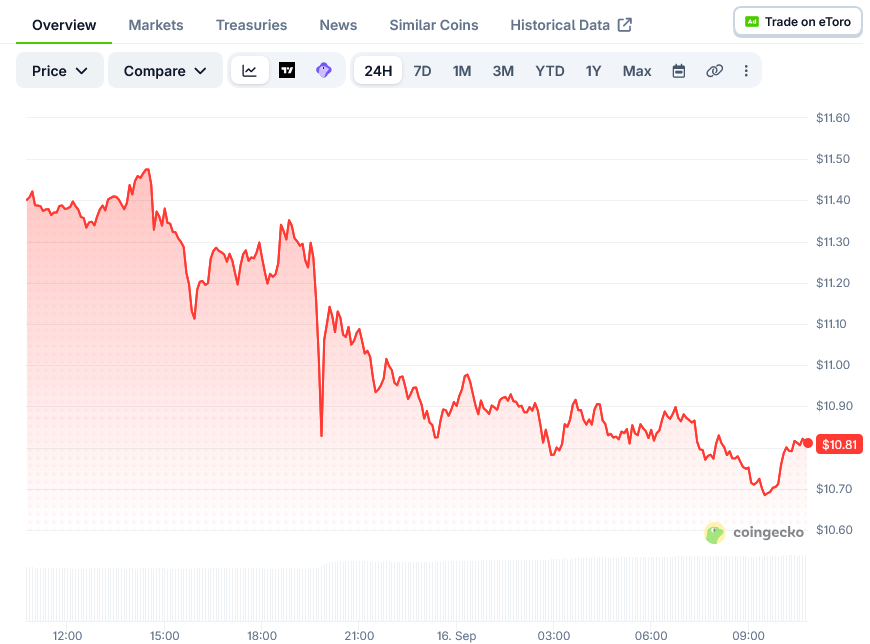
Bitcoin was trading at approximately $64,492 when this report was compiled, with the cryptocurrency Fear and Greed Index registering 28, indicating “Fear” sentiment among market participants.
The post BIP-361: Bitcoin’s Defense Strategy Against Quantum Computing Attacks appeared first on Blockonomi.



 English (US) ·