
 3 hours ago
16
3 hours ago
16
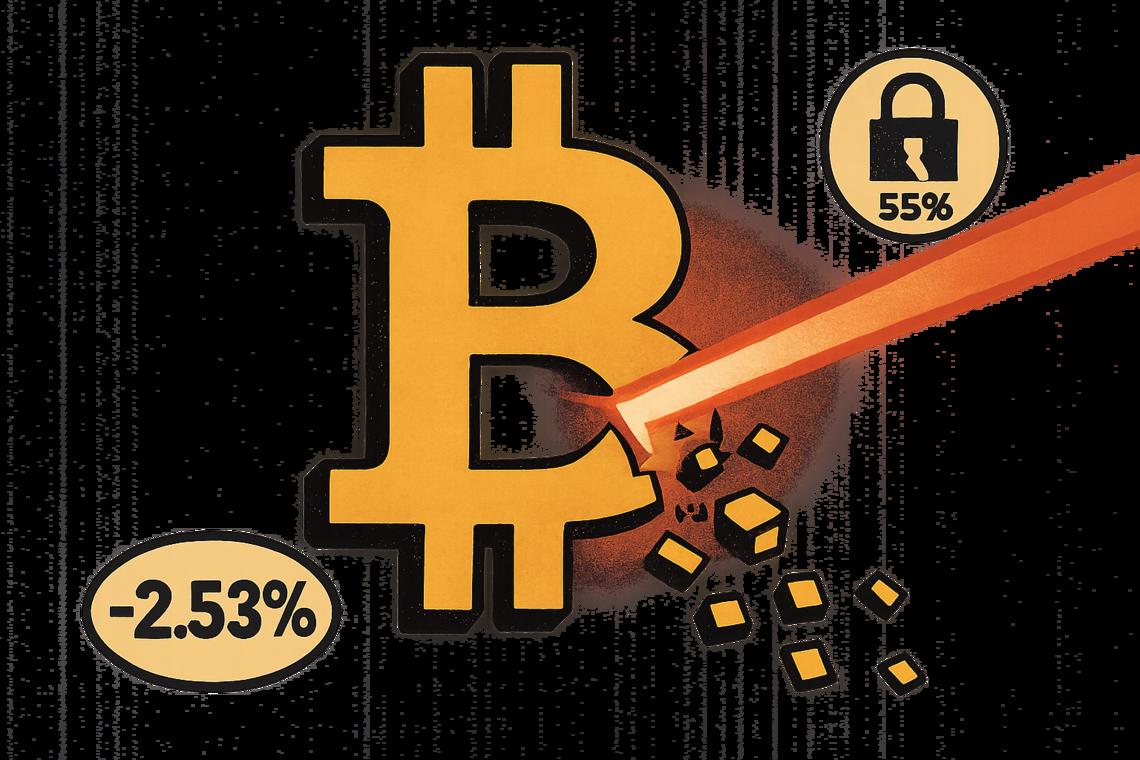
Bitcoin just tested one of its most contested rule changes yet — and the numbers suggest it isn’t going well for the proposal’s backers. At block 961,632, the network entered mandatory signaling for BIP-110, a soft fork designed to curb non-financial data on the blockchain, but the Bitcoin BIP-110 signaling effort arrived with miner backing stuck below 3%, far short of what it needs to force real change.
Key takeaways
- BIP-110 entered mandatory signaling at block 961,632 with miner support at just 2.53%, well below the 55% threshold required for activation.
- Nodes enforcing BIP-110 began rejecting blocks that didn’t signal with version bit 4, splitting a minority chain off from the dominant Bitcoin network.
- The breakaway chain quickly fell behind the main chain, and low miner participation makes a lasting rival chain unlikely.
- BIP-110 would impose roughly one year of restrictions on output scripts and certain Taproot features to discourage inscriptions and reduce storage costs for node operators.
- Critics including Strategy’s Michael Saylor and Blockstream’s Adam Back warn the plan could split Bitcoin and cause valid transactions to be rejected; developers have also prepared fallback proof-of-work code as a contingency.
BIP-110 Begins Mandatory Signaling With Miner Support Under 3%
BIP-110’s mandatory-signaling phase kicked off at block 961,632 on Saturday, following backing from miners across only 51 of the last 2,016 blocks — a 2.53% rate, according to the BIP-110 monitor. That’s nowhere close to the 55% threshold the proposal needs to lock in early. CoinDesk reported that the signaling phase began at around 19:35 UTC that day, with support “seldom exceeding 2.5%.” Crypto Briefing similarly noted that signaling for the proposal has fluctuated between 0.3% and 2.6% in recent periods, with no major mining pool publicly backing it.
What the signaling window means for nodes
Starting at block 961,632, nodes enforcing BIP-110 began rejecting any block that didn’t set version bit 4, the signal miners use to indicate support. Ordinary Bitcoin nodes kept accepting both signaling and non-signaling blocks as normal. When the first block at that height arrived without the required signal, BIP-110-enforcing nodes — running mostly on Bitcoin Knots software — rejected it outright and split off from the main chain, according to Crypto Briefing.
A Minority Chain Splits Off, But Struggles to Survive
A minority BIP-110 branch did emerge once enforcing nodes rejected the non-signaling block, but it fell behind the dominant chain almost immediately. The reason is simple: without meaningful hash power behind it, a breakaway chain can’t produce blocks at anything close to Bitcoin’s usual pace.
Bitcoin’s difficulty adjustment assumes a certain baseline of mining power. When that hash rate collapses on a minority chain, block times can stretch from the target ten minutes to hours or even days, Crypto Briefing noted. That dynamic makes a sustained rival chain unlikely unless significantly more miners come on board.
The comparison to Bitcoin’s 2017 history is instructive. Unlike the Bitcoin Cash fork of that year, which launched with substantial mining support and same-day exchange listings, the BIP-110 fork arrived with single-digit miner interest and no exchange infrastructure ready to receive it. For node operators still running BIP-110 enforcement, the practical choice now is either to disable it and resync with the main chain or keep operating what amounts to a largely abandoned network.
What BIP-110 Actually Restricts
Written by pseudonymous developer Dathon Ohm — with input from longtime Bitcoin developer Luke Dashjr, according to Crypto Briefing — BIP-110 is formally titled the “Reduced Data Temporary Softfork.” It proposes consensus restrictions lasting roughly one year, or about 52,416 blocks if activated on schedule.
The rules would constrain the majority of fresh output scripts to 34 bytes, set a maximum of 83 bytes for OP_RETURN outputs, impose restrictions on specific data pushes and witness elements at 256 bytes, and place temporary constraints on multiple Taproot functionalities. Transaction outputs that remained unspent prior to the activation would stay exempt from the new limits.
Supporters frame these restrictions as a way to discourage inscriptions and other non-monetary data that drive up storage and bandwidth costs for people running full nodes. The proposal’s primary target has been the data-storage techniques behind projects like Ordinals and Runes, which have flooded blocks with content unrelated to simple payments.
Saylor, Back and Other Critics Push Back
Not everyone agrees the trade-off is worth it. Strategy Executive Chairman Michael Saylor and Blockstream CEO Adam Back have both publicly opposed BIP-110, warning that it could split Bitcoin and cause nodes to reject transactions that are otherwise valid under the network’s existing rules. Saylor has gone further, characterizing the proposal as already having failed and predicting any resulting fork would become economically insignificant.
The pushback highlights a deeper tension in how Bitcoin governs itself. BIP-110’s backers are pursuing it as a user-activated soft fork, meaning it depends on node operators rather than miners to force the rule change — users update their software to reject blocks from miners that don’t signal support, effectively pressuring miners to fall in line or be cut off. Supporters point to the 2017 activation of SegWit through BIP-148 as historical precedent, since that upgrade also gained traction through user pressure rather than miner consensus alone, according to CoinDesk.
Why this matters: a soft fork that can’t win over miners but still gets pushed through node enforcement raises real questions about how Bitcoin resolves disputes over block space when the mining industry and parts of the user base disagree. It also tests whether inscriptions and data-heavy transactions — which some see as clutter and others see as legitimate use of the chain — get decided by hash power, by node adoption, or by neither.
Timeline Ahead: Lock-In, Enforcement and a Fallback Plan
The specification sets block 963,648 as the start of BIP-110’s locked-in state and block 965,664 as the point when its transaction restrictions would actually take effect, roughly four weeks after the signaling window opened. That window was designed to run from block 961,632 through 963,647, with nodes enforcing BIP-110 rejecting non-signaling blocks throughout.
Given how far miner support sits from the 55% mark, BIP-110 proponents have also discussed a more drastic fallback: changing Bitcoin’s proof-of-work rules outright. On Aug. 1, Bitcoin developer Chris Guida rebased preliminary code for such a change, originally written by Bitcoin Knots maintainer Luke Dashjr. Guida described the code at the time as a contingency in case miners kept opposing BIP-110, though he said no activation date had been set for it.
Whether that fallback ever gets used may depend on what happens over the coming weeks, as the industry watches to see if the minority chain gains any traction or simply stalls out under its own weight.
FAQ
What is BIP-110 and what does it propose?
BIP-110 is a Bitcoin Improvement Proposal that seeks temporary consensus restrictions lasting about one year on output script sizes and Taproot features, aiming to limit non-monetary data stored on the blockchain.
What was the miner signaling support level when BIP-110 started mandatory signaling?
Miner signaling support was 2.53% at the start of mandatory signaling, well below the 55% threshold required for early activation.
What happens to nodes enforcing BIP-110 at block 961,632?
Nodes enforcing BIP-110 began rejecting blocks that did not signal with version bit 4 starting at block 961,632, causing those nodes to fork away from the main Bitcoin chain.
Is the minority BIP-110 chain likely to persist?
Unlikely. The low miner support means the minority BIP-110 chain has already fallen behind the dominant Bitcoin chain, and it would need substantially greater mining participation to survive over time.
Article produced with the assistance of artificial intelligence and reviewed by the editorial team.







 English (US) ·