
 1 month ago
49
1 month ago
49
- Bitcoin has dropped below the $60,000 mark after losing a key support level near $63,000.
- Despite the decline, whale activity and exchange flows suggest large investors are not rushing to exit.
- Lower open interest could reduce liquidation risks, leaving spot demand and ETF flows to shape Bitcoin’s next move.
Bitcoin’s latest pullback has brought fresh uncertainty to the crypto market, with the leading cryptocurrency slipping below the psychological $60,000 level. At the time of writing, BTC was trading around $59,500 after failing to hold above the important $63,000 support zone that had offered some stability earlier in the week. While the price action has clearly weakened, the broader market picture isn’t entirely bearish. Large investors, at least so far, don’t appear to be abandoning their positions, and that could make a difference if buying pressure returns.
According to CryptoQuant data, exchange netflows remained positive at roughly 2,600 BTC even after the correction. That means more Bitcoin continues moving onto exchanges than leaving them. On the surface, that isn’t exactly comforting because coins transferred to exchanges are often prepared for selling, hedging, or active trading. Still, it doesn’t automatically signal a wave of panic selling. Instead, it suggests that traders are staying flexible while waiting for the market to reveal its next direction.
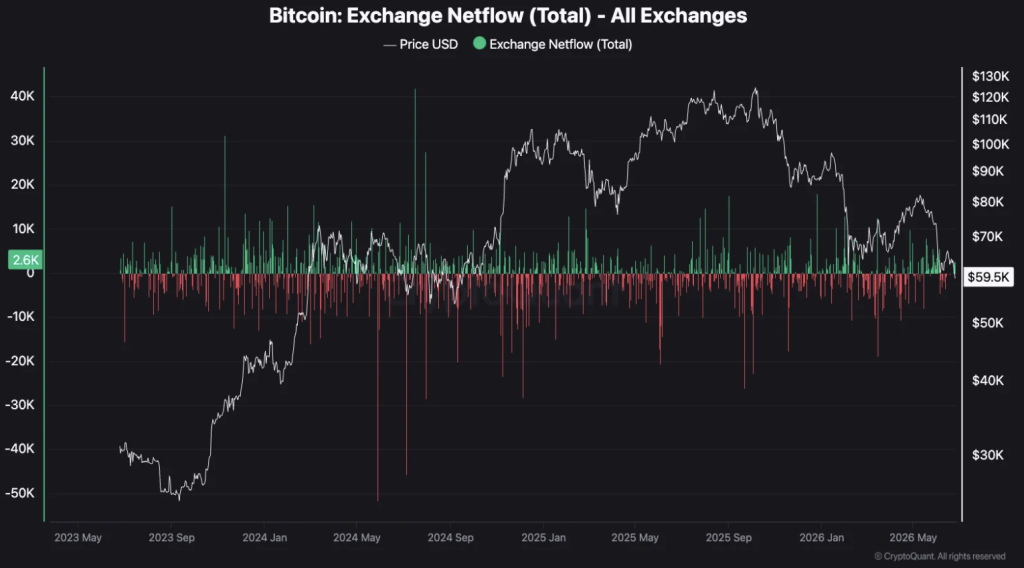
Lower Leverage Could Create a Healthier Market
Another notable shift has come from Bitcoin’s open interest, which has cooled significantly from its 2025 highs. At press time, total open interest had fallen to around $20.6 billion, showing that leveraged positions have been steadily reduced over recent weeks.
This matters because excessive leverage often fuels violent liquidations when prices move sharply. With fewer leveraged bets stacked across the market, Bitcoin’s latest decline doesn’t resemble the kind of cascading liquidation event seen during previous corrections. In a way, the market looks cleaner now, less crowded and perhaps a bit healthier, even if sentiment has weakened. It’s not a guarantee of a rebound, of course, but it does reduce one major source of downside volatility.
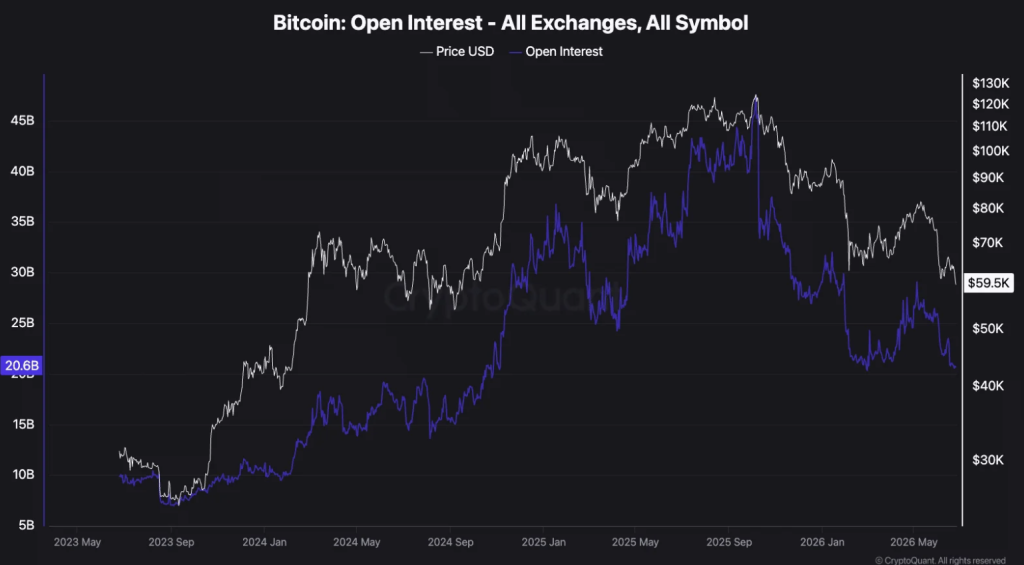
Trading Volume May Hold the Key
Historically, major spikes in trading volume have appeared near important turning points rather than after a trend has already been confirmed. Those bursts usually reflect meaningful activity, whether that’s aggressive accumulation, large-scale distribution, or forced selling during periods of stress.
This market cycle, however, has looked a little different. Derivatives have been driving much of the trading activity, while spot markets have taken more of a back seat. That doesn’t mean institutional investors or whales have disappeared, especially with spot Bitcoin ETFs now playing a much larger role than in previous cycles. The bigger question is whether another surge in abnormal trading volume will emerge while Bitcoin continues hovering around the uncertain $59,000 to $60,000 range.
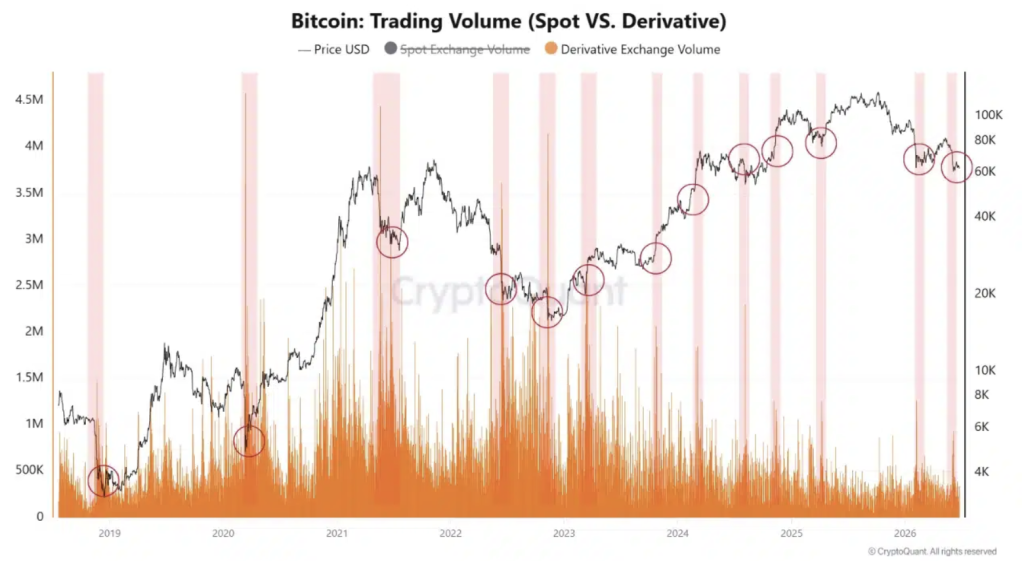
Bitcoin’s Next Direction Depends on Several Catalysts
Although market activity has slowed, Bitcoin is far from inactive. Reduced leverage lowers the odds of sudden liquidation-driven crashes, but price swings remain very much on the table, particularly after such a sharp break below support.
Going forward, traders will likely keep a close eye on spot market demand, ETF inflows, and derivatives positioning. If buyers regain confidence around the current price range, Bitcoin could stabilize and attempt another move higher. If not, the market may continue searching for stronger support before any meaningful recovery begins. For now, patience seems to be the dominant strategy among the biggest players.
Disclaimer: BlockNews provides independent reporting on crypto, blockchain, and digital finance. All content is for informational purposes only and does not constitute financial advice. Readers should do their own research before making investment decisions. Some articles may use AI tools to assist in drafting, but every piece is reviewed and edited by our editorial team of experienced crypto writers and analysts before publication.







 English (US) ·