
 4 months ago
59
4 months ago
59
- Over $500 million was wagered on prediction markets tied to U.S.–Iran tensions
- New U.S. legislation aims to ban betting on war, assassinations, and violent events
- Bitcoin showed little safe-haven reaction despite escalating geopolitical tensions
Rising geopolitical tension in the Middle East has unexpectedly pushed activity into a rather unusual corner of the crypto world — prediction markets. As uncertainty grew around the situation between the United States and Iran, traders began pouring huge amounts of capital into platforms where users can essentially bet on global events.
Hundreds of millions of dollars flowed into these markets almost overnight. And yet, while all that speculation was happening, Bitcoin — often marketed as “digital gold” — barely reacted. That contrast has left some analysts scratching their heads a bit, wondering whether Bitcoin truly behaves like a traditional safe-haven asset during global crises.
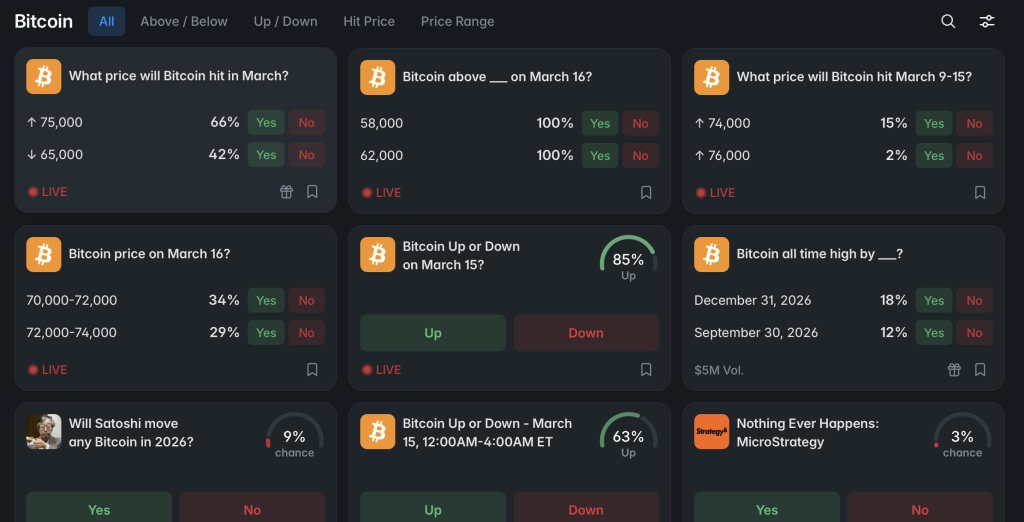
Traders Pour Money Into War Prediction Platforms
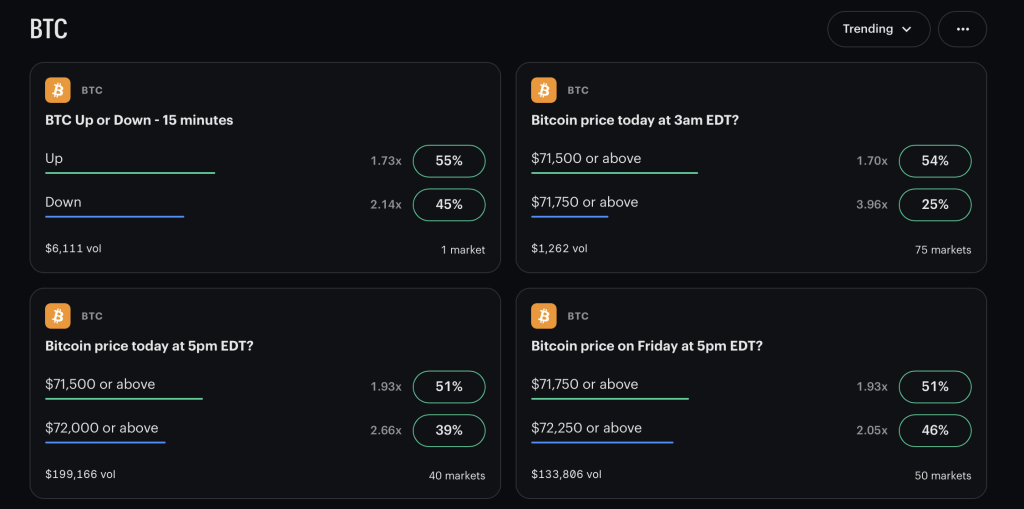
Blockchain-based prediction platforms such as Polymarket and Kalshi saw a surge in trading activity as tensions escalated. On these platforms, users can trade contracts tied to specific outcomes — whether a conflict escalates, whether a political event occurs, or even whether military action happens before a certain date.
During the latest crisis, lawmakers said more than $500 million was wagered on contracts related to potential U.S. military strikes against Iran.
It’s a strange concept if you step back and think about it. Essentially, traders were speculating on the timing and likelihood of geopolitical events in real time.
Supporters of prediction markets argue that these platforms actually improve forecasting. By putting money behind predictions, the theory goes, markets can sometimes aggregate information more efficiently than polls or traditional analysts.
Critics, though, see things very differently.
Ethical Concerns Begin to Surface
The rise of war-related prediction markets has sparked growing ethical debate among academics and policymakers.
Karoline Thomsen and Professor Douglas Guilfoyle from the University of New South Wales Sydney recently warned that betting markets tied directly to conflict risk turning human tragedy into financial speculation.
Their argument is simple — and uncomfortable.
If traders can profit from predicting wars, military strikes, or political assassinations, the system begins to blur the line between forecasting and exploitation.
Even more concerning, these markets could theoretically create incentives for individuals to seek out sensitive information about military operations.
If early knowledge of geopolitical developments becomes financially valuable, some traders might attempt to obtain insider or classified information to gain an edge.
And that, critics say, introduces serious national security risks.
Lawmakers Push Back With New Legislation
The surge in war-related betting has already caught the attention of U.S. lawmakers.
A new bipartisan proposal known as the Discouraging Exploitative Assassination, Tragedy, and Harm Betting in Event Trading Systems Act — abbreviated somewhat grimly as the DEATH BETS Act — was introduced this week.
The bill aims to prohibit prediction-market contracts tied to events involving war, terrorism, assassinations, or individual deaths.
Representative Mike Levin, who introduced the bill alongside Senator Adam Schiff, argued that markets tied to human tragedy should not exist in regulated financial systems.
“Betting on war and death should be illegal,” Levin said.
If passed, the legislation would prevent exchanges regulated by the Commodity Futures Trading Commission from listing contracts connected to violent geopolitical events.
Bitcoin Fails to Act Like a Safe Haven
What made the situation even more interesting was Bitcoin’s muted reaction.
In previous cycles, geopolitical shocks often triggered sharp moves across crypto markets. This time, however, Bitcoin and Ethereum barely moved despite rising global tension.
According to Erik Norland, chief economist at CME Group, crypto assets still show surprisingly weak correlations with traditional safe-haven assets like gold or the U.S. dollar.
In fact, the correlation between Bitcoin and gold has remained close to zero in many periods.
That suggests crypto prices may be driven more by internal market dynamics — investor sentiment, liquidity, speculation — rather than global macroeconomic stress.
Structural Limits Could Also Play a Role
Norland also pointed out something more technical.
Bitcoin’s network processes only around three to seven transactions per second, which is significantly slower than newer blockchain systems capable of handling thousands. While Bitcoin remains the largest crypto asset by market value, this limitation raises questions about how the network might compete in the long term if real-world financial activity continues moving onto blockchain infrastructure.
Some analysts believe newer networks with higher throughput could eventually capture larger portions of economic activity.
Whale Activity Clouds Bitcoin’s Outlook
Meanwhile, on-chain data hints that Bitcoin’s current rally may be losing some momentum.
Analytics firm CryptoQuant recently reported that large Bitcoin holders — commonly referred to as whales — have begun moving more funds onto exchanges. Historically, that pattern often precedes selling pressure.
The exchange whale ratio has climbed to about 0.55, signaling an increase in large transfers into trading platforms.
According to CCN analyst Abiodun Oladokun, if buying demand does not strengthen soon, Bitcoin could face a short-term pullback.
Support levels currently sit around $65,000. If that area breaks, prices could potentially slide closer to $60,000. On the other hand, a strong breakout above the current range could still push Bitcoin toward roughly $75,300.
For now though, the situation highlights a curious shift in the crypto landscape.
Prediction markets surged during the geopolitical crisis — while Bitcoin, the asset often described as digital gold, remained mostly… quiet.
Disclaimer: BlockNews provides independent reporting on crypto, blockchain, and digital finance. All content is for informational purposes only and does not constitute financial advice. Readers should do their own research before making investment decisions. Some articles may use AI tools to assist in drafting, but every piece is reviewed and edited by our editorial team of experienced crypto writers and analysts before publication.





 English (US) ·