
 3 months ago
90
3 months ago
90
- Bitcoin is entering its longest correction of the current cycle, reaching 238 days below its most recent all-time high.
- Historical data shows previous Bitcoin cycles experienced even longer consolidation periods before reaching new record prices.
- Despite ETF outflows and macroeconomic pressure, long-term holders continue accumulating Bitcoin during the correction.
Bitcoin is about to cross a notable threshold, one that will likely get traders talking again. Tomorrow marks 238 days since Bitcoin last reached an all-time high, making this the longest correction phase of the current market cycle.
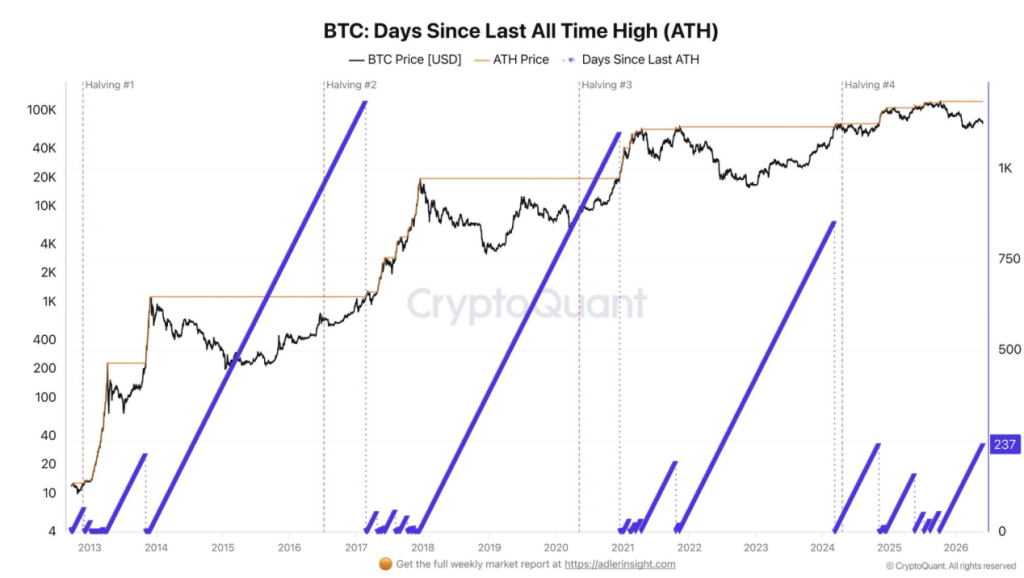
At first glance, that might sound concerning. After all, crypto investors aren’t exactly known for their patience. But when you zoom out and compare today’s market with previous cycles, the picture becomes a bit more interesting. According to data shared by on-chain analyst Darkfost, Bitcoin has endured much longer waiting periods before reaching fresh record highs in the past.
Back in the cycle that followed 2015, Bitcoin needed roughly 1,180 days before eventually topping out. The cycle that began in 2019 wasn’t much different, requiring around 1,094 days before reaching its peak. Compared to those numbers, the current cycle still looks relatively young despite recent frustration among investors.
What’s particularly unique this time around is that Bitcoin managed to hit a cycle peak much earlier than many expected. The rally reached a new all-time high before the April 2024 halving event, breaking a pattern that had remained intact for years.
History Suggests Bitcoin Could Still Be Following Its Usual Path
Another chart shared by Darkfost highlights the number of days Bitcoin has spent below its all-time high during previous cycles. Looking at that data, the current correction doesn’t appear especially unusual. In fact, it still falls comfortably within the historical range seen after prior halvings.
Following both the 2016 and 2020 halving events, Bitcoin spent hundreds of days moving sideways or trading below previous highs before eventually entering its strongest bullish phase. Those periods weren’t exciting, and they certainly tested investors’ patience, but they weren’t abnormal either.
Bitcoin is now entering day 238 below its latest record high. While that officially makes it the longest correction of this cycle, it remains considerably shorter than many of the consolidation periods seen in earlier market environments.
There’s also another timeline worth considering. The next Bitcoin halving is expected around April 2028, roughly 670 days away. If Bitcoin fails to establish a new all-time high before then, the market could spend more than 900 days without setting a fresh record. That sounds dramatic, sure, but from a long-term perspective it wouldn’t necessarily break historical patterns. It may simply mean this cycle is unfolding at a slower pace than many traders anticipated.
Why Bitcoin Has Been Under Pressure Recently
Technical charts aren’t the only reason Bitcoin has struggled to regain momentum. Several major developments have weighed on market sentiment over recent weeks.
One of the biggest events occurred on May 26, when an unidentified entity reportedly sold approximately $1.26 billion worth of BlackRock Bitcoin Trust shares. The position was reportedly offloaded at a 2.3% discount, suggesting the seller accepted a loss of nearly $29.5 million just to exit quickly.
Large transactions like that naturally attract attention. They tend to feel more urgent and emotional than a routine portfolio rebalance, which can shake confidence across the broader market.
At the same time, macroeconomic concerns continue to create uncertainty. Rising tensions between the United States and Iran have increased geopolitical risks, while persistent inflation worries remain a constant concern for investors. Neither of those factors has done Bitcoin any favors.
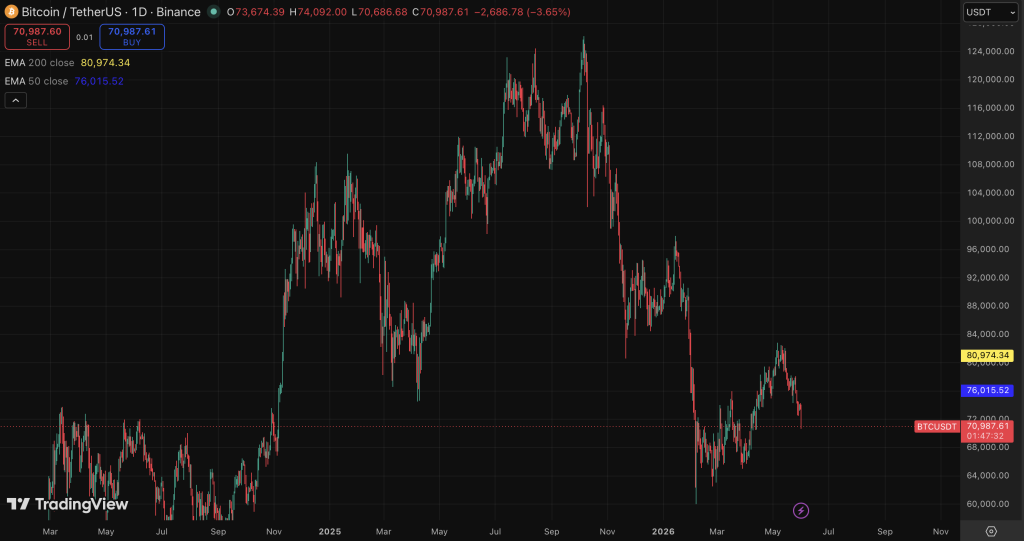
Bitcoin began June trading below $73,000 as risk appetite softened across financial markets. Comments from former Federal Reserve Chairman Jerome Powell regarding concerns about political interference in central bank operations added another layer of uncertainty. While Bitcoin is often viewed as an alternative to traditional financial systems, periods of monetary uncertainty can still trigger heightened volatility across crypto markets.
Long-Term Holders Continue Accumulating
Despite the negative headlines, not everything beneath the surface looks bearish.
ETF outflows have dominated market discussions lately, but long-term Bitcoin holders appear to be taking a very different approach. Instead of selling, many continue accumulating during the correction. That creates a fascinating contrast between short-term institutional selling and long-term investors who seem comfortable riding through volatility.
This divergence matters. A billion-dollar ETF outflow shouldn’t be ignored, but neither should the behavior of investors who have historically accumulated during periods of weakness. Bitcoin has spent much of its existence frustrating participants with long stretches of consolidation before eventually resuming its upward trend.
Maybe this is simply another one of those periods. It wouldn’t be the first time.
What Happens Next?
For now, Bitcoin remains caught between two competing narratives.
On one side, investors must deal with ETF outflows, inflation concerns, geopolitical uncertainty, and broader risk-off sentiment across financial markets. Those factors continue creating headwinds that could extend the current correction.
On the other side, historical cycle data remains largely intact. Long-term holders continue accumulating, and the post-halving structure that has defined previous Bitcoin bull markets has not been completely invalidated.
If institutional selling begins to slow and macroeconomic conditions stabilize, Bitcoin could eventually challenge key resistance levels once again. If uncertainty continues dominating markets, however, the correction may drag on for longer than many traders would like.
Either way, tomorrow marks an important milestone. Bitcoin will officially enter the longest correction phase of this cycle. The real question isn’t how long the correction has lasted so far. It’s whether Bitcoin is still following the same post-halving roadmap that has guided every major cycle before it.
Disclaimer: BlockNews provides independent reporting on crypto, blockchain, and digital finance. All content is for informational purposes only and does not constitute financial advice. Readers should do their own research before making investment decisions. Some articles may use AI tools to assist in drafting, but every piece is reviewed and edited by our editorial team of experienced crypto writers and analysts before publication.








 English (US) ·