
 1 month ago
96
1 month ago
96
- Bitcoin slipped below $64,000 after July U.S. inflation matched forecasts, keeping BTC trapped within its $62,000 to $66,000 trading range.
- Headline inflation cooled to 3.4%, while core CPI eased to 2.5%, giving the Federal Reserve more flexibility heading into its September decision.
- Options traders remain cautious about further downside, although whale accumulation and declining volatility could set the stage for a larger Bitcoin move.
Bitcoin fell below $64,000 on Wednesday after the latest U.S. inflation report delivered few surprises for financial markets. July’s Consumer Price Index landed almost exactly where economists expected, leaving traders without the kind of macro catalyst needed to push BTC decisively out of its recent range.
Headline inflation cooled to 3.4% year-over-year from 3.5% in June, while core CPI eased to 2.5% from 2.6%. Both readings matched expectations, creating an unusual situation where the data was encouraging enough to avoid another inflation scare, but not soft enough to significantly change expectations surrounding Federal Reserve policy.
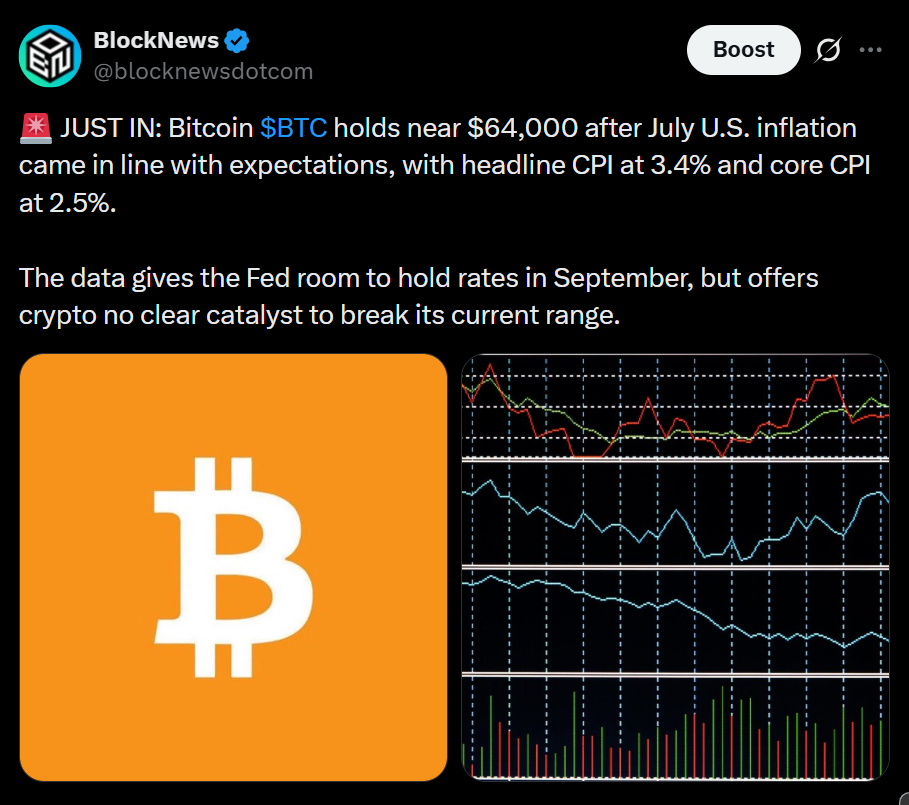
Bitcoin subsequently traded around $63,600, remaining trapped inside the roughly $62,000 to $66,000 range that has dominated price action for several weeks.
Federal Reserve Gets More Room to Wait
The inflation report appears to give the Federal Reserve additional flexibility heading into September rather than forcing policymakers toward an immediate change.
With inflation still sitting above the Fed’s longer-term target, analysts generally don’t expect policymakers to declare victory yet. At the same time, gradually cooling inflation reduces pressure for a more aggressive response, keeping the September decision unusually uncertain.
For Bitcoin and other risk assets, that leaves the macro environment largely unchanged. The CPI report removed some of the risk surrounding an unexpectedly hot inflation reading, but it also failed to provide the strong dovish signal that could have triggered another wave of crypto buying.
Attention will now increasingly shift toward upcoming economic data and signals from Federal Reserve officials as traders search for clues about the direction of monetary policy.
Bitcoin Options Traders Remain Defensive
While Bitcoin’s spot price has been relatively quiet, derivatives markets suggest traders aren’t completely comfortable with the outlook.
Bitcoin options expiring near the end of August continue to show stronger demand for downside protection around $60,000 compared with equivalent upside exposure near $70,000. That imbalance indicates traders are still willing to pay a premium to protect portfolios against another decline.
At the same time, bullish positioning hasn’t disappeared. Exposure around the $70,000 level has been rebuilt, suggesting some investors are preparing for a potential breakout even while protecting themselves against downside risk.
Implied volatility has also fallen toward unusually low levels. Bitcoin attempted to move above $65,000 six times between August 5 and August 10 but failed to record a daily close above the level, reinforcing the importance of the upper end of its current range.

Bitcoin Whales Continue Accumulating
On-chain activity offers a somewhat different picture from the cautious options market.
Long-term holder supply declined by roughly 210,000 BTC in its first weekly drop of 2026. However, analysts attributed much of that movement to investors who purchased Bitcoin around $71,000 to $76,000 and later sold at a loss after crossing the 155-day long-term holder threshold.
That behavior may point more toward late-stage bearish conditions than widespread distribution from profitable long-term investors.
Meanwhile, wallets holding more than 1,000 BTC reached a 2026 high of approximately 3.06 million Bitcoin on August 8. The increase suggests some of the market’s largest holders are accumulating while weaker participants exit positions.
Bitcoin’s $66K Resistance Becomes Critical
Bitcoin’s immediate technical battle remains centered around the $66,000 level.
BTC has repeatedly struggled to escape its current range, but a convincing break above $66,000 could change short-term sentiment quickly. Some analysts believe such a move could open the door for another test of $70,000.
Historical performance following similar inflation reports provides some additional optimism. Bitcoin has averaged gains of roughly 3.7% following in-line CPI releases over the past three years, a move that, if repeated, could bring the cryptocurrency close to its current resistance zone.
Still, historical averages provide no guarantee of what happens next, particularly while derivatives traders continue paying for downside protection.
Crypto Market Waits for Its Next Catalyst
The combination of low volatility, subdued futures activity and repeated failures around resistance has left Bitcoin in an unusually quiet phase.
Perpetual futures trading activity recently dropped to a three-year low, reinforcing the sense that traders are waiting rather than aggressively positioning in either direction. Periods like this can persist, but compressed volatility can also precede much larger price movements once a meaningful catalyst arrives.
The next immediate macro test will come from U.S. producer price data. Beyond that, Federal Reserve signals, liquidity conditions and upcoming inflation releases could determine whether Bitcoin finally escapes its $62,000 to $66,000 range.
For now, neither bulls nor bears have established clear control. But with volatility compressed and large Bitcoin holders continuing to accumulate, the battle around $66,000 could become increasingly important for determining where the crypto market heads next.
Disclaimer: BlockNews provides independent reporting on crypto, blockchain, and digital finance. All content is for informational purposes only and does not constitute financial advice. Readers should do their own research before making investment decisions. Some articles may use AI tools to assist in drafting, but every piece is reviewed and edited by our editorial team of experienced crypto writers and analysts before publication.








 English (US) ·