
 1 month ago
55
1 month ago
55
- Bitcoin continues to trade above $64,000, but strong resistance is still preventing a decisive breakout.
- Spot Bitcoin ETFs have seen billions in outflows, while on-chain data shows whales quietly accumulating.
- Analysts remain divided, though many believe Bitcoin could still be setting up for a much larger cycle.
Bitcoin (BTC) extended its recent recovery, climbing about 2.3% over the past 24 hours to trade near $64,380 at the time of writing. The move has helped improve market sentiment, but one major hurdle remains: the cryptocurrency still hasn’t managed to reclaim the $80,000 level it last traded above in mid-May.
Even so, several technical indicators continue leaning in the bulls’ favor.
On the four-hour chart, the Relative Strength Index (RSI) and MACD are both showing improving momentum, while Bollinger Bands have begun tightening. That combination often signals a larger move may be approaching, although it doesn’t reveal which direction the breakout will ultimately take.
On-Chain Data Paints a Mixed Picture
While technical charts appear constructive, on-chain data tells a more complicated story.
According to CryptoQuant, Bitcoin is currently sitting in what analysts describe as a transitional phase rather than a confirmed bull market or a prolonged bear market. The data suggests the market is still searching for its next clear direction.
One concern continues to come from the United States.
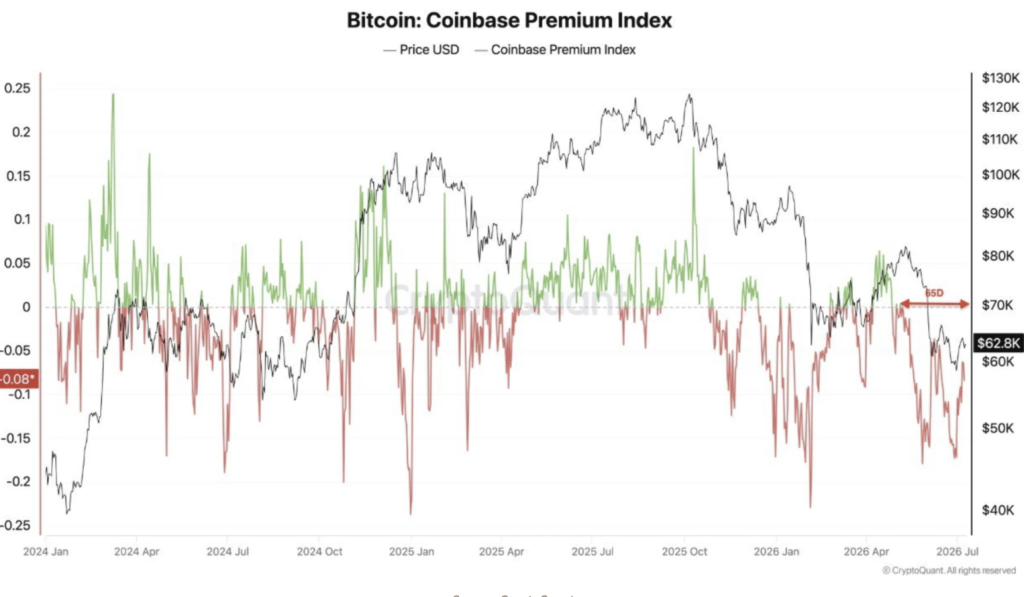
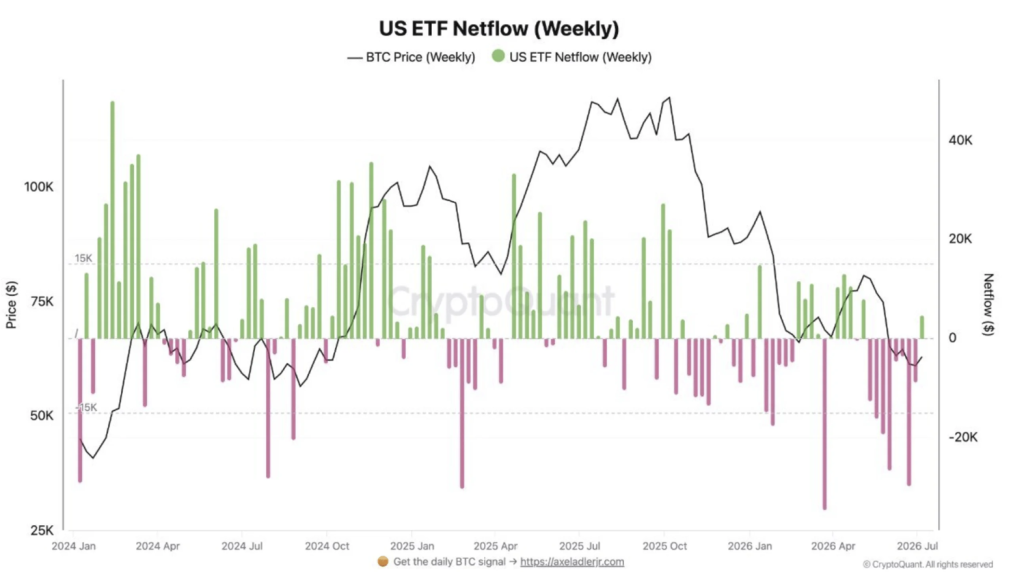
Since October 2025, investors have withdrawn roughly $10 billion from spot Bitcoin ETFs. At the same time, the Coinbase Premium Index has remained negative for an astonishing 65 consecutive days, signaling relatively weak buying demand from both U.S. institutions and retail investors.
Normally, numbers like these would be viewed as bearish.
Yet the market hasn’t collapsed—and there’s a reason why.
Bitcoin Whales Continue Quietly Accumulating
Despite persistent ETF outflows, large investors appear to be absorbing much of the selling pressure.
CryptoQuant’s on-chain data shows that newer Bitcoin whales have steadily increased their holdings as coins continue shifting away from long-term holders toward recently established large wallets.
That rotation could be more important than it first appears.
While ETF investors have been reducing exposure, these deep-pocketed buyers have quietly stepped in, preventing supply from overwhelming the market. It’s a dynamic that may help explain why Bitcoin has remained relatively resilient despite billions leaving exchange-traded funds.
In short, one group has been selling… another has been buying.
Analysts Believe the Bigger Cycle Is Still Intact
Several market analysts remain optimistic despite the conflicting signals.
Former NASA engineer and crypto analyst Benjamin Cowen recently reiterated his long-term confidence in Bitcoin’s broader market structure, arguing that the current weakness does not necessarily invalidate the larger cycle.
Another widely followed market observer pointed to what they believe is a recurring four-year cycle.
According to the analysis, an anonymous 4chan user accurately predicted Bitcoin’s October 2025 market top, with that forecast aligning closely with a separate independent cycle model. If history continues to rhyme, the analyst believes the fourth quarter of 2026 could present another major accumulation opportunity before a much stronger market expansion in 2027.
Whether that prediction ultimately plays out remains uncertain, but it has certainly attracted attention across the crypto community.
Bitcoin Still Appears Undervalued, Says Analyst
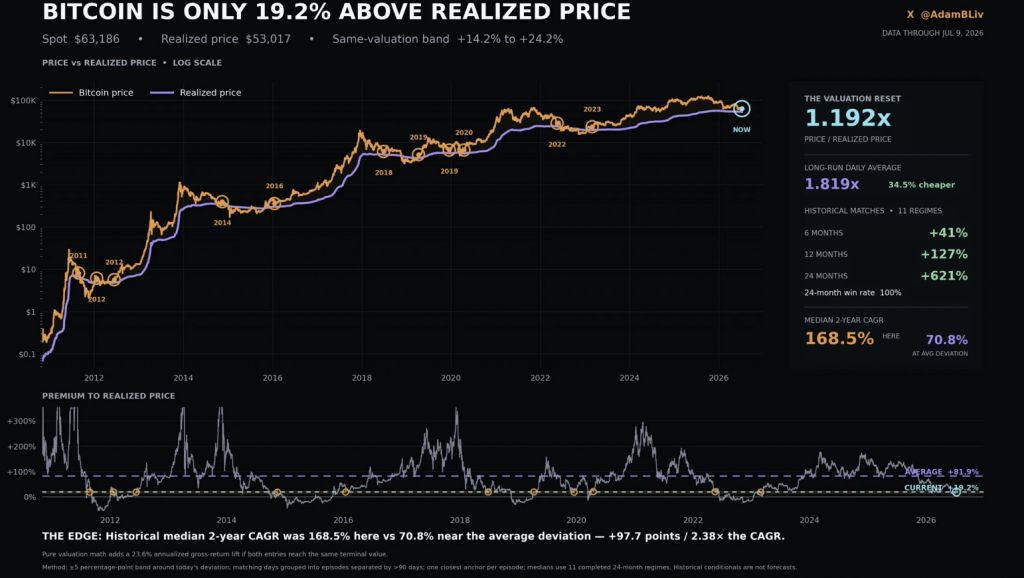
Analyst Adam Livingston offered another bullish perspective by comparing Bitcoin’s current market price with its realized price—the average price at which all circulating BTC last moved on-chain.
According to Livingston, Bitcoin is trading only about 19.2% above its realized price. Historically, that premium has averaged closer to 81.9%, suggesting the asset may still be undervalued relative to previous market cycles.
Looking back at earlier periods when Bitcoin traded near similar valuation levels, Livingston found a surprisingly consistent pattern.
Past cycles produced median returns of roughly 41% after six months, 127% after one year, and more than 620% over two years. While historical performance never guarantees future results, those figures help explain why many long-term investors continue accumulating during periods of uncertainty.
Fresh Capital May Still Be the Missing Piece
Despite improving technical indicators and growing whale accumulation, one important ingredient still appears to be missing.
As AMBCrypto recently noted, stronger sentiment alone may not be enough to fuel a sustained bull market. For Bitcoin to break decisively into a new expansion phase, fresh capital will likely need to return to spot markets in much larger amounts.
Until that happens, Bitcoin may continue grinding higher in fits and starts, balancing encouraging on-chain trends against cautious institutional participation.
For now, the tug-of-war continues—and the next wave of buyers could determine where Bitcoin heads next.
Disclaimer: BlockNews provides independent reporting on crypto, blockchain, and digital finance. All content is for informational purposes only and does not constitute financial advice. Readers should do their own research before making investment decisions. Some articles may use AI tools to assist in drafting, but every piece is reviewed and edited by our editorial team of experienced crypto writers and analysts before publication.








 English (US) ·