
 4 months ago
71
4 months ago
71
Bitcoin recorded a rare two-block chain reorganization on Monday, quickly resolving a brief split between major mining pools without disrupting users or funds.
Foundry USA Extends Lead in Bitcoin Reorg Race
The event unfolded around block height 941880 on March 23, when competing blocks were mined nearly simultaneously, creating a temporary fork between chains led by the mining pool giant Foundry USA and a rival branch backed by Antpool and Viabtc.
Bitcoin developer and “observer” b10c discovered the reorg. “We just had a rare-ish two block fork/reorg between Foundry and AntPool+ViaBTC. Foundry mined six blocks in a row,” the developer wrote. “*seven, Foundry mined seven blocks in a row,” the X account b10c added.
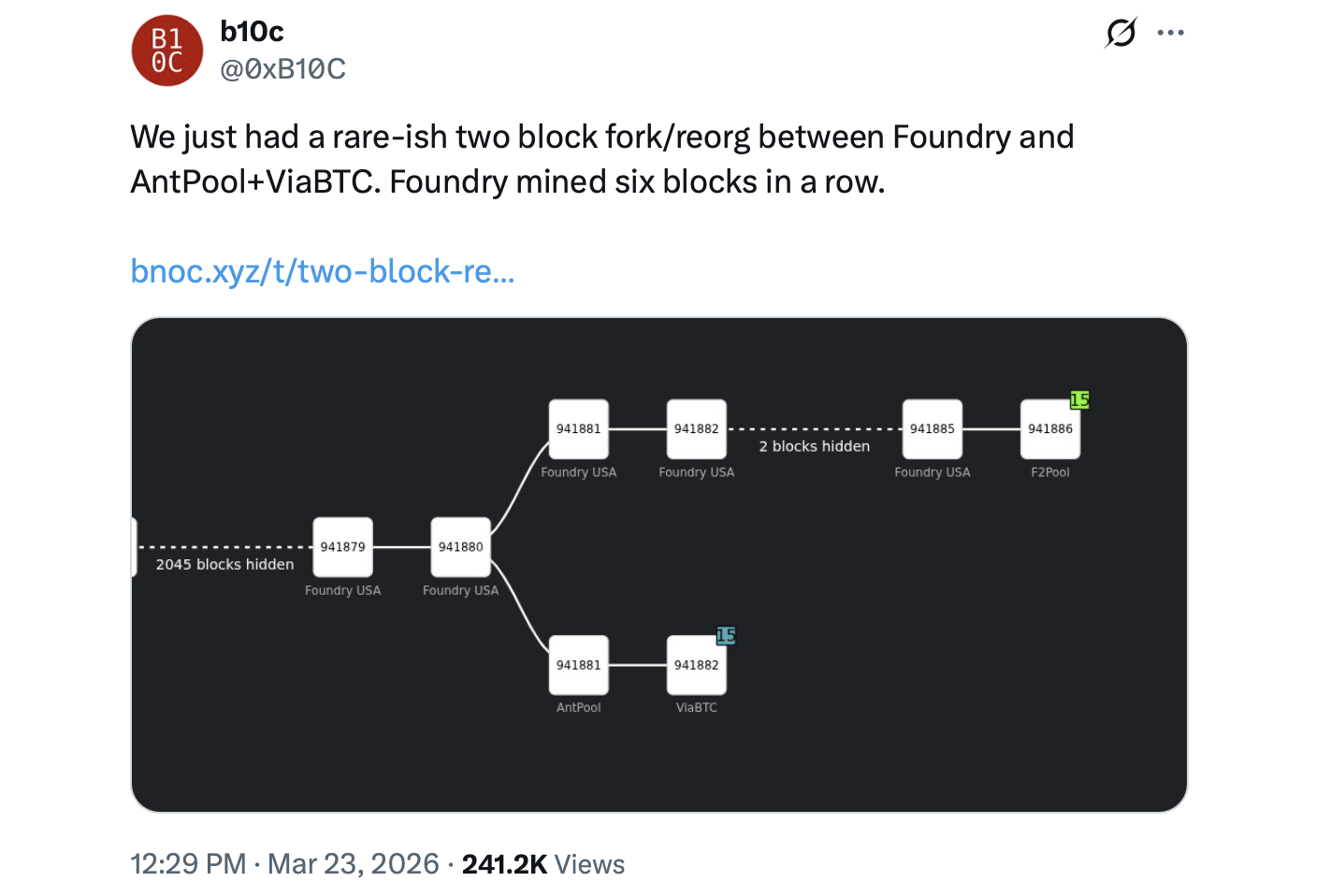
Within seconds, both sides extended their versions of the chain, producing two parallel branches of equal length. For a short window, different nodes recognized different chains as valid, a standard outcome when blocks are discovered at nearly the same time. The tie did not last long.
Foundry USA pulled ahead by mining additional consecutive blocks, ultimately extending its chain beyond the competing branch. Once it established the longer chain, the network followed suit, abandoning the shorter version.
The rival blocks mined by Antpool and Viabtc were marked as “orphaned,” meaning they were removed from Bitcoin’s canonical history. Transactions included in those blocks were not lost; they returned to the mempool and were later processed again.
Analysts and onlookers, including Bitcoin observer b10c, described the episode as routine behavior under Bitcoin’s proof-of-work system. No exploit, double-spend, or malfunction was detected. If anything, the system did exactly what it is designed to do.
Short reorganizations—especially single-block events—happen from time to time due to network latency and simultaneous discoveries. Two-block reorganizations are less common, but still well within expected parameters. The timing is notable.
The reorg came shortly after a 7.76% downward difficulty adjustment, one of the largest declines this year. At the same time, global hashrate has slipped from prior highs, easing competition just enough to increase the odds of near-simultaneous block discoveries.
That combination can produce brief forks like this one. Mining concentration also played a role. Foundry USA, which controls a significant share of global hashrate, was able to string together multiple blocks and decisively win the race. Larger pools tend to have an edge in these moments, occasionally leaving smaller competitors with orphaned blocks.
Still, there was no broader disruption. The network converged within minutes, users saw no impact, and Bitcoin continued processing transactions as usual. The episode serves as a clean, real-world example of Nakamoto consensus resolving conflicts without human intervention.
In other words, nothing broke—and nothing needed fixing.
FAQ 🔎
- What is a Bitcoin reorganization?
A reorg occurs when competing blocks create temporary forks and the network selects the longest chain. - Did users lose funds during the reorg?
No, all transactions remained safe and were reprocessed if needed. - How rare is a two-block reorg?
It is uncommon but expected under Bitcoin’s design during tight mining races. - Why did Foundry USA win the fork?
It mined additional blocks faster, giving its chain more cumulative proof-of-work.






 English (US) ·