
 4 months ago
72
4 months ago
72
- Mining costs exceed Bitcoin price, forcing miners into losses
- First hashrate decline in years signals miner capitulation
- AI infrastructure offers better returns, pulling capital away
Something unusual is happening in Bitcoin mining, and it’s not a small shift. For the first time in years, hashrate has actually declined. That might sound technical, but it’s one of the clearest signals that something has broken in the economics of mining, at least for now.
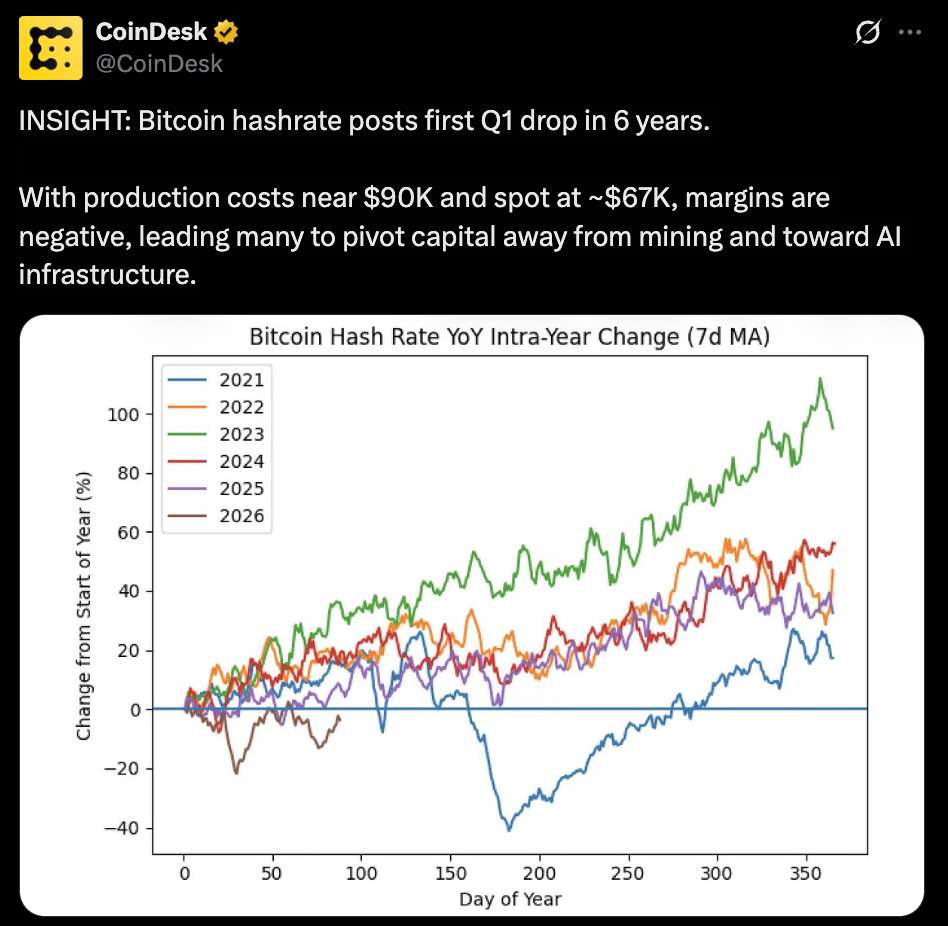
Hashrate usually trends in one direction, up. More machines, more power, more competition. When it drops, it means miners are shutting off. And they don’t do that unless the math stops working.
Mining Economics Are Under Pressure
Right now, the numbers are tough to ignore. It’s estimated that producing one Bitcoin costs somewhere between $80,000 and $90,000, while the market price is sitting closer to the mid-$60,000 range. That gap puts a large portion of miners underwater.
On top of that, hashprice, the revenue earned per unit of computing power, has dropped to near breakeven levels. For many operators, it’s not just lower profit margins, it’s sustained losses. And that changes behavior quickly.
Hashrate Drop Signals Capitulation
When margins compress like this, weaker players start to exit. Older machines get turned off, high electricity costs become unsustainable, and less efficient setups shut down entirely. Estimates suggest up to 20% of the network may already be operating at a loss.
That’s what we’re seeing now. Not panic selling, but gradual capitulation. As those miners leave, total hashrate falls. It’s a natural reset, but one that doesn’t happen often.
AI Is Pulling Capital Away
What makes this cycle different is where that capital is going. Miners aren’t just shutting down, they’re pivoting. The same infrastructure used for mining, power contracts, cooling systems, data centers, can be repurposed for AI workloads.
And the returns are significantly better. AI data centers can generate multiple times the revenue per unit of energy compared to mining. So the decision becomes less ideological and more practical. If one use case is losing money and another is profitable, capital moves.

Mining vs AI Is Becoming a Real Trade-Off
This isn’t just a side trend, it’s starting to look like a direct competition for resources. Energy, hardware, and infrastructure are finite, and AI is now bidding for the same inputs Bitcoin mining relies on.
Some mining firms are already shifting a large portion of their operations toward AI, with expectations that a majority of revenue could come from it in the near future. That’s a big shift in how these companies operate.
What This Means for Bitcoin
In the short term, a declining hashrate can look bearish. It signals stress and reduced participation. But structurally, it can actually help rebalance the network. As inefficient miners exit, mining difficulty adjusts, making it easier and more profitable for those who remain.
Bitcoin has gone through cycles like this before. What’s different now is the presence of a stronger alternative, AI, pulling resources away at the same time.
A Repricing of Compute Power
At a deeper level, this isn’t just about mining. It’s about how compute power is being valued. For years, Bitcoin mining was one of the most profitable ways to monetize energy and hardware. Now that assumption is being challenged.
The hashrate drop isn’t a failure of the network. It’s a signal that the market is recalibrating. And right now, the value of compute is being redefined by something bigger than crypto alone.
Disclaimer: BlockNews provides independent reporting on crypto, blockchain, and digital finance. All content is for informational purposes only and does not constitute financial advice. Readers should do their own research before making investment decisions. Some articles may use AI tools to assist in drafting, but every piece is reviewed and edited by our editorial team of experienced crypto writers and analysts before publication.






 English (US) ·