
 5 months ago
55
5 months ago
55
- Retail traders are selling at losses while long-term Bitcoin holders remain inactive
- Exchange reserves have dropped by over 200,000 BTC this year, tightening available supply
- Analysts say Bitcoin bull cycles often resume once price reclaims the short-term whale cost basis near $85K
Bitcoin is hovering close to the $70,000 level, and on-chain data is starting to reveal an interesting split in the market. Retail traders appear to be selling off their coins, while long-term holders are… well, barely moving at all. That contrast has analysts paying closer attention, because historically, these kinds of setups can tighten supply and quietly build pressure beneath the surface.
The divergence is becoming hard to ignore. While smaller investors seem eager to exit positions, older wallets — many sitting on massive unrealized profits — remain untouched. Some analysts believe this imbalance could eventually squeeze available supply if demand suddenly returns.
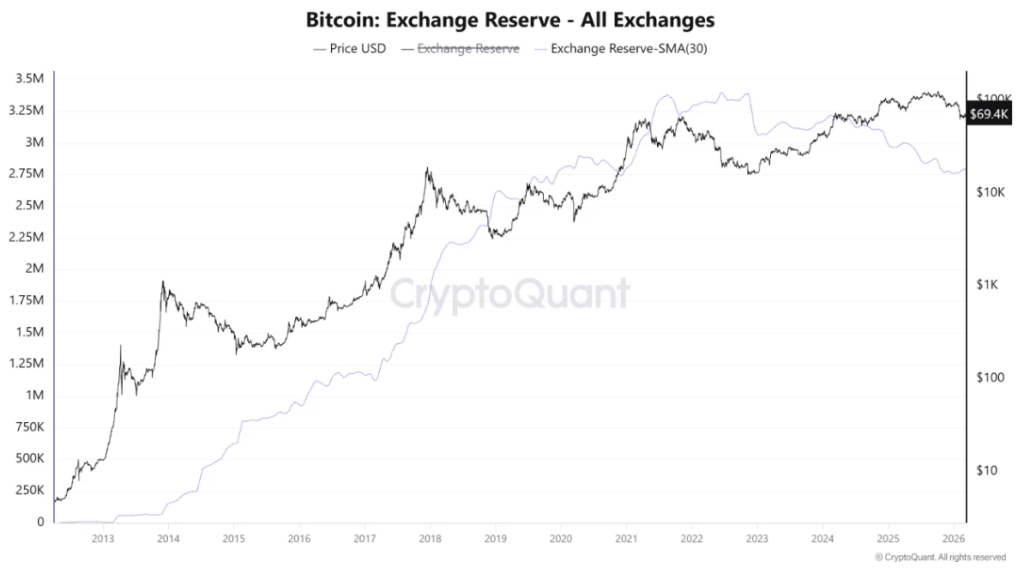
Exchange Supply Shrinks Even as Panic Selling Appears
According to on-chain analyst GugaOnChain, Bitcoin reserves sitting on exchanges have fallen sharply this year. Since January, reserves dropped by roughly 204,000 BTC, sliding from about 2.99 million coins to around 2.786 million. In simple terms, fewer coins are sitting on exchanges ready to be sold, even though short-term holders are actively offloading.
Another signal comes from the Short-Term Holder Spent Output Profit Ratio, or SOPR-STH. That metric currently sits near 0.97, which suggests recent buyers are selling their coins at a loss. Readings below 1.0 typically mean traders are exiting positions in the red, often because of panic rather than a calculated strategy.
Meanwhile, older Bitcoin holders — the ones who bought years ago — aren’t doing much at all. According to GugaOnChain, most of those older coins remain untouched, even though many of them carry enormous unrealized gains. The analyst described the current selling pressure as largely emotional, driven by newer traders who bought at higher levels and are now cutting their losses.
Whale Cost Basis Becomes a Key Market Signal
A separate market update from CryptoQuant contributor burakkesmeci highlighted another layer of the story. Whales that accumulated Bitcoin within the past 155 days are currently holding an average cost basis of roughly $85,600.
With Bitcoin trading far below that level, those newer whales are technically underwater. That matters more than it might seem at first glance.
Historically, Bitcoin bull cycles tend to resume only after the price climbs back above this group’s average entry point and holds there for a while. When price stays below that threshold, markets tend to drift into bearish phases. When it reclaims it, momentum usually flips the other direction.
According to burakkesmeci, Bitcoin briefly tested this level earlier in the year during January, but it failed to break through. Instead, the rejection pushed the price back down toward the $60,000 range.

Market Shock Events Offer Mixed Signals
Last weekend delivered an unexpected stress test for the market. Oil prices surged sharply, yet Bitcoin managed to hold above the $70,000 mark. Fundstrat’s Tom Lee interpreted the move as a sign that Bitcoin might be regaining its reputation as a store-of-value asset.
The theory faced another quick test shortly afterward.
Bitcoin suddenly swung between roughly $69,000 and $71,200 after U.S. President Donald Trump posted on social media that there was “nothing left to target” in Iran. Within minutes of the statement, Bitcoin spiked nearly $2,000 before cooling off again — a reminder of how quickly macro headlines can ripple through the crypto market.
Bitcoin Still Trails the Broader Crypto Market
Despite the recent volatility, Bitcoin has slightly underperformed the broader crypto market over the past week. Data from CoinGecko shows BTC down about 3.7% during that period, compared with a roughly 1.7% decline across the wider crypto sector.
Zoom out a bit further, and the picture becomes even more complicated. Bitcoin’s one-year return currently sits around negative 15%, and the asset remains roughly 45% below its all-time high.
For now, the market seems stuck between two forces — emotional selling from newer traders and quiet accumulation from long-term holders. If history is any guide though… these kinds of standoffs don’t usually last forever.
Disclaimer: BlockNews provides independent reporting on crypto, blockchain, and digital finance. All content is for informational purposes only and does not constitute financial advice. Readers should do their own research before making investment decisions. Some articles may use AI tools to assist in drafting, but every piece is reviewed and edited by our editorial team of experienced crypto writers and analysts before publication.






 English (US) ·