
 4 months ago
65
4 months ago
65
- Bitcoin falls ~24% in Q1 2026, marking its weakest start in years
- Six-month drawdown deepens to around -41%, showing sustained pressure
- Macro forces, not crypto fundamentals, are driving the downturn
Bitcoin’s drop from around $87K to the mid-$60Ks in Q1 doesn’t just stand out because of the numbers. It’s how the move unfolded that’s catching attention. There wasn’t a dramatic crash or a sharp rebound. Instead, it’s been a slow, steady grind lower.
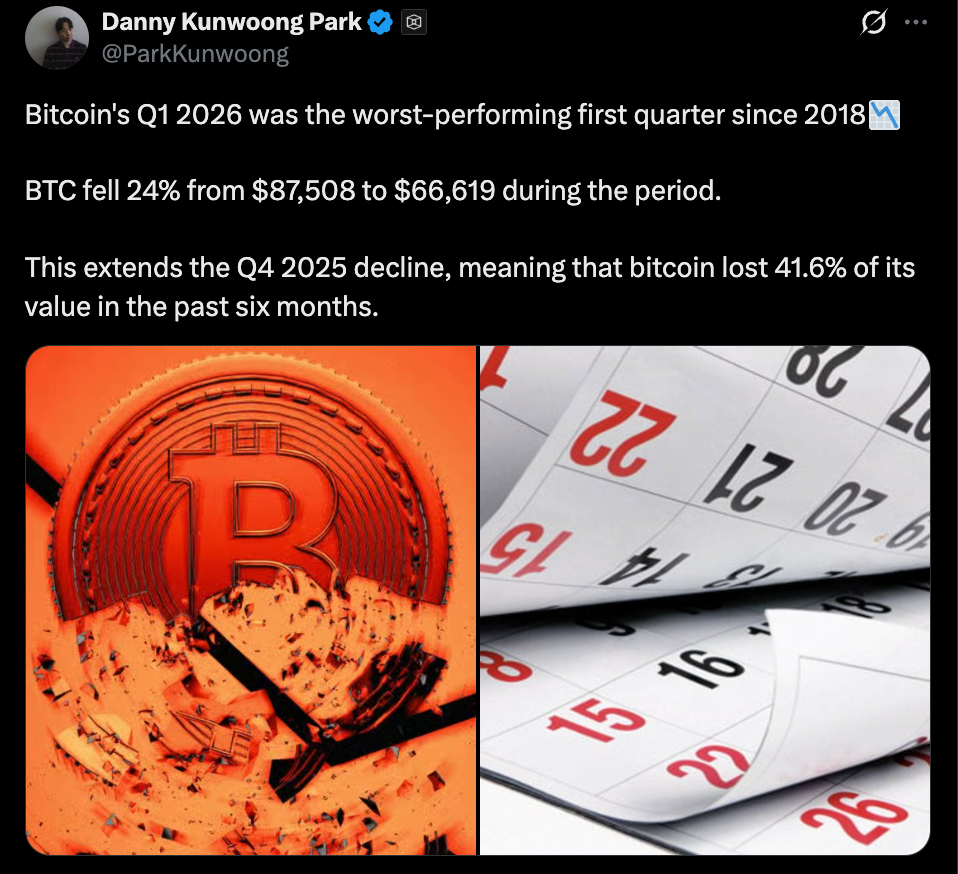
That kind of price action tends to signal something different. Not panic, but persistent selling pressure. And when that stretches across multiple months, it starts to look less like noise and more like a market searching for a bottom.
A Drawdown That’s Still Expanding
Zooming out, this isn’t just a bad quarter. It extends a broader pullback that began late in 2025, pushing the total drawdown to roughly 40% over six months.
That matters because sustained declines like this usually reflect structural pressure, not short-term volatility. Markets don’t move like this without a reason, even if that reason isn’t immediately obvious.
And right now, the pressure isn’t coming from inside crypto.
Macro Is Driving the Narrative Again
The dominant force here is macro. Rising geopolitical tension, tighter financial conditions, and shifting capital flows are all weighing on risk assets.
Bitcoin, despite its narrative as a hedge, continues to behave more like a high-beta asset in this environment. When liquidity tightens, it drops. When uncertainty increases, capital moves elsewhere.

ETF flows tell a similar story. What was once steady inflow has turned into outflows, removing a key source of demand that supported previous rallies.
The Pattern Feels Familiar
There’s an obvious comparison being made to 2018. Back then, a weak start to the year led into a longer period of grinding downside.
This setup isn’t identical, but the rhythm is similar. Momentum fades, conviction weakens, and price struggles to find a strong base. It’s the kind of environment that slowly wears down participants rather than forcing quick exits.
At the same time, history rarely repeats perfectly. In past cycles, extended weakness has often been followed by strong reversals once macro conditions stabilize.
Not a Collapse, But a Grind
What makes this phase different is its pace. This isn’t a sudden collapse that shocks the market. It’s a slow bleed that chips away at confidence over time.
That kind of movement tends to last longer, simply because it doesn’t trigger a clear capitulation event. Instead, it drifts, testing patience more than risk tolerance.
Waiting for the Shift
For a meaningful reversal, something needs to change. That could be easing macro conditions, improving liquidity, or a shift in investor positioning.
Until then, rallies may struggle to hold. Not because Bitcoin is fundamentally broken, but because the broader environment isn’t supportive.
The Bigger Question Ahead
At this point, the question isn’t how far Bitcoin has fallen. It’s how long this type of pressure can persist before the market finds a new direction.
Because when the shift does come, it tends to happen quickly. But for now, the trend is still searching for that turning point.
Disclaimer: BlockNews provides independent reporting on crypto, blockchain, and digital finance. All content is for informational purposes only and does not constitute financial advice. Readers should do their own research before making investment decisions. Some articles may use AI tools to assist in drafting, but every piece is reviewed and edited by our editorial team of experienced crypto writers and analysts before publication.







 English (US) ·