
 3 weeks ago
80
3 weeks ago
80
- Bitcoin’s 90-day correlation with gold has climbed to its highest level in nearly six years, according to Bitwise.
- The shift came as long-term Treasury yields rose, the dollar weakened and investors moved toward scarce assets during renewed bond-market stress.
- Bitcoin’s correlation with U.S. stocks has fallen sharply, strengthening the argument that BTC may be behaving more like a macro hedge than a traditional risk asset.
Bitcoin and gold are moving more closely together as investors respond to rising bond yields, currency concerns and broader fears around government debt.
According to Bitwise, the 90-day correlation between the two assets recently reached its highest level since 2020. The move followed another selloff in longer-dated U.S. Treasurys and increased bond purchases by Treasury Secretary Scott Bessent.
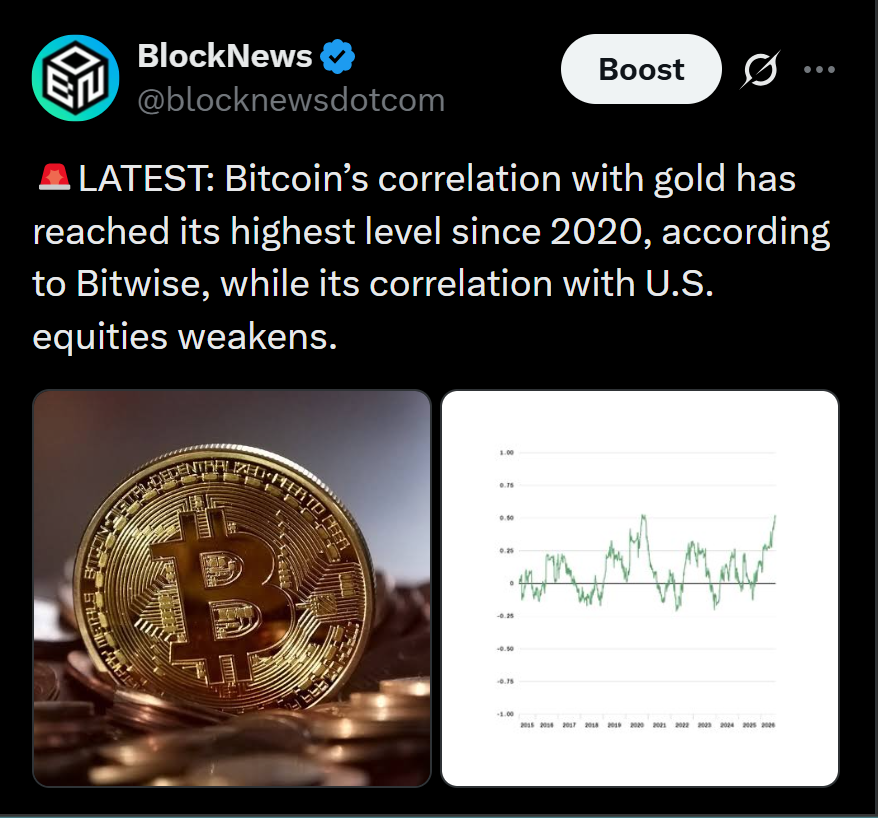
Bitcoin gained 22.4% over the following week, its strongest weekly advance since March 2024, while gold climbed around 5%. Stocks, meanwhile, moved lower.
Bitwise Europe Research Director André Dragosch said the market increasingly appears to treat Bitcoin and gold similarly when macroeconomic pressure becomes more intense.
Bitcoin Looks More Like an Amplified Gold Trade
Dragosch said investors are becoming less likely to distinguish between Bitcoin and gold during periods when concerns around currency debasement rise.
Bitcoin was also negatively correlated with the U.S. Dollar Index at the end of August, meaning weakness in the dollar tended to coincide with strength in BTC and gold.
That relationship supports the argument that Bitcoin is increasingly trading as a scarce monetary asset during certain macro environments.
The last time Bitcoin and gold showed a comparable 90-day correlation was around 2020, when governments and central banks introduced massive fiscal and monetary stimulus in response to the Covid crisis.
Bitcoin’s Stock Correlation Falls
Bitcoin’s relationship with equities has moved in the opposite direction.
Glassnode said BTC’s 30-day correlation with the S&P 500 fell close to zero during the August rally while U.S. stocks remained largely flat.

Bloomberg Senior ETF Analyst Eric Balchunas also noted that Bitcoin has shown a lower correlation with U.S. equities over the past six months than gold, small-cap stocks, emerging markets and even Treasurys.
That challenges the idea that Bitcoin simply trades as a leveraged version of technology stocks.
However, Glassnode cautioned that sharp decorrelations during government bond selloffs have historically been temporary, meaning it is still too early to call the move a permanent structural shift.
Bitcoin Faces Resistance Above $83,000
Bitcoin briefly climbed above $80,000 following a 25% rally in August before pulling back toward $76,000.
Glassnode identified a concentration of long-term holder supply between roughly $83,000 and $86,000, creating an important resistance zone if Bitcoin resumes its climb.
Its primary accumulation area remains much lower, around $62,000 to $65,000.
Bitcoin was trading near $77,600, placing it between those two major levels.
At approximately $78,000 in late August, around 68% of Bitcoin’s supply was in profit, compared with 65% when BTC traded near similar levels in May.
Spot Bitcoin ETFs were also attracting an average of roughly $290 million per day during the strongest part of the rally, while daily ETF trading volumes remained near $3 billion.
If Bitcoin continues moving alongside gold while separating from equities, its role as a potential monetary hedge and portfolio diversifier could become an increasingly important part of its investment case.
Disclaimer: BlockNews provides independent reporting on crypto, blockchain, and digital finance. All content is for informational purposes only and does not constitute financial advice. Readers should do their own research before making investment decisions. Some articles may use AI tools to assist in drafting, but every piece is reviewed and edited by our editorial team of experienced crypto writers and analysts before publication.







 English (US) ·