
 8 hours ago
22
8 hours ago
22
- BitMEX will permanently shut down its exchange after more than 11 years of operation following a strategic business review.
- Trading will end on September 23, with users urged to withdraw their assets before ongoing account fees begin.
- Once the dominant crypto derivatives platform, BitMEX lost market share to rivals including Binance, Bybit, OKX, and Hyperliquid.
BitMEX, one of the most influential exchanges in cryptocurrency history, has announced it will permanently close its trading platform after more than a decade in operation.
Parent company HDR Global Trading Limited said the decision follows a strategic review of both its business and the broader crypto industry. New account registrations ended immediately on July 23, marking the beginning of a phased shutdown.
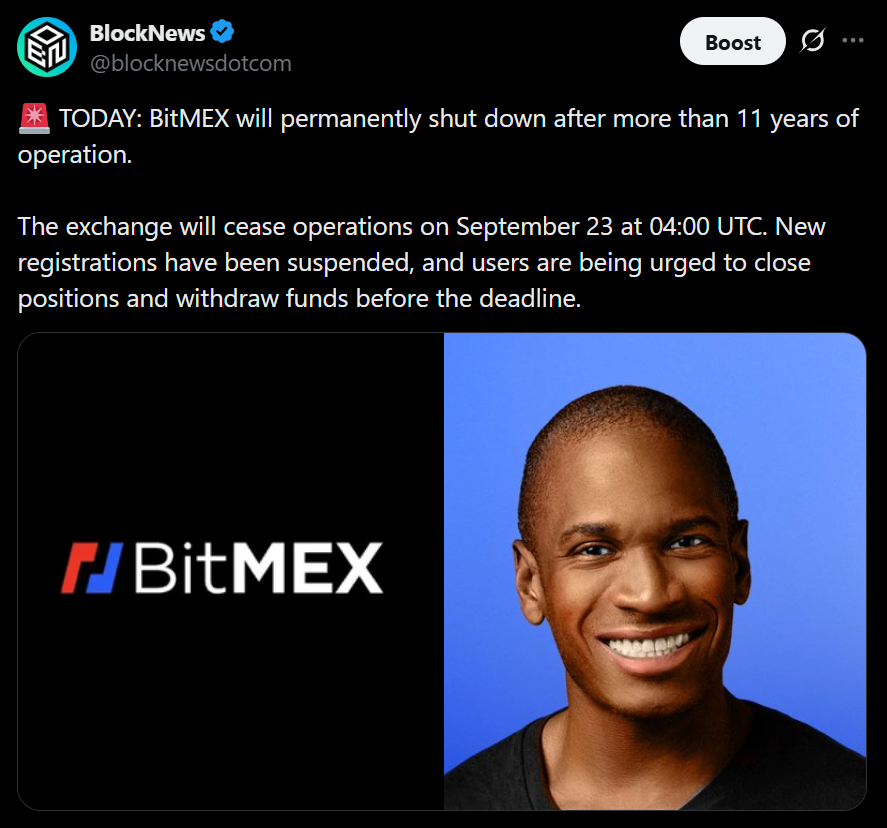
The closure brings an end to one of crypto’s most recognizable exchanges, which helped reshape digital asset trading through the invention of the perpetual futures contract.
Exchange Begins Phased Shutdown
BitMEX outlined a multi-stage wind-down process for existing customers.
Beginning August 26, traders will only be able to reduce or close existing positions as new trading activity becomes restricted. On September 23, all remaining positions will be automatically closed, trading will cease entirely, and customers will only be able to access their balances and withdraw funds.
The exchange also confirmed that all staked BMEX tokens have already been returned to user accounts and warned customers to remain alert for phishing scams that may attempt to exploit the shutdown announcement.
Withdrawal Deadline Comes With Fees
BitMEX is encouraging users to withdraw their assets before the final trading deadline.
Customers who leave KYC-verified funds on the platform after September 23 will be charged a monthly custody fee equal to the greater of $50 or 1% annually of their remaining balance.
The company said it will continue contacting users who have not withdrawn their assets after trading ends.
The Exchange That Changed Crypto Trading
Founded in 2014 by Arthur Hayes, Ben Delo, and Samuel Reed, BitMEX became one of the industry’s most influential exchanges after launching the world’s first perpetual swap contract in 2016.
The product allowed traders to maintain leveraged Bitcoin positions without contract expiration dates by using a funding-rate mechanism to keep futures prices aligned with the spot market.
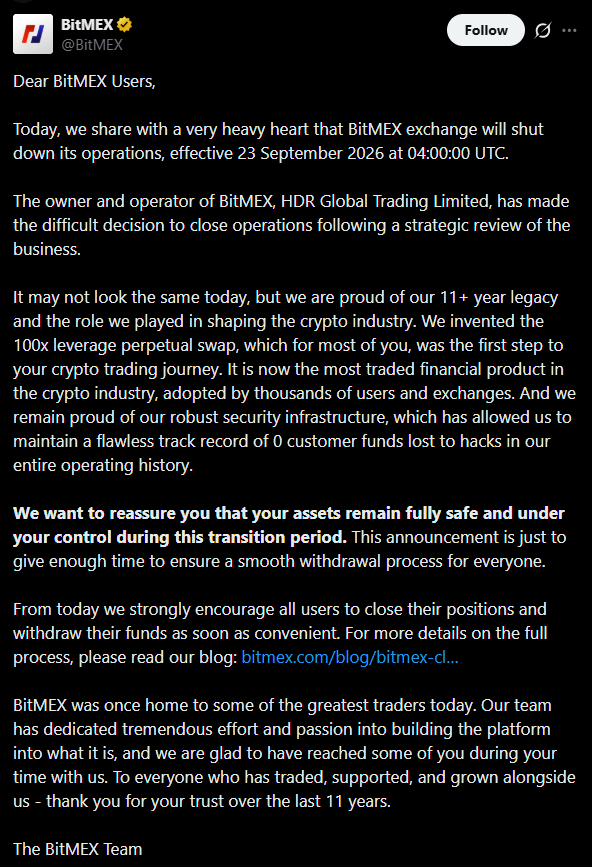
Combined with leverage of up to 100x, the innovation transformed crypto derivatives trading and was later adopted by nearly every major centralized and decentralized exchange.
Competition and Regulation Changed the Landscape
Despite pioneering perpetual futures, BitMEX gradually lost its dominant position as competitors expanded their product offerings and liquidity.
The exchange also faced significant regulatory challenges. In 2020, U.S. authorities charged the company and its founders over anti-money laundering compliance failures. BitMEX later pleaded guilty and paid a $100 million fine in 2025. That same year, President Donald Trump granted pardons to the company’s founders, a former executive, and the company itself.
By the time the shutdown was announced, BitMEX accounted for only about 0.08% of global perpetual futures trading volume, a dramatic decline from the more than 50% market share it once held.
While BitMEX’s exchange is coming to an end, its impact on the cryptocurrency industry remains significant. The perpetual futures model it introduced has become the dominant crypto derivatives product, continuing to generate billions of dollars in daily trading volume across the global market.
Disclaimer: BlockNews provides independent reporting on crypto, blockchain, and digital finance. All content is for informational purposes only and does not constitute financial advice. Readers should do their own research before making investment decisions. Some articles may use AI tools to assist in drafting, but every piece is reviewed and edited by our editorial team of experienced crypto writers and analysts before publication.







 English (US) ·