
 4 weeks ago
68
4 weeks ago
68
- BlackRock’s Robbie Mitchnick says Bitcoin’s recent rally has strengthened its case as a portfolio diversifier rather than simply another risk asset.
- Bitcoin’s correlation with the Nasdaq has fallen sharply as concerns over debt, deficits and bond markets increase demand for scarce assets.
- Spot Bitcoin ETFs have attracted roughly $2.4 billion in net inflows in August as BTC tests resistance around $80,000 to $83,000.
Bitcoin’s rebound toward $80,000 is strengthening its case as a portfolio diversifier, according to BlackRock Head of Digital Assets Robbie Mitchnick.
Speaking to CNBC, Mitchnick acknowledged that Bitcoin can sometimes trade like a traditional risk-on asset because of its volatility, speculative activity and leveraged trading. But he argued that its underlying drivers can be very different from those affecting equities and other conventional investments.
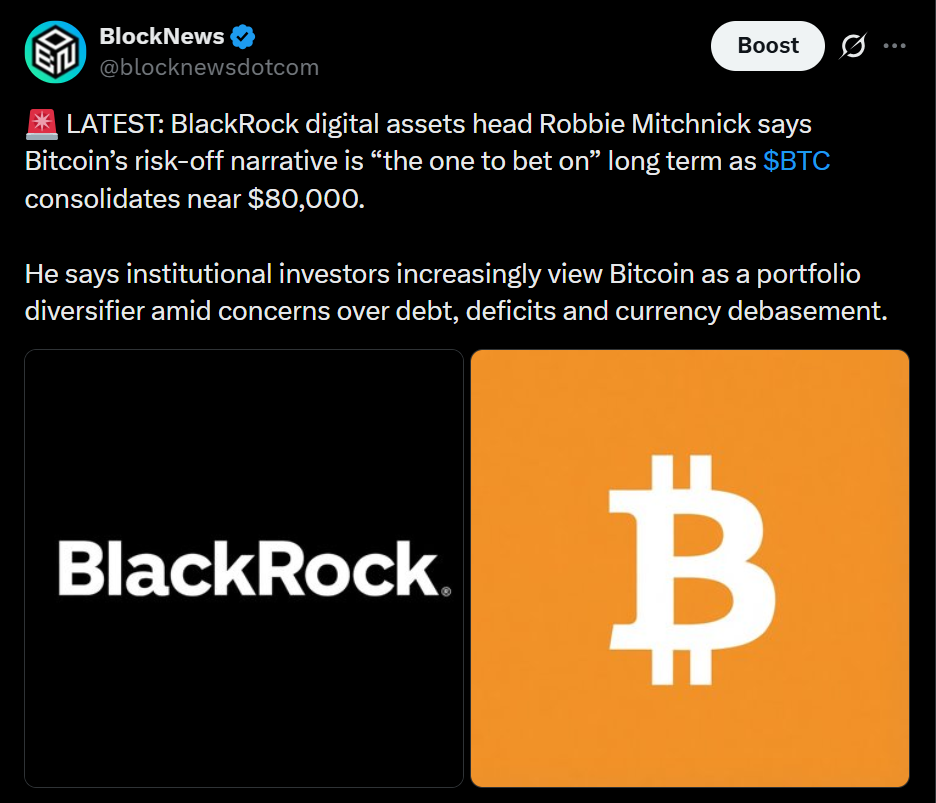
Mitchnick described Bitcoin as a “global scarce decentralized emerging monetary alternative,” saying its recent performance alongside gold, while equities and fixed-income markets faced pressure, fits that longer-term investment thesis.
BlackRock’s IBIT is currently the largest U.S. spot Bitcoin ETF, holding more than $76 billion in assets under management.
Debt Concerns Strengthen Bitcoin’s Store-of-Value Case
Bitcoin recently surged from the low $60,000s to briefly above $81,000, with concerns surrounding global government debt and deficits returning to the market.
Mitchnick said those concerns could benefit scarce assets such as Bitcoin and gold whenever they move back into focus.
He also argued that younger investors may increasingly view Bitcoin in a similar way to how previous generations viewed gold — as an alternative store of value outside traditional monetary systems.
Bitcoin’s changing relationship with other markets is adding to that argument. Wintermute OTC Trader Jasper De Maere said Bitcoin’s correlation with the Nasdaq has fallen to around 0.3 after previously reaching close to 0.9.
During August, Bitcoin has instead behaved more like gold as investors increasingly focus on the so-called debasement trade.

Bitcoin ETF Demand Returns
Institutional demand has also improved during the latest rally.
Kraken Chief Economist Thomas Perfumo said U.S. spot Bitcoin ETFs have recorded approximately $2.4 billion in net inflows during August, making it their strongest month of 2026 and recovering nearly half of their year-to-date deficit.
Perfumo said additional demand could emerge if Strategy resumes Bitcoin purchases. The company has remained sidelined as a buyer since May.
However, he cautioned that Bitcoin may still be some distance from the price-discovery and speculative phase normally associated with the strongest stages of a bull market.
Uncertainty surrounding monetary policy, the Clarity Act and the U.S.-Iran conflict could also continue creating volatility.
Bitcoin Faces Major Resistance Near $83,000
Bitcoin’s next major test sits between roughly $80,000 and $83,000.
LMAX Group Market Strategist Joel Kruger said Bitcoin is currently consolidating after its sharp rally, allowing overbought market conditions to cool. The previous May high just below $83,000 remains an important resistance level.
De Maere similarly identified $80,000 to $81,000 as the immediate range to watch after Bitcoin was rejected near $81,200. If the market turns lower, the mid-$70,000 region could provide the first significant area of support.
21Shares co-founder Ophelia Snyder argued that Bitcoin’s ability to consolidate after the initial short squeeze suggests the rally may have developed into something broader than forced buying.
She linked the move more closely to developments in U.S. bond markets and growing concerns around monetary conditions. As Bitcoin develops further as a monetary asset, Snyder expects its relationship with bond markets and its potential role as a monetary-policy hedge to become increasingly important.
Disclaimer: BlockNews provides independent reporting on crypto, blockchain, and digital finance. All content is for informational purposes only and does not constitute financial advice. Readers should do their own research before making investment decisions. Some articles may use AI tools to assist in drafting, but every piece is reviewed and edited by our editorial team of experienced crypto writers and analysts before publication.







 English (US) ·