
 1 month ago
65
1 month ago
65
- Bolivia is evaluating the use of USDT to help address a shortage of physical U.S. dollars.
- The proposal could improve dollar-denominated payments and cross-border transactions without relying on cash.
- While still in the early stages, the initiative could become a milestone for stablecoin adoption in Latin America.
Bolivia is exploring whether Tether’s USDT can play a role in its national payment system as the country looks for solutions to an ongoing shortage of physical U.S. dollars. Although discussions remain preliminary, the proposal signals a growing willingness among governments to examine stablecoins as part of their financial infrastructure.
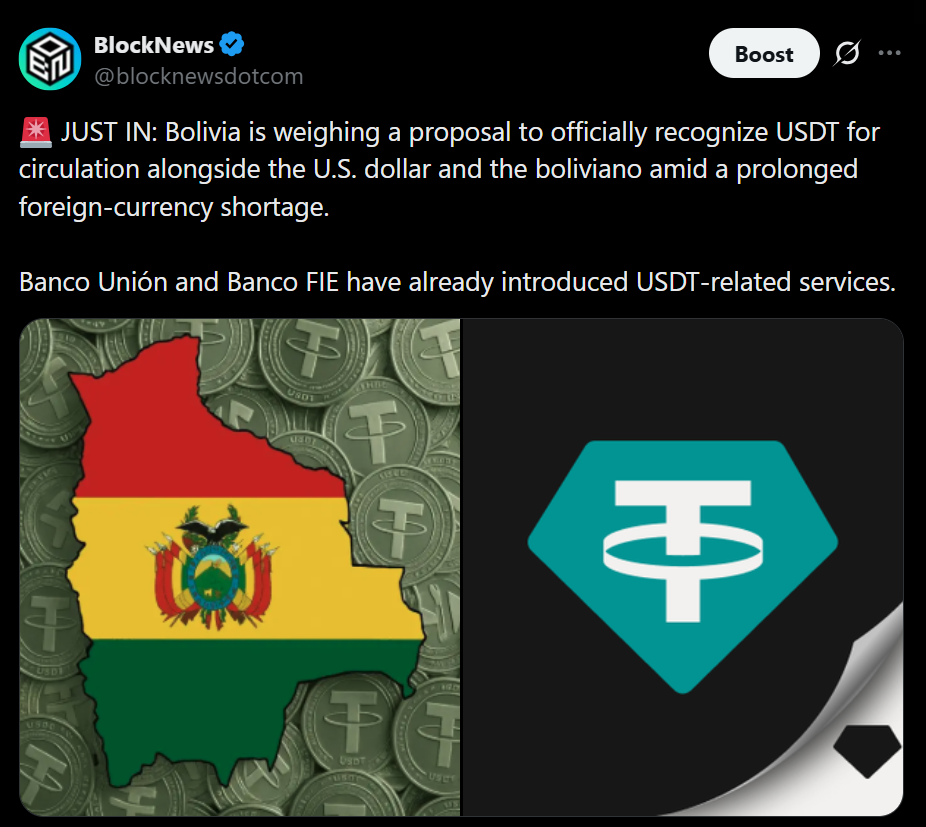
If adopted, USDT could provide businesses and consumers with a digital alternative for dollar-denominated transactions, reducing dependence on physical cash while making international payments faster and more accessible.
USDT Could Help Ease Dollar Shortages
Bolivia has experienced limited access to physical U.S. dollars, creating challenges for businesses that rely on foreign currency for imports, trade, and international settlements.
Officials are now evaluating whether a dollar-backed stablecoin like USDT could help fill that gap. Because USDT is designed to maintain a value close to one U.S. dollar, it could allow users to transact digitally without requiring physical banknotes.
The approach may also improve cross-border payments by enabling faster settlements while reducing some of the friction associated with traditional banking channels.
Regulatory Challenges Still Remain
Despite the potential benefits, Bolivia still faces several hurdles before any nationwide implementation could move forward.
Regulators would need to establish clear rules covering consumer protection, compliance, anti-money laundering requirements, and the safe custody of digital assets. Authorities would also need to ensure there is sufficient liquidity to allow users to convert between the local currency, the boliviano, and USDT without significant price disruptions.
As a result, officials have emphasized that the proposal remains under evaluation and that no final decision has been reached.
Latin America Continues Embracing Stablecoins
Stablecoins have become increasingly popular across Latin America as businesses and consumers seek faster, lower-cost alternatives for payments, remittances, and preserving value against currency volatility.
If Bolivia ultimately integrates USDT into its payment infrastructure, it could become one of the first countries in the region to formally incorporate a stablecoin into elements of its national payment system. Such a move may encourage neighboring countries to explore similar initiatives as digital assets become more integrated into traditional finance.
For now, the project remains in its early stages, with regulators continuing to assess the operational, legal, and financial implications before deciding whether to move forward.
Disclaimer: BlockNews provides independent reporting on crypto, blockchain, and digital finance. All content is for informational purposes only and does not constitute financial advice. Readers should do their own research before making investment decisions. Some articles may use AI tools to assist in drafting, but every piece is reviewed and edited by our editorial team of experienced crypto writers and analysts before publication.








 English (US) ·