
 2 hours ago
11
2 hours ago
11
Recent data released by the Central Bank of Brazil reveals that demand for digital assets and stablecoins has exploded in Brazil, with purchases surging 155% YoY until May 2026, when Brazilians purchased $12.138 billion worth of these assets.
Key Takeaways
- Central Bank of Brazil data shows digital asset purchases jumped 155% YoY to $12.138B by May 2026.
- Brazil bought $2.632B in stablecoins during May 2026, reinforcing dollar-proxy demand across Latam.
- Lula administration may revisit stablecoin rules after the 2026 election, with Abcripto opposing proposals.
Brazilian Digital Asset Demand Explodes in 2026
The hunger for digital assets in Brazil remains unquenched, even as the current bear market rages in the crypto industry.
New data released by the Central Bank of Brazil on June 26 shows that demand for digital assets, especially stablecoins, which are one of the most popular use cases for this tech, has exploded in May and throughout 2026.
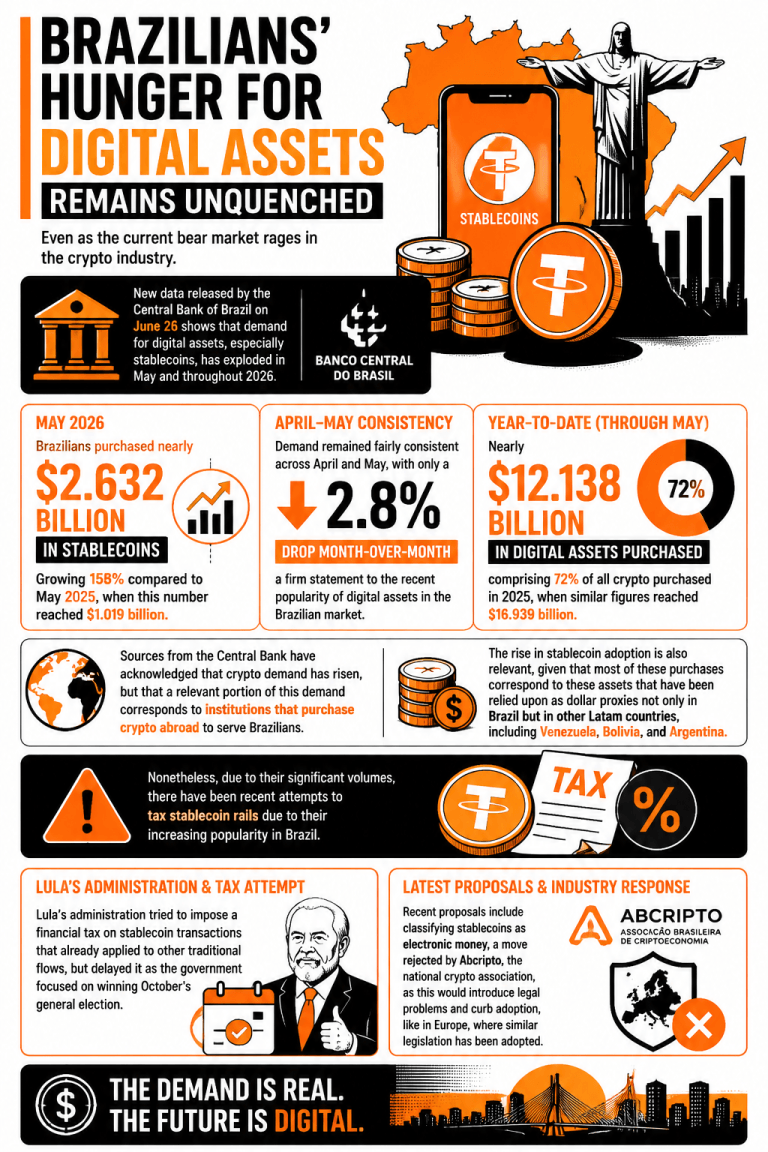
In May, Brazilians purchased nearly $2.632 billion in stablecoins, growing 158% compared to May 2025, when this number reached $1.019 billion.
This shows that demand remained fairly consistent across April and May, with only a drop of 2.8% month-over-month, a firm statement to the recent popularity of digital assets in the Brazilian market.
This is reinforced by taking yearly figures into account. Through May, nearly $12.138 billion in digital assets have been purchased, comprising 72% of all crypto purchased in 2025, when similar figures reached $16.939 billion.
Sources from the Central Bank have acknowledged that crypto demand has risen, but that a relevant portion of this demand corresponds to institutions that purchase crypto abroad to serve Brazilians.
The rise in stablecoin adoption is also relevant, given that most of these purchases correspond to these assets that have been relied upon as dollar proxies not only in Brazil but in other Latam countries, including Venezuela, Bolivia, and Argentina.
Nonetheless, due to their significant volumes, there have been recent attempts to tax stablecoin rails due to their increasing popularity in Brazil.
Lula’s administration tried to impose a financial tax on stablecoin transactions that already applied to other traditional flows, but delayed it as the government focused on winning October’s general election.
Recent proposals include classifying stablecoins as electronic money, a move rejected by Abcripto, the national crypto association, as this would introduce legal problems and curb adoption, like in Europe, where similar legislation has been adopted.







 English (US) ·