
 4 weeks ago
82
4 weeks ago
82
Brent crude futures broke above $100 a barrel on Thursday for the first time since late May, after Yemen’s Houthi movement claimed strikes on two Saudi Arabian oil tankers in the Red Sea and President Donald Trump warned Iran it would face “major military punishment” for further attacks.
Key Takeaways
- Brent crude topped $100 a barrel Thursday after Houthi strikes on two Saudi tankers in the Red Sea.
- AAA reported gasoline reached $4.091 a gallon as the Dow fell about 600 points on the news.
- Trump warned Iran of “major military punishment” as CENTCOM struck Tehran for a 12th straight night.
Oil Jumps as a Second Front Opens
Brent gained as much as 7% Thursday, touching an intraday high above $101 before settling near $100.13 to $100.80 a barrel, according to exchange data. West Texas Intermediate rose more than 6%, climbing into the low $90s, a level not seen since June 11.
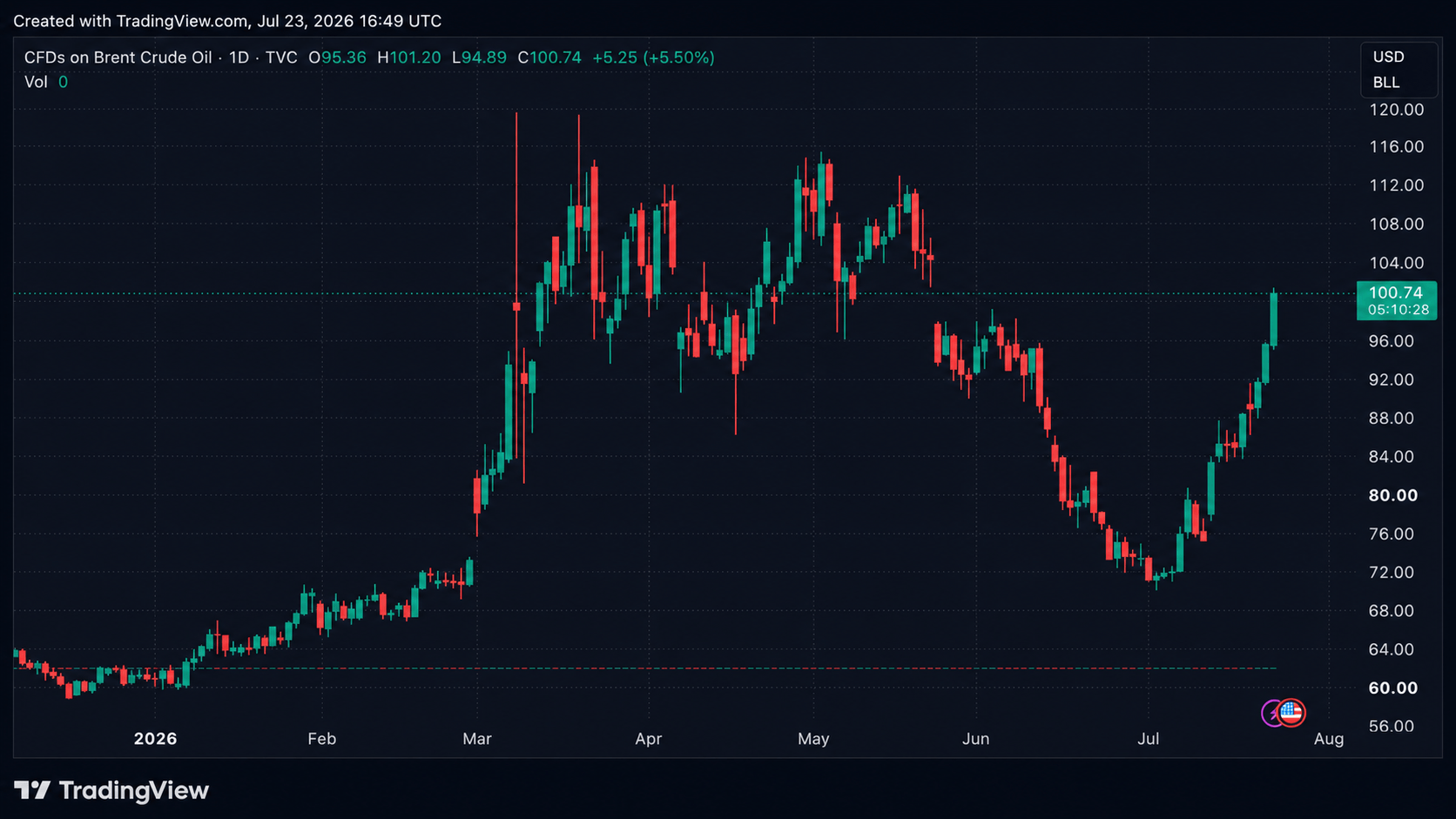 Brent oil at 12:49 p.m. EDT on July 23, 2026.
The rally caps a month in which Brent has already risen more than 30%. Prices are now roughly 40% above where they stood before the U.S.-Iran war began in late February, and up more than 60% year to date by some measures.
Houthis Claim Tanker Strikes
Reports detail that the Houthis said they used drones and missiles to hit the Encelia and a second vessel identified as the Layla, arguing the ships had broken a maritime blockade the group declared against Saudi Arabia earlier in the week. Saudi state media confirmed the Encelia caught fire while transiting the Red Sea. All crew members were reported safe.
The United Kingdom Maritime Trade Operations explained that a tanker was struck about 70 nautical miles southwest of Al Shuqaiq. Five Saudi tankers had already diverted course in the days before the strikes, following Houthi warnings.
These were the first confirmed ship attacks outside the immediate area of the Strait of Hormuz since the war intensified. The Red Sea and the Bab el-Mandeb Strait carry an estimated 12% to 15% of global maritime trade, worth more than $1 trillion a year. Around roughly 4 million to 4.5 million barrels a day of Saudi crude could face elevated risk if the attacks continue.
Trump Warns Iran
On Truth Social, Trump stressed the United States would hold Iran responsible for future Houthi attacks, calling the group a “Surrogate and/or Proxy of Iran.” He wrote that “major military punishment will be inflicted upon Iran and, of course, the Houthis, themselves,” adding that the group had “acted very professionally and smart” earlier in the conflict but was “starting up again.”
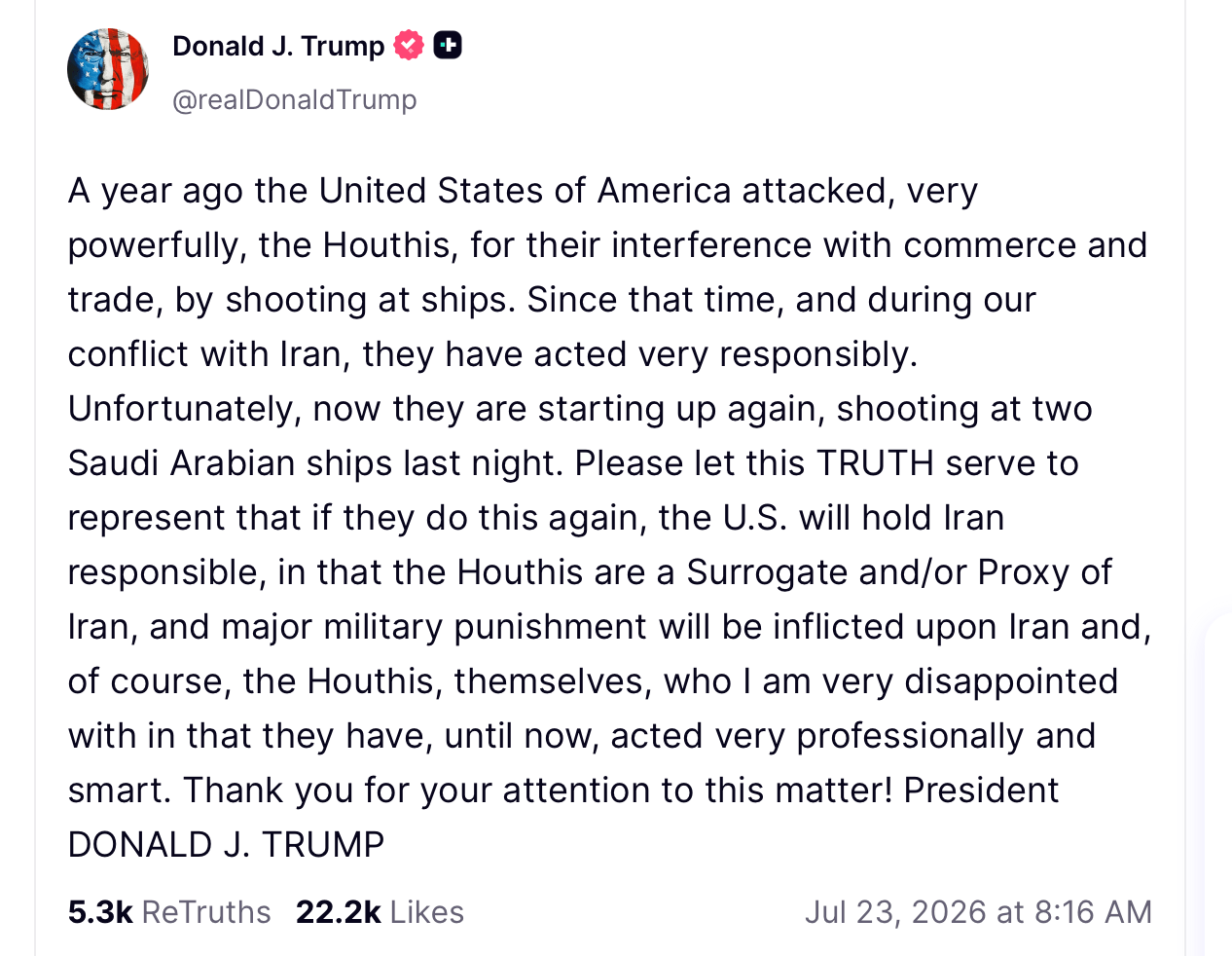 Trump’s Truth Social post on Thursday.
Trump had already warned he would destroy an Iranian bridge or power plant for every ship Iran struck in the Strait of Hormuz. He told Axios he was “considering a massive attack” on Iran, describing it as “bigger than ever before” and saying he was “close to making a decision.”
U.S. Central Command carried out its 12th consecutive night of strikes on Iranian drone and missile storage sites and air defenses. Iran responded through its Tasnim News Agency, warning it would retaliate against U.S.-linked infrastructure and energy assets in the region.
A War Now in Its Fifth Month
The conflict began on February 28 under the U.S. codename “Operation Epic Fury,” when American and Israeli forces struck Iranian military infrastructure and leadership, killing Supreme Leader Ali Khamenei. Iran answered with missile and drone attacks across the region and restricted traffic through the Strait of Hormuz, a route that normally carries about a fifth to a quarter of global seaborne oil.
Daily Hormuz transits fell from roughly 130 ships before the war to single or low double digits on some days. A ceasefire reached earlier in the summer collapsed in July, and strikes between U.S. and Iranian forces have since become a near-nightly occurrence.
Consumers and Markets Feel the Squeeze
AAA’s national average for regular gasoline reached $4.091 a gallon Thursday, up from $4.060 a day earlier. Diesel averaged about $5.21 a gallon. Crude prices typically reach the pump within a few days to two weeks, so further increases are likely if oil stays elevated.
The Dow fell roughly 600 points, and the 10-year Treasury yield climbed above 4.70% as inflation expectations firmed. European Central Bank President Christine Lagarde pointed to the Houthi attacks as a factor darkening Europe’s economic outlook. International Energy Agency chief Fatih Birol said restoring normal flows through Hormuz remains essential.
RBC Capital Markets strategist Helima Croft emphasized that the war has entered a more dangerous phase, with fighting spreading to the Red Sea and Iran potentially targeting Gulf desalination plants. She said Brent could retest its 2022 high near $128, or even approach the 2008 peak above $146, if the conflict escalates further. Saudi Arabia can reroute some crude westward to its Yanbu terminal on the Red Sea, but that corridor is now under direct threat.
Traders are watching shipping data, strike reports and any sign of diplomacy, with Oman mentioned as a potential mediator, in the days ahead.



 English (US) ·