
 2 months ago
100
2 months ago
100
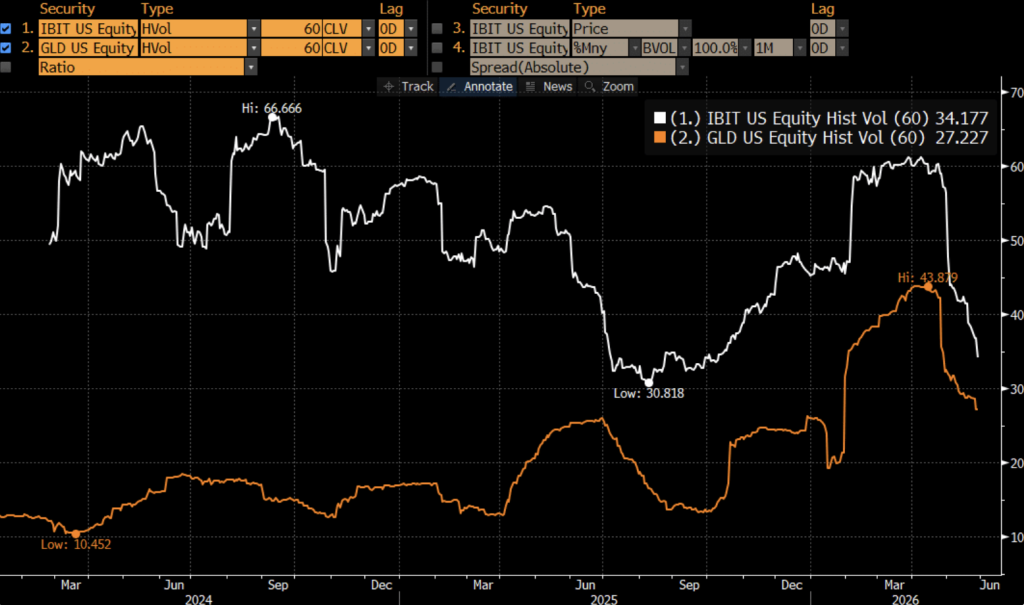
- Bitcoin’s volatility has fallen significantly and is gradually moving closer to gold’s volatility profile.
- Institutional investors may view this shift positively as they seek alternative assets for diversification rather than high-risk growth.
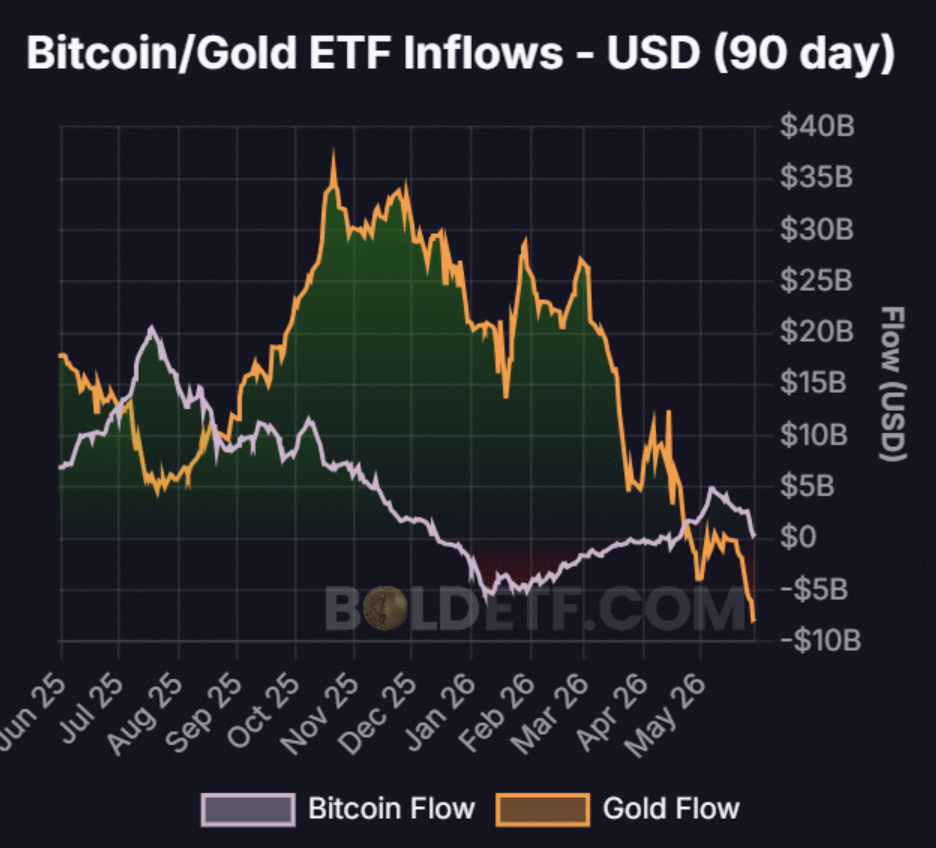
- ETF outflows from both Bitcoin and gold suggest demand for macro hedges has cooled amid improving geopolitical expectations.
For years, one of the biggest criticisms directed at Bitcoin was simple: it was too volatile. Financial advisors, wealth managers, and institutional investors often argued that BTC’s dramatic price swings made it unsuitable as a serious hedge or alternative to traditional safe-haven assets like gold. That narrative may be starting to change.
According to Bloomberg ETF analyst Eric Balchunas, the volatility gap between Bitcoin and gold has narrowed considerably, a trend he believes is receiving far less attention than it deserves. While both assets have experienced a challenging period recently, the reduction in volatility could actually be one of the more important developments happening beneath the surface.
Balchunas pointed out that Bitcoin’s 60-day volatility, measured through BlackRock’s iShares Bitcoin Trust (IBIT), has fallen sharply from above 60 to roughly 35. Gold has also become less volatile, with its corresponding ETF dropping from around 43 to near 25. The difference still exists, but the gap is noticeably smaller than it was just a few years ago.
Institutions May Prefer Stability Over Massive Returns
The shift matters because large investors often approach Bitcoin very differently than retail traders. Many crypto enthusiasts dream of explosive gains, but institutions tend to think in a different way. They already have access to growth-focused investments through technology stocks, venture capital, and other risk assets.
What many of them want instead is diversification.
According to Balchunas, conversations with major ETF industry participants suggest that institutional investors are becoming increasingly interested in Bitcoin as a genuine alternative asset rather than simply a high-risk growth trade. In their view, Bitcoin’s long-term appeal strengthens if it begins behaving more like gold and less like a speculative tech stock.
That distinction is important. Diversification works best when assets behave differently from one another, and if Bitcoin can maintain strong performance while gradually reducing its volatility profile, it may become more attractive to pension funds, advisors, and large portfolio managers seeking alternatives outside traditional markets.
Whether Bitcoin eventually reaches gold-like volatility remains an open question. Still, the trend is moving in that direction, and that’s something many institutional investors are watching closely.
ETF Outflows Reflect Cooling Demand for Macro Hedges
Interestingly, the shrinking volatility gap has arrived alongside declining demand for both Bitcoin and gold ETFs. Earlier in May, Bitcoin ETF inflows exceeded $5 billion, reflecting strong investor appetite for the asset. Since then, those flows have slowed dramatically, with net inflows dropping close to flat.
Gold has experienced an even larger shift. During the same period, gold ETFs reportedly recorded nearly $8 billion in outflows as investors reduced exposure to traditional safe-haven assets.
Analysts at JPMorgan, led by Nikolaos Panigirtzoglou, believe the trend reflects a cooling of what they describe as the “debasement trade.” This trade gained popularity during periods of heightened geopolitical uncertainty and inflation concerns, particularly as tensions in West Asia fueled fears of energy market disruptions.
At the height of those concerns, investors rushed toward assets viewed as protection against currency debasement, inflation, and macroeconomic instability. Bitcoin and gold were among the biggest beneficiaries of that shift. Now, however, expectations surrounding a potential U.S.-Iran agreement have reduced some of those fears, causing demand for defensive assets to ease.
Bitcoin’s Relationship With Gold May Offer Clues About the Bottom
Despite recent weakness, some market observers believe Bitcoin could be approaching an important turning point. At the time of writing, BTC was trading near $73,500, roughly 11% below its second-quarter high of $82,800.
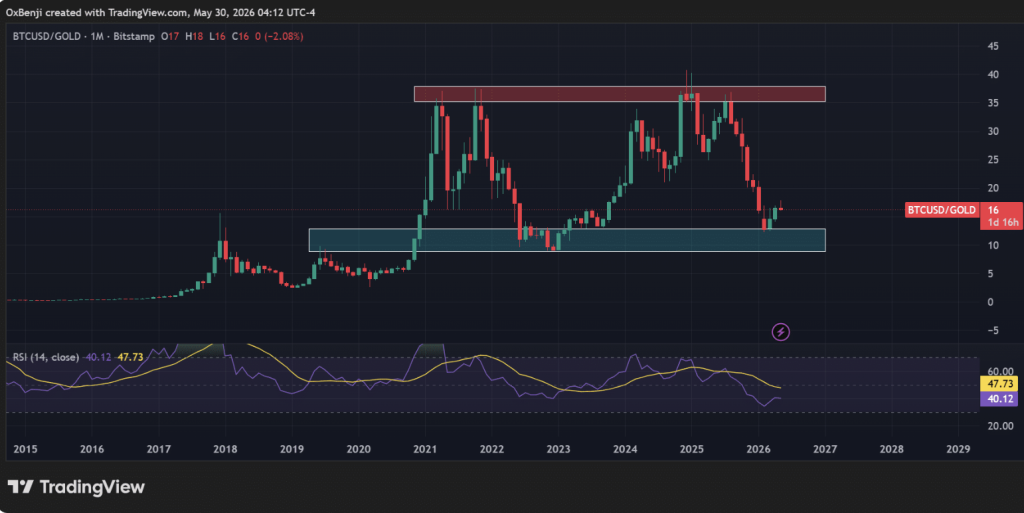
While the correction has frustrated bullish investors, historical data suggests there may be reasons for cautious optimism. One metric attracting attention is the Bitcoin-to-gold ratio, which compares Bitcoin’s value relative to gold. Historically, this ratio has provided useful signals during major market cycles.
During the 2022 bear market, Bitcoin eventually found support when the BTC-to-gold ratio approached the 10 level. Some analysts believe a similar pattern may be developing again, hinting that the worst of the current correction could be nearing its end.
Of course, no single indicator can predict market bottoms with certainty. Crypto markets remain heavily influenced by macroeconomic conditions, investor sentiment, regulatory developments, and liquidity flows. Still, the historical relationship between Bitcoin and gold continues offering valuable context as traders search for clues about where the market may head next.
Bitcoin’s Evolution Into an Alternative Asset Continues
What makes the current environment particularly interesting is that Bitcoin’s story appears to be evolving. The asset is no longer viewed exclusively as a speculative bet by every corner of the market. Increasingly, institutions are evaluating it through the lens of portfolio construction, diversification, and long-term risk management.
That doesn’t mean Bitcoin has become gold. Not yet, anyway. The two assets still behave differently in many situations, and Bitcoin remains significantly more volatile overall. Yet the gap continues narrowing, and that trend alone could reshape how large investors think about digital assets in the years ahead.
For now, ETF flows may be slowing and macro hedge demand may be cooling. But beneath those short-term shifts, a more subtle transformation may be taking place. Bitcoin is gradually becoming less of an outlier and more of an established alternative asset, one volatility cycle at a time.
Disclaimer: BlockNews provides independent reporting on crypto, blockchain, and digital finance. All content is for informational purposes only and does not constitute financial advice. Readers should do their own research before making investment decisions. Some articles may use AI tools to assist in drafting, but every piece is reviewed and edited by our editorial team of experienced crypto writers and analysts before publication.






 English (US) ·