
 8 months ago
122
8 months ago
122
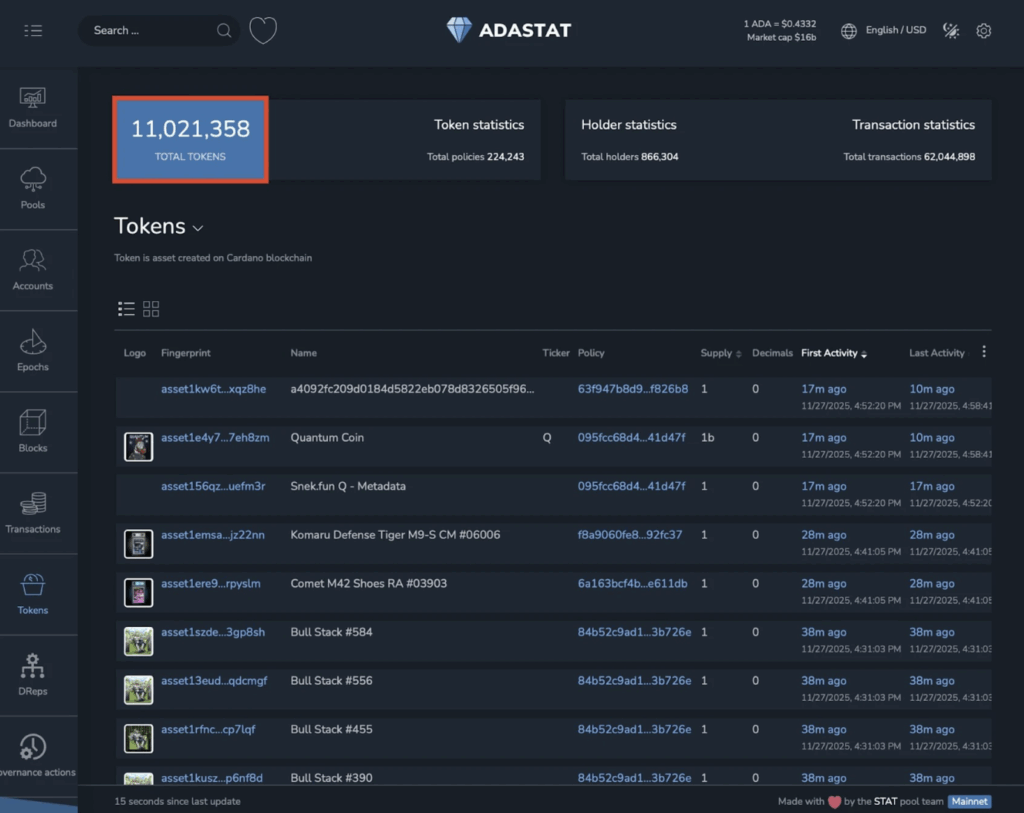
- Cardano passes 11M token policies driven by memecoins, NFTs, DeFi tests, and lightweight micro-projects.
- A ₳70M integrations budget is now under governance voting for 2026 ecosystem preparation.
- Five critical pillars include stablecoins, custody, analytics, bridges, and global-grade oracles.
Cardano has officially passed 11 million token policies, a milestone that reflects how active its base layer has quietly become. This growth comes from all sorts of experiments — memecoins, community tokens, NFTs, tiny DeFi trials, and a flood of micro-projects that keep launching straight on Cardano without needing smart contracts at all.
Because Cardano lets creators mint and manage tokens directly at the protocol level, developers have been free to experiment without dealing with expensive gas fees or complex contract logic. It’s one reason Cardano has stayed active even during periods where other networks slowed down or became too costly to use. Token-policy data shows that a slice of builders, collectors, and communities prefer Cardano for its low, predictable fees and its simple token rules that don’t break every few months.
₳70M integrations budget enters governance review
Intersect announced that the Cardano Critical Integrations Budget — a large initiative preparing the ecosystem for 2026 — has now been posted online for review. Delegated Representatives and the Constitutional Committee will evaluate it and cast their governance votes.
The budget outlines how Input Output, EMURGO, the Cardano Foundation, Intersect, and the Midnight Foundation are coordinating, especially following last week’s major mainnet event. Under the plan, ₳70,000,000 from the Treasury will support a single integrations program focused on missing infrastructure and strategic gaps that Cardano needs to fill.
This includes stable-money frameworks, improved liquidity pathways, institutional support systems, and integrations for real-world assets and DePIN projects. Several of these integrations are already in conversations with large industry partners, meaning community approval could kickstart a very real development cycle — with oversight handled by Intersect as the administrator. Their board, mostly elected by the community, has already endorsed the role.
The five integration pillars shaping Cardano’s next chapter
The Critical Integrations Budget highlights five major categories that will guide Cardano’s next phase:
1. Tier-one stablecoins
These are essential for DeFi, liquidity markets, and real-world payments. Cardano needs them at scale, and this pillar aims to finally deliver that.
2. Institutional-grade custody and wallets
If Cardano wants banks, fintechs, and large enterprises participating, it needs secure, compliant custody solutions — and that’s what this category targets.
3. Advanced on-chain analytics
Regulators, enterprises, and serious DeFi users need real-time, transparent data. This pillar focuses on building that visibility into the ecosystem.
4. High-quality cross-chain bridges
Liquidity has to move. Users have to move. Cardano must be able to interconnect cleanly with larger ecosystems, and this section addresses exactly that.
5. World-recognized oracles
Stablecoins, real-world asset trading, and complex DeFi all rely on precise external data feeds. Cardano needs top-tier oracle integrations to keep up.
Closing thoughts
Passing 11 million token policies shows how active Cardano’s foundation layer has become — and the ₳70M integrations budget marks the beginning of its next major expansion cycle. If the community approves the proposal, Cardano could be heading into a phase where infrastructure finally catches up with the network’s long-term vision. Here is where the next chapter starts to take shape.
The post Cardano Crosses 11 Million Token Policies — Here Is Why This Milestone Matters for Its Next Phase of Growth first appeared on BlockNews.









 English (US) ·