
 2 months ago
81
2 months ago
81
- Charles Hoskinson says 1,096 BTC from Cardano’s early fundraising period was used to pay for an independent audit.
- Investor Thomas Braziel remains unconvinced and is calling for supporting documents and payment records.
- The controversy arrives as Cardano faces broader debates over governance, treasury spending, and community direction.
The debate surrounding Cardano’s early treasury funds is heating up again, with founder Charles Hoskinson addressing questions about a long-disputed stash of 1,096 Bitcoin linked to the project’s crowdfunding years.
During a recent livestream AMA, Hoskinson pushed back against growing criticism and attempted to clarify where the funds went. According to him, the Bitcoin allocation was used years ago to pay for auditing work related to Cardano’s original token sale, not for anything improper as some critics have suggested.
Still, not everyone is satisfied with that explanation.
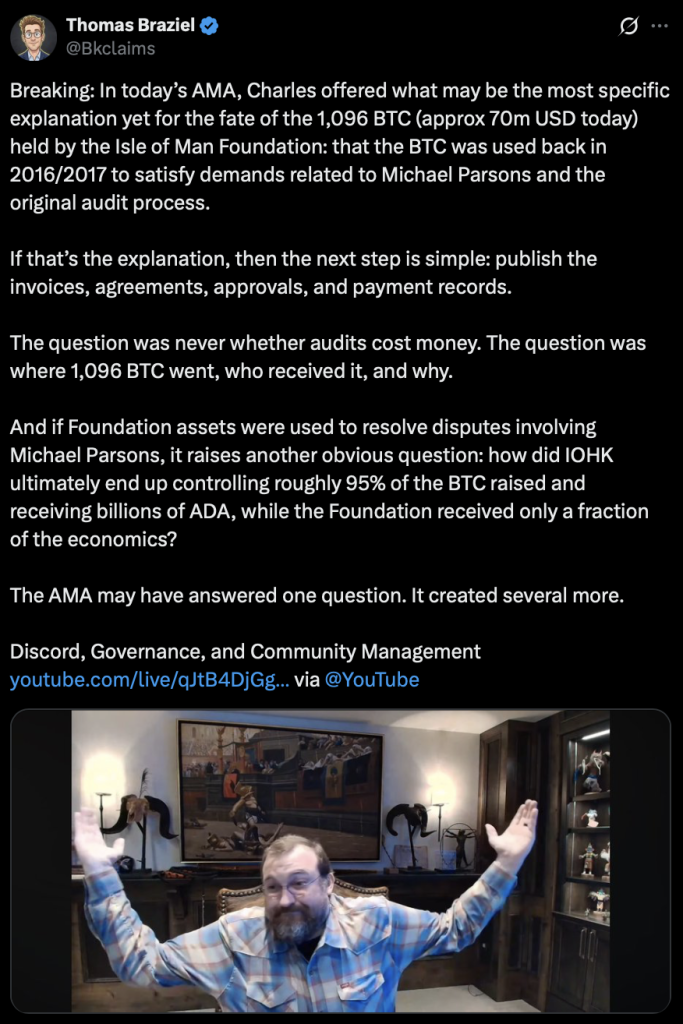
Hoskinson Explains the 1,096 BTC Transaction
The controversy centers around Cardano’s crowdfunding campaign, which ran between October 2015 and January 2017. During that period, the project raised roughly 108,844 BTC, making it one of the largest crypto fundraising efforts of its time.
Out of that total, 1,096 BTC was allocated to an Isle of Man Foundation entity involved in some of Cardano’s early legal and operational activities. The organization no longer exists, but questions about the funds have resurfaced recently.
Investor and 117 Partners founder Thomas Braziel publicly challenged the transaction, asking why the funds were transferred and requesting a full breakdown of how they were ultimately spent.
Hoskinson responded during his weekend AMA, explaining that the matter dates back to an email sent by former Cardano Chairman Michael Parsons in March 2016. According to Hoskinson, Parsons requested compensation for auditing the crowdsale process.
At the time, Bitcoin was trading around $414.
“The closing price of Bitcoin on March 13, 2016, was about $414,” Hoskinson said. “That works out to roughly $400,000 for three auditors.”
He stated that the payments were distributed among three independent reviewers: Michael Parsons, John McGuire, and Bruce Milligan.
Transparency Questions Refuse to Go Away
While Hoskinson believes the explanation is straightforward, he also expressed frustration with what he sees as an endless cycle of accusations.
According to him, every attempt to provide clarification simply creates another round of criticism, pulling resources and attention away from Cardano’s development efforts. He argued that some of the demands for transparency are less about finding answers and more about fueling controversy.
That criticism, however, has done little to quiet skeptics.
Braziel quickly responded after the AMA, saying the explanation actually raised more questions than it answered. He questioned how IOHK ultimately gained control of roughly 95% of the Bitcoin raised during the crowdsale while receiving billions of ADA, whereas the Foundation ended up with a much smaller share.
For Braziel, the solution is simple.
“If that’s the explanation, then publish the invoices, agreements, approvals, and payment records,” he argued on social media.
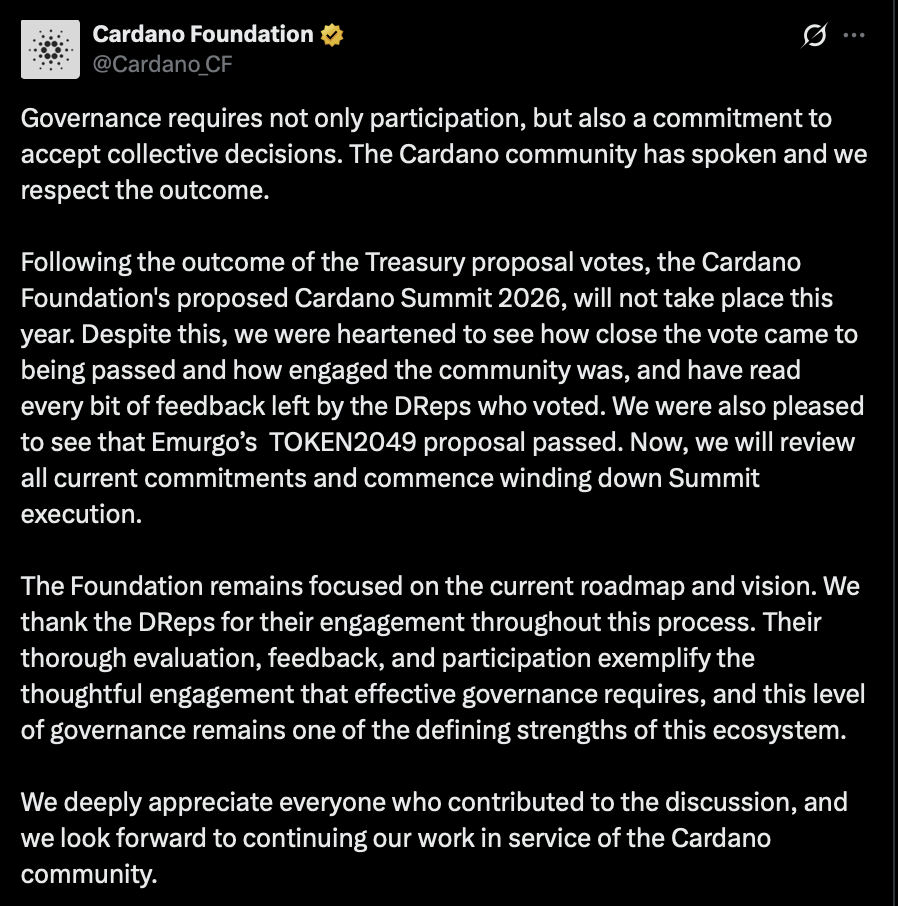
Disagreement Over the Numbers
Part of the disagreement centers on timing.
Braziel believes the valuation presented by Hoskinson may not accurately reflect when the audit work actually occurred. If the audit happened later than claimed, Bitcoin’s market price would have been substantially higher, potentially changing the true value of the payments.
In his view, the math still doesn’t fully line up.
The dispute highlights a broader challenge facing many long-running crypto projects. Early fundraising decisions that seemed routine at the time are now being reexamined years later, often through the lens of today’s much larger valuations and stricter expectations around transparency.
Cardano Faces Broader Governance Challenges
The BTC controversy arrives during a particularly sensitive period for the Cardano ecosystem.
Governance discussions have intensified across the community, with treasury spending, voting processes, and community engagement all coming under scrutiny. Hoskinson recently revealed plans to shift much of Cardano’s community activity toward Discord, arguing that current social media environments have become increasingly difficult to manage.
Meanwhile, the Cardano Foundation’s budget process has sparked fresh debate. Only a fraction of submitted proposals have received approval under the new governance framework, leading to frustration among some community members.
One of the most visible examples came when organizers canceled the planned 2026 Singapore Summit after a proposed ADA treasury allocation worth approximately $7.8 million was rejected.
Taken together, these disputes show that Cardano’s conversations are no longer focused solely on technology and development. Governance, accountability, and treasury management are becoming just as important to the project’s future.
Disclaimer: BlockNews provides independent reporting on crypto, blockchain, and digital finance. All content is for informational purposes only and does not constitute financial advice. Readers should do their own research before making investment decisions. Some articles may use AI tools to assist in drafting, but every piece is reviewed and edited by our editorial team of experienced crypto writers and analysts before publication.



 English (US) ·