
 1 month ago
30
1 month ago
30
- Cardano whales accumulated roughly $35 million worth of ADA in recent days
- DeFi total value locked on Cardano rose about 22% to $140 million
- A head-and-shoulders pattern could signal up to 20% downside if support breaks
Cardano hasn’t had the easiest start to 2026. The price of ADA is down roughly 22% since the beginning of the year, and technical signals still suggest the broader downtrend may not be finished yet. On the surface, the charts don’t look particularly encouraging.
But underneath the noise, something interesting is happening. Large Cardano whales have quietly accumulated around $35 million worth of ADA in recent days. That timing is raising eyebrows, especially since it coincides with a new ecosystem token listing. The obvious question now is whether these large investors are positioning early… even while the charts remain bearish.
Hidden Bearish Divergence Still Threatens the Trend
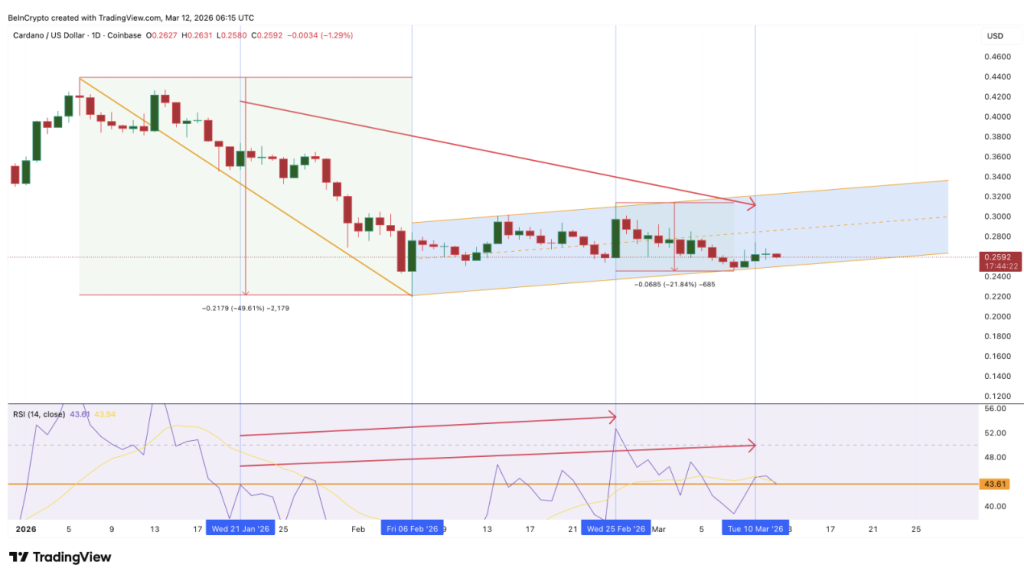
Cardano has been moving inside an ascending channel since early February. At first glance, that kind of structure can look bullish because price slowly climbs between two parallel trendlines. But context matters here.
Before this channel appeared, ADA dropped nearly 50% between January 6 and February 6. Because of that, the current upward structure may simply represent a recovery phase rather than a true reversal. In other words, the market could just be catching its breath before deciding what comes next.
Momentum indicators add another layer of caution. Between January 21 and March 10, Cardano’s price formed a lower high while the Relative Strength Index (RSI) pushed to a higher high.
That mismatch creates what traders call a hidden bearish divergence. Typically, that pattern hints that the broader downtrend may still continue even if prices temporarily stabilize. The same signal appeared earlier this year, and shortly after… ADA dropped more than 21%.
Now the signal is back again.
Whales Accumulate $35 Million in ADA
Despite the warning signs from technical indicators, large holders have been increasing their positions.
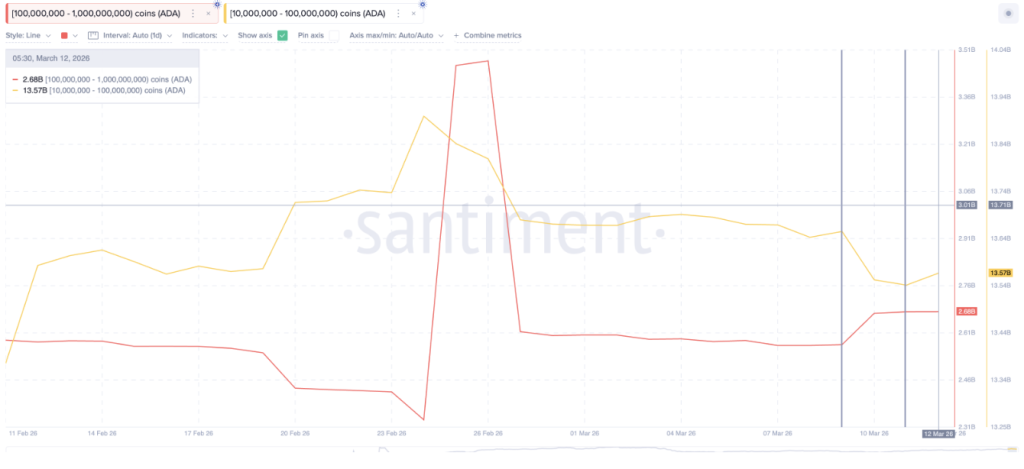
Blockchain data shows that wallets holding between 100 million and 1 billion ADA expanded their holdings from roughly 2.57 billion ADA on March 9 to about 2.68 billion ADA. That’s an addition of around 110 million coins.
Another whale group — wallets holding between 10 million and 100 million ADA — initially reduced their holdings but began buying again around March 11. Their balances climbed from about 13.54 billion ADA to roughly 13.57 billion ADA.
Combined, these groups added roughly 140 million ADA, worth close to $35 million at current prices.
The timing is notable. The first wave of accumulation started around March 9, and the second group resumed buying around March 11 — right when a new ecosystem token received a full spot listing on Binance.
Ecosystem Developments May Be Driving Whale Interest
The token in question, called NIGHT, is tied to Midnight — a privacy-focused sidechain connected to the Cardano ecosystem. Midnight aims to introduce privacy-enabled smart contracts while remaining interoperable with the main Cardano network.
That development could explain why whales started accumulating even while the charts remain uncertain. Large investors often position themselves around ecosystem developments rather than short-term price action.
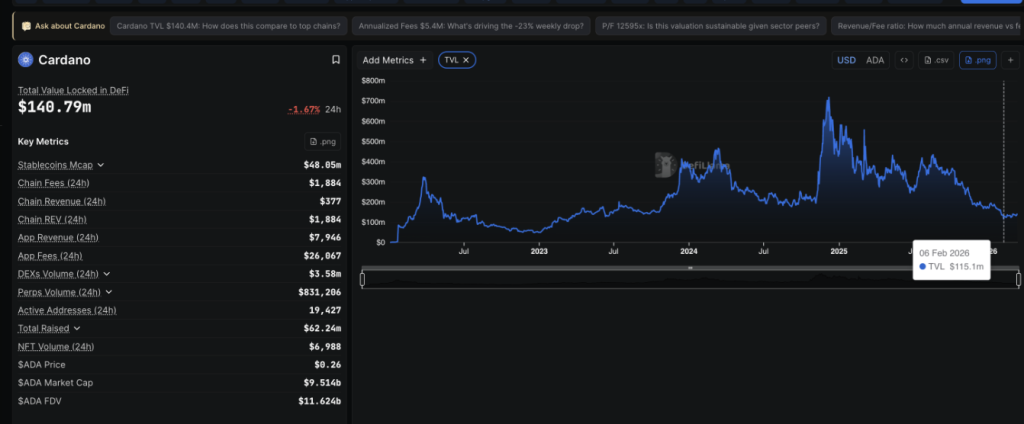
Network fundamentals have also shown some improvement recently. Cardano’s total value locked (TVL) in decentralized finance has increased from around $115 million to roughly $140 million over the past few weeks — a rise of nearly 22%.
TVL measures how much capital is locked into DeFi applications and is often used as a signal of network activity. The increase isn’t massive, but it does show signs of gradual growth.
Traders Stay Cautious While Leverage Drops
Even with whale accumulation and improving ecosystem signals, the broader market still appears cautious.
Spot exchange flows remain relatively quiet. Daily inflows and outflows have mostly stayed below $1 million, suggesting many traders are sitting on the sidelines and waiting for clearer signals.
The derivatives market paints a similar picture. Cardano open interest — which measures the total value of outstanding futures contracts — has dropped from roughly $550 million in late February to about $440 million today.
That’s a decline of nearly 20%.
When open interest falls, it usually means leveraged traders are closing positions and reducing exposure. Lower leverage can actually make markets more stable because fewer forced liquidations occur during volatility.
Interestingly, that stability might also explain why whales feel comfortable accumulating.
Bearish Chart Pattern Still Signals Possible 20% Drop
Shorter-term charts still show potential downside risk, though. On the 8-hour timeframe, Cardano appears to be forming a head-and-shoulders pattern — a classic bearish structure that often precedes further declines.
The critical level to watch is the neckline, which currently sits just above $0.240.
If ADA breaks below that level, the pattern could activate. The first downside target would sit around $0.206, while the full measured move points closer to $0.195 — representing nearly 20% downside.
Of course, bearish setups can always fail. A move above $0.274 would weaken the structure, while a stronger breakout above $0.313 would invalidate the head-and-shoulders pattern completely.
For now, Cardano sits in an unusual spot. Whale accumulation and ecosystem growth hint at long-term optimism, yet the charts still lean bearish.
Markets sometimes do that. Two narratives pulling in opposite directions… until eventually one wins.
Disclaimer: BlockNews provides independent reporting on crypto, blockchain, and digital finance. All content is for informational purposes only and does not constitute financial advice. Readers should do their own research before making investment decisions. Some articles may use AI tools to assist in drafting, but every piece is reviewed and edited by our editorial team of experienced crypto writers and analysts before publication.




 English (US) ·