
 1 month ago
52
1 month ago
52
- Cardano continues offering some of the lowest transaction fees among major blockchains, even as network activity increases.
- The network has become more decentralized, while Bitwise’s proposed crypto ETF could boost institutional exposure to ADA.
- Although Cardano’s fundamentals remain strong, ADA still faces key resistance levels before a sustained price recovery can begin.
Cardano may not be leading the market in price performance, but its blockchain continues moving in the right direction.
While ADA has struggled to build momentum over recent weeks, the network itself is quietly improving across several important areas. Transaction costs remain extremely low, decentralization continues to strengthen, and institutional interest appears to be growing as investment firms explore new crypto products that include ADA.
It’s another reminder that price and network development don’t always move together.
Cardano Keeps Transaction Fees Exceptionally Low
One of Cardano’s biggest advantages continues to be its low operating costs.
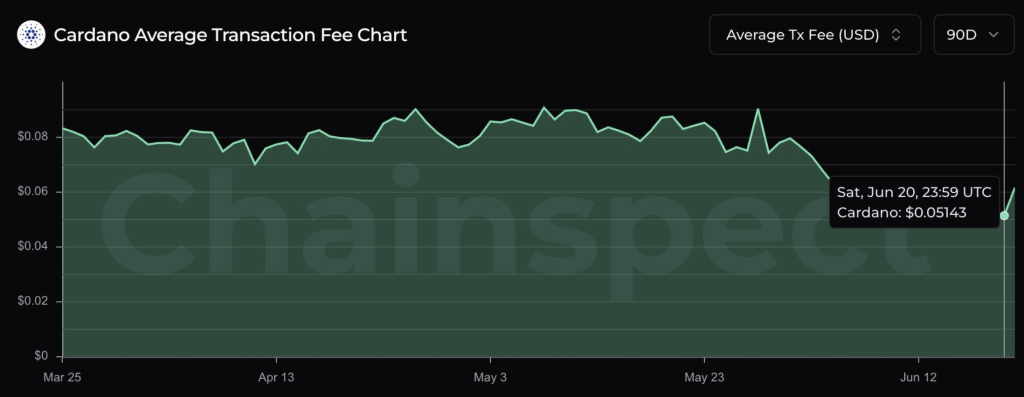
According to blockchain researcher MB, data from Chainspect shows transaction fees have remained remarkably stable over the past three months, generally fluctuating between $0.07 and $0.09.
That’s notable because many blockchain networks experience sharp spikes in fees whenever activity increases.
Cardano has largely avoided that problem.
Even during periods of heavier DeFi usage, NFT transactions, and staking activity, fees only briefly approached the upper end of that range before falling again.
By June 20, the average transaction fee had dropped to approximately $0.051, representing a decline of roughly 35% compared to the earlier average near $0.08.
Although fees have edged slightly higher since then, they remain among the lowest across major blockchain networks.
For users and developers, lower costs make Cardano a more attractive platform for regular transactions and decentralized applications.
ADA Still Faces Technical Challenges
The blockchain may be performing well, but ADA’s chart tells a more cautious story.
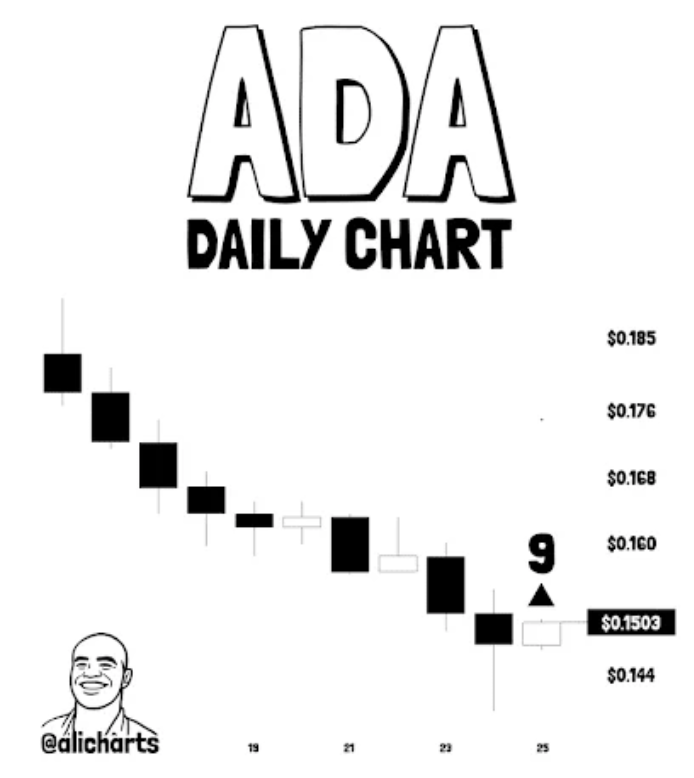
According to crypto analyst Ali Charts, the daily chart recently generated a TD Sequential buy signal following the security incident that saw approximately 129 million ADA, worth roughly $20 million, stolen from Cardano wallets.
Buy signals often suggest selling pressure may be fading, but analysts are urging caution.
A recovery could easily run into strong resistance between $0.160 and $0.176, an area where sellers have repeatedly stepped in before.
The broader trend also remains bearish.
ADA continues forming a pattern of lower highs and lower lows, which generally indicates sellers still control the larger market structure. At the time of analysis, the token was trading around $0.150 while holding above support near $0.144.
As long as that bearish structure remains intact, any short-term rally could face significant obstacles.
Decentralization Continues Improving
Away from price charts, Cardano continues making progress in one of the areas it has long prioritized: decentralization.
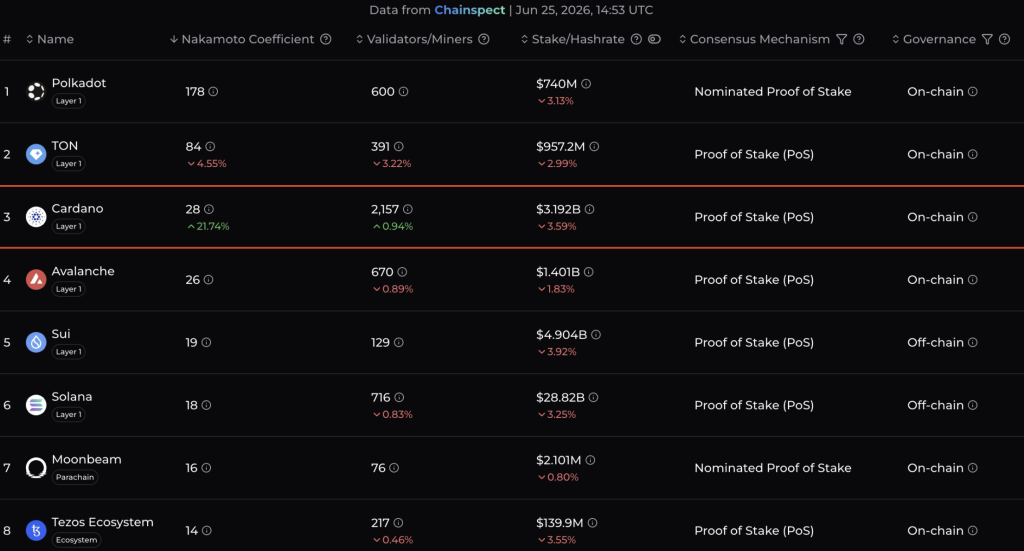
According to Chainspect, Cardano’s Nakamoto Coefficient has climbed to 28, allowing the network to move ahead of Avalanche and become the third most decentralized blockchain currently tracked under that metric.
The Nakamoto Coefficient measures how many independent entities would need to coordinate in order to compromise a blockchain.
A higher number generally indicates a more decentralized and resilient network.
With a score of 28, Cardano now requires more independent participants to act together before the network’s security could theoretically be threatened, strengthening its overall resilience.
Institutional Interest Could Continue Growing
Cardano may also receive additional attention from institutional investors.
According to market analyst Cheeky Crypto, Bitwise plans to launch a diversified cryptocurrency ETF containing ten digital assets, with ADA expected to be included among them.
If approved, the fund would provide traditional investors with another regulated avenue to gain exposure to Cardano without directly purchasing the cryptocurrency.
While inclusion in an ETF doesn’t guarantee immediate price gains, it often improves visibility and can increase long-term institutional participation over time.
Can ADA Turn Strong Fundamentals Into Price Growth?
For now, traders remain focused on one key question.
Can Cardano’s improving fundamentals eventually translate into stronger price performance?
The first challenge is technical.
ADA needs to establish support before breaking above the important resistance zone between $0.160 and $0.176. Clearing that area would represent a meaningful improvement in market structure after several weeks of weakness.
Beyond price action, investors will likely continue monitoring Cardano’s network growth, its steady progress toward greater decentralization, and developments surrounding Bitwise’s proposed ETF.
Those factors may not move the market overnight, but together they continue strengthening the long-term case for the Cardano ecosystem, even while ADA itself remains under pressure.
Disclaimer: BlockNews provides independent reporting on crypto, blockchain, and digital finance. All content is for informational purposes only and does not constitute financial advice. Readers should do their own research before making investment decisions. Some articles may use AI tools to assist in drafting, but every piece is reviewed and edited by our editorial team of experienced crypto writers and analysts before publication.






 English (US) ·