
 1 month ago
66
1 month ago
66
- Charles Hoskinson is testing a new wallet recovery smart contract that uses zero-knowledge proofs to restore access without revealing recovery phrases.
- The experiment comes as Cardano prepares for its biggest protocol upgrade since staking launched in 2020.
- Despite ADA trading near multi-year lows, on-chain activity and community engagement continue to trend higher.
Cardano founder Charles Hoskinson has unveiled an early experiment that could eventually change how crypto users recover lost wallets. Instead of relying on traditional methods that expose a wallet’s recovery phrase, the new concept uses zero-knowledge proofs, allowing users to prove ownership without revealing sensitive information.
The announcement arrives at an interesting time. Cardano’s price has struggled for months, yet developer activity across the network hasn’t slowed down. If anything, it’s picking up.
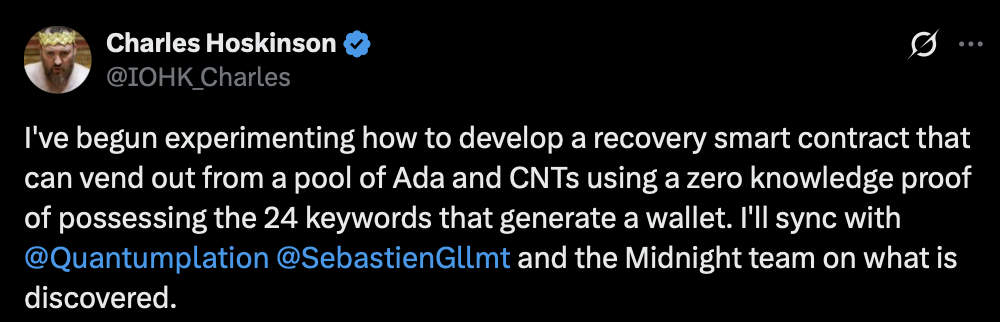
Charles Hoskinson Experiments With Zero-Knowledge Wallet Recovery
Hoskinson revealed on X that he has started testing a wallet recovery smart contract designed to securely release ADA and Cardano Native Tokens after verifying ownership through a zero-knowledge proof.
The concept is fairly simple, at least in theory.
Rather than entering or exposing a 24-word recovery phrase, users would generate cryptographic proof confirming they possess the correct seed phrase. The smart contract verifies that proof, then unlocks access to the associated assets—all without the recovery words ever being revealed.
If successful, the approach could significantly improve wallet security while reducing one of the biggest risks in self-custody: exposing recovery phrases during the recovery process.
Hoskinson also confirmed he plans to collaborate with Quantumplation, Sebastien Guillemot, and the Midnight development team as testing continues.
The announcement quickly sparked discussion throughout the Cardano community. Some users wondered whether the technology could eventually become a standard recovery solution across Web3 wallets.
Hoskinson poured a bit of cold water on that idea.
According to him, the project isn’t intended to become a universal wallet recovery feature. Instead, it’s specifically aimed at addressing what he described as the “white hat issue,” though he stopped short of explaining exactly what that means in practice.
For now, the project remains experimental, and no timeline has been shared for a public release.
Cardano’s Biggest Upgrade Since Shelley Draws Closer
The wallet recovery experiment isn’t the only major development happening inside the Cardano ecosystem.
Crypto analyst Dan Gambardello recently highlighted the launch of the Musashi Dojo public testnet for Ouroboros Leios, calling it the most significant Cardano upgrade since the Shelley hard fork introduced staking back in July 2020.
According to Gambardello, major blockchain networks can’t afford to stand still. Continuous upgrades are necessary if they hope to handle larger user bases and increasing transaction demand over the coming years.
He argued that infrastructure improvements deserve just as much attention as price action—perhaps even more.
The Musashi Dojo testnet gives developers a live environment to stress-test Leios before it eventually reaches the main network. If successful, the upgrade is expected to improve transaction throughput and overall network efficiency.
For long-term Cardano supporters, that’s arguably a much bigger story than the daily price chart.
Network Activity Rises Even as ADA Price Struggles
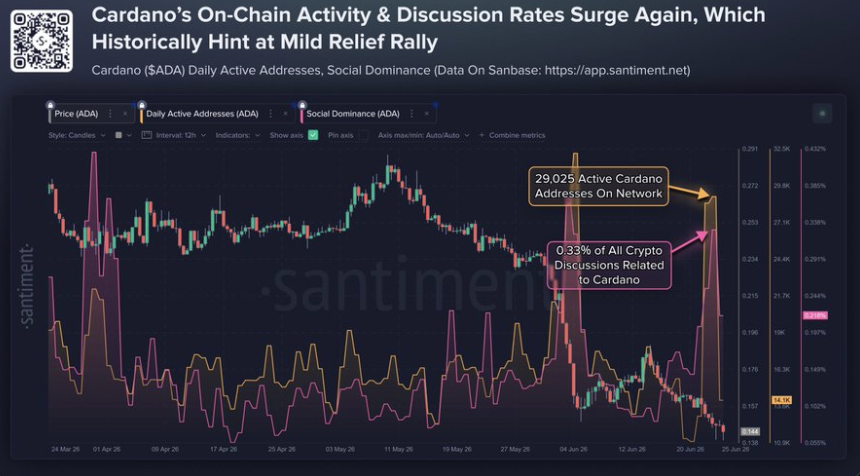
Although ADA continues trading near its lowest levels since late 2020, on-chain data paints a more encouraging picture.
Figures from Santiment show daily active addresses have jumped for the second time this month, while social media conversations surrounding Cardano have also increased noticeably.
That combination suggests user engagement remains surprisingly resilient despite weak market sentiment.
Santiment attributed much of the recent attention to several high-profile developments, including Hoskinson’s comments that more Cardano projects could fail, his decision to step back from some of his public-facing responsibilities, and ongoing debates surrounding treasury funding within the community.
Those headlines have undoubtedly fueled bearish discussions.
At the same time, they’ve also brought Cardano back into the spotlight.
Interestingly, Santiment noted that previous spikes in active addresses and social activity have often been followed by short-term relief rallies. Whether history repeats itself this time remains uncertain, but traders are paying attention.
For now, Cardano sits at an interesting crossroads.
Developers continue building new infrastructure behind the scenes, the Leios upgrade moves closer to reality, and innovative security experiments like Hoskinson’s wallet recovery project continue pushing the ecosystem forward. Meanwhile, investors are watching closely to see whether improving network fundamentals can eventually translate into stronger ADA price performance.
Disclaimer: BlockNews provides independent reporting on crypto, blockchain, and digital finance. All content is for informational purposes only and does not constitute financial advice. Readers should do their own research before making investment decisions. Some articles may use AI tools to assist in drafting, but every piece is reviewed and edited by our editorial team of experienced crypto writers and analysts before publication.





 English (US) ·