
 3 months ago
69
3 months ago
69
- Cardano Summit 2026 has been canceled after a treasury funding proposal failed to reach the required approval threshold.
- The proposal received roughly 65% support but fell short of the 66.67% supermajority needed to unlock treasury funds.
- The outcome highlights both the strengths and challenges of Cardano’s decentralized governance system.
Cardano’s biggest annual event will not be happening in 2026. The Cardano Foundation has confirmed that Cardano Summit 2026, which was scheduled to take place in Singapore next October, has been canceled after the community rejected a treasury funding proposal needed to support the event.
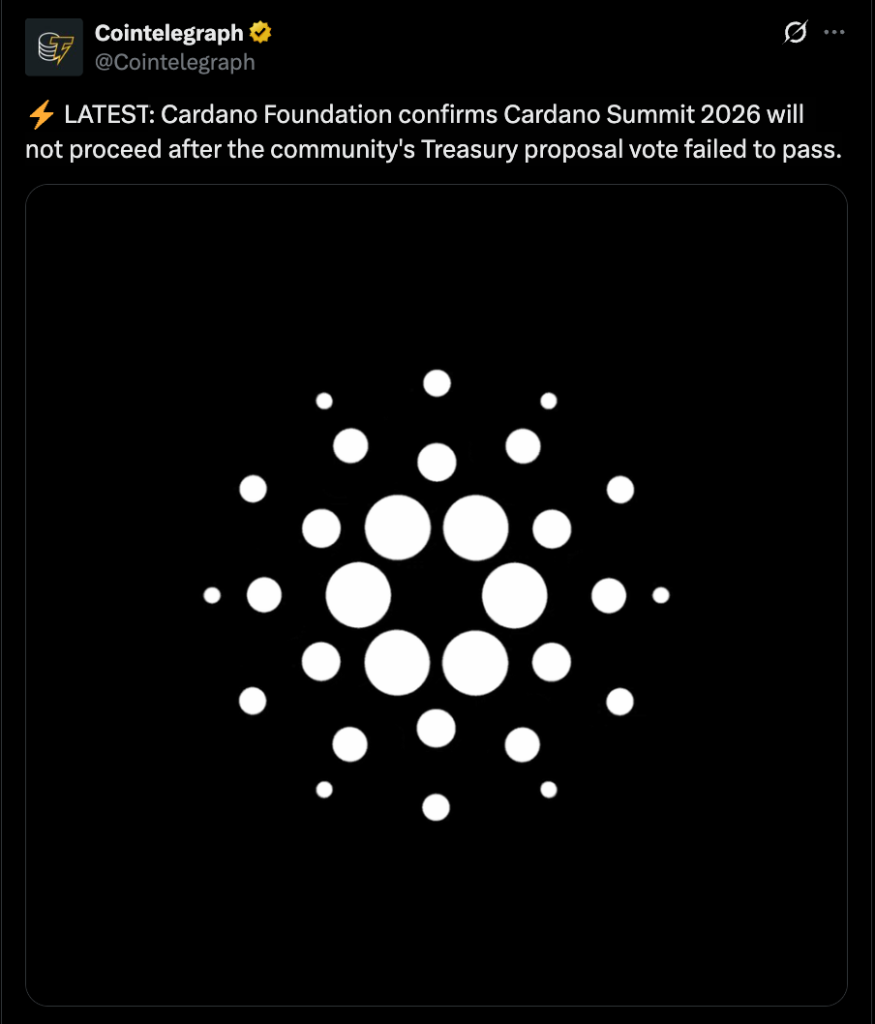
The revised proposal requested 7.8 million ADA, valued at roughly $2 million, from the Cardano treasury. While the measure secured approximately 65% support from Delegated Representatives, or DReps, it ultimately fell short of the 66.67% supermajority required for approval. As a result, the funding request failed, and the Foundation announced it would begin winding down preparations for the summit.
Decentralized Governance Comes With Consequences
For years, blockchain projects have promoted decentralized governance as one of the industry’s defining features. Cardano’s latest vote provided a very public example of what that actually means in practice.
Even with support from Cardano founder Charles Hoskinson and Cardano Foundation CEO Frederik Gregaard, the proposal was unable to cross the required threshold. The Foundation accepted the outcome and confirmed it would respect the community’s decision rather than seeking alternative ways to bypass the vote.
That is not always how governance discussions play out across crypto. Many projects promote decentralization in theory, but significant decisions are often heavily influenced by insiders. In this case, the community had the final say, and the answer was no.
Treasury Spending Faces Real Scrutiny
While some community members expressed disappointment over the cancellation, others viewed the result as evidence that Cardano’s governance framework is functioning exactly as intended. Treasury funds are not automatically available simply because leadership supports a proposal. Every major spending request must be evaluated and approved by the broader governance process.
That level of scrutiny is relatively rare across many blockchain ecosystems. Governance votes are sometimes criticized for low participation rates or predictable outcomes. Cardano’s latest decision demonstrated that treasury allocations can face genuine resistance, even when they involve one of the network’s highest-profile events.
The outcome may frustrate some supporters in the short term, but it also reinforces the idea that treasury resources belong to the community rather than a small group of decision-makers.
Governance Maturity Is Being Tested
As blockchain networks evolve, governance becomes increasingly important. Managing a treasury, allocating resources, and balancing competing priorities requires more than technology alone. It requires active participation and a willingness to make difficult decisions.
The Cardano Summit proposal highlighted that reality. Supporters of the event argued that it offered marketing value, community engagement, and ecosystem growth opportunities. Opponents questioned whether the cost justified the expenditure. Ultimately, enough voters remained unconvinced to prevent the proposal from reaching the required threshold.
These kinds of debates are likely to become more common as decentralized governance systems mature. The challenge is not simply giving communities voting power. It is ensuring those communities are willing to use it responsibly.
A Real Example of Decentralization in Action
The cancellation of Cardano Summit 2026 will undoubtedly disappoint many community members who hoped to attend the event. Yet the bigger story may be what the outcome says about the network itself. Cardano‘s governance system was tested on a highly visible proposal, and the result was accepted without controversy or intervention.
In an industry where decentralization is often discussed more than it is demonstrated, Cardano has provided a clear example of governance operating as designed. The community reviewed the proposal, weighed the costs and benefits, voted accordingly, and the Foundation respected the decision. Whether one agrees with the outcome or not, that process may ultimately strengthen confidence in Cardano’s governance model for years to come.
Disclaimer: BlockNews provides independent reporting on crypto, blockchain, and digital finance. All content is for informational purposes only and does not constitute financial advice. Readers should do their own research before making investment decisions. Some articles may use AI tools to assist in drafting, but every piece is reviewed and edited by our editorial team of experienced crypto writers and analysts before publication.





 English (US) ·