
 1 month ago
52
1 month ago
52
- CFTC Chair Michael Selig warned regulators will be forced to create crypto rules if Congress fails to pass the CLARITY Act.
- The legislation would divide oversight of digital assets between the CFTC and the SEC while creating a unified federal framework.
- Political disagreements and a shrinking Senate calendar continue to cloud the bill’s chances of passing this year.
The race to pass the CLARITY Act is entering a critical stage as lawmakers face a narrowing legislative window before Congress’s August recess. CFTC Chair Michael Selig warned that if lawmakers fail to approve the long-awaited crypto market structure bill, federal regulators will effectively be left to write the rules themselves.
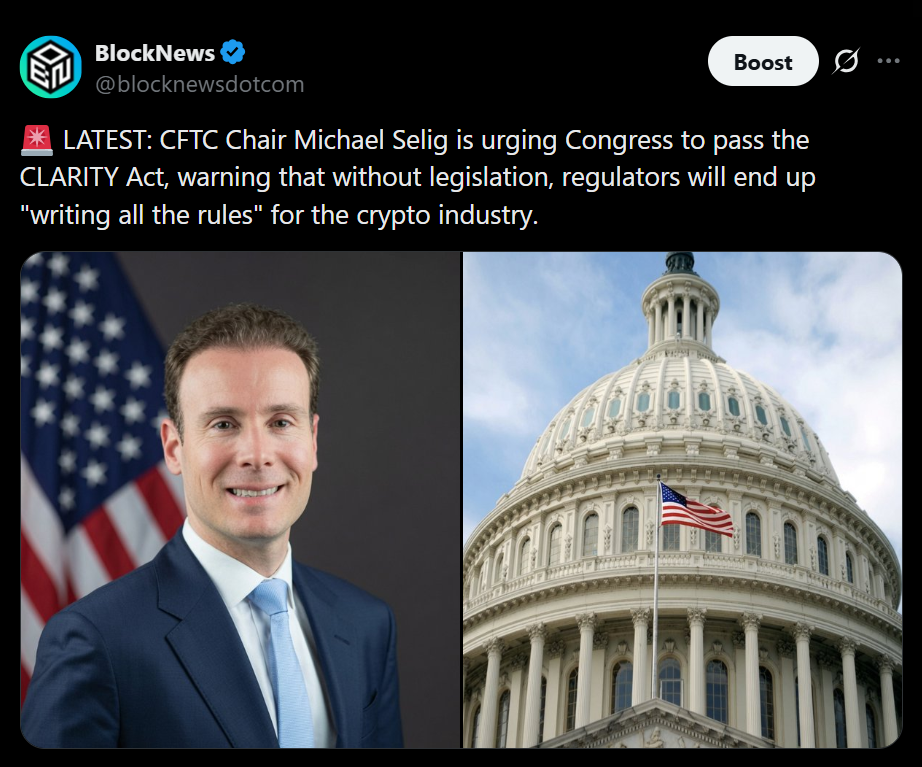
Speaking in an interview with Fox Business, Selig urged Congress to move the legislation forward, arguing that the cryptocurrency industry needs clear federal standards instead of relying on a fragmented system of state regulations.
CFTC Warns Against Regulatory Uncertainty
According to Selig, the absence of comprehensive federal legislation has forced cryptocurrency businesses to operate under what he described as a patchwork of state laws that create unnecessary complexity for both companies and investors.
He argued that the CLARITY Act would provide much-needed certainty by establishing a clear division of responsibilities between the Commodity Futures Trading Commission and the Securities and Exchange Commission.
“We’re so close. We have to get this done,” Selig said, warning that without congressional action, regulators would ultimately end up writing many of the industry’s rules themselves.
Political Disagreements Continue Delaying the Bill
Although the House previously approved the legislation, negotiations continue in the Senate as lawmakers work through several outstanding issues.
Selig said one of the biggest obstacles has been the addition of issues beyond the bill’s original market structure goals. Some Democratic lawmakers have pushed for ethics provisions addressing President Donald Trump, his family, and their cryptocurrency businesses, an effort Selig believes has complicated bipartisan negotiations.
Meanwhile, lawmakers have also continued debating provisions involving decentralized finance, anti-money laundering safeguards, and other regulatory measures.
Senate Faces Tight Timeline
Senator Cynthia Lummis, who chairs the Senate Digital Asset Subcommittee, said lawmakers have been negotiating the legislation since last Labor Day. She noted that discussions have covered a broad range of issues, including stablecoin regulations, decentralized finance, ethics rules, and illicit finance protections.
Although lawmakers had hoped to release updated legislative text around the July 4 holiday, negotiations have taken longer than expected, increasing pressure as the Senate calendar becomes more crowded.
With Congress approaching its August recess, many observers believe the remaining legislative window is becoming increasingly narrow.

Analysts Lower Expectations for Passage
Several research firms have become more cautious about the bill’s prospects this year. Galaxy Research recently reduced its estimated probability of CLARITY Act passage in 2026 from 60% to 50%, citing limited legislative time and slower-than-expected negotiations.
TD Cowen also warned that approval before the November midterm elections remains uncertain due to unresolved political disagreements and outstanding policy issues.
At the same time, some law enforcement organizations have expressed concerns about provisions protecting non-custodial blockchain developers, arguing that certain sections of the legislation could make investigations involving illicit finance more difficult.
For now, the CLARITY Act remains one of the most closely watched pieces of cryptocurrency legislation in the United States. Its outcome could shape how digital assets are regulated for years to come and determine whether the industry finally receives the regulatory certainty many companies have been seeking.
Disclaimer: BlockNews provides independent reporting on crypto, blockchain, and digital finance. All content is for informational purposes only and does not constitute financial advice. Readers should do their own research before making investment decisions. Some articles may use AI tools to assist in drafting, but every piece is reviewed and edited by our editorial team of experienced crypto writers and analysts before publication.








 English (US) ·