
 6 days ago
27
6 days ago
27
- Phantom won’t be treated as a broker, easing regulatory pressure on wallets
- The ruling allows wallets to integrate trading without becoming intermediaries
- This could unlock more crypto product development inside the U.S.
The CFTC just made a decision that, at first glance, looks technical… but it could reshape how crypto wallets operate in the United States. Phantom received a “no-action” position from the regulator, meaning it won’t need to register as an introducing broker simply for enabling access to trading through third-party services.
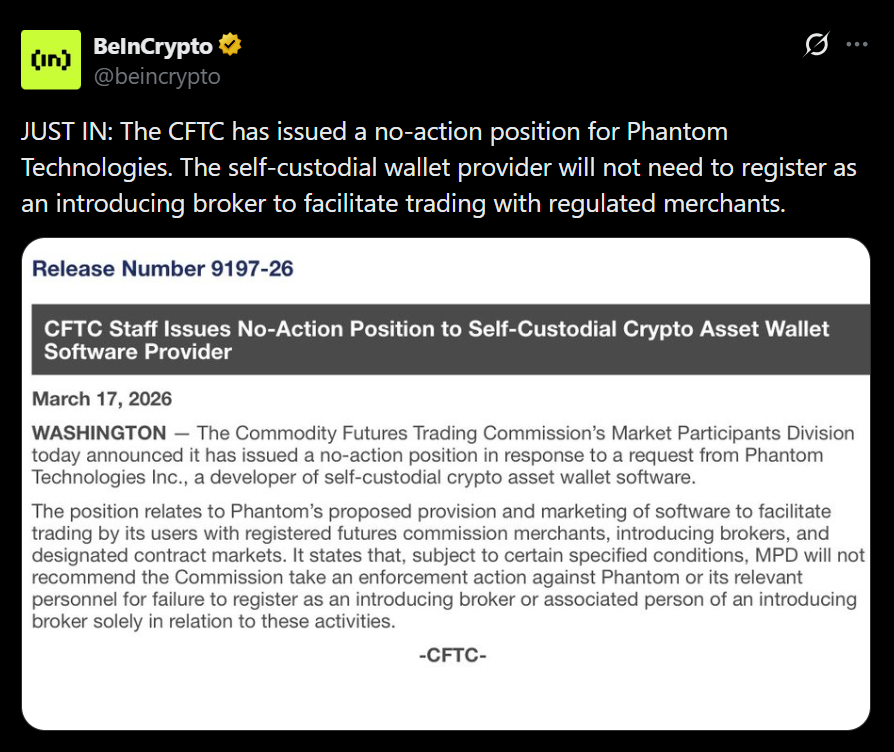
That distinction matters more than it sounds. The CFTC is effectively drawing a line between infrastructure and financial intermediaries. Phantom doesn’t hold user funds, execute trades, or act as a counterparty — and the regulator is now formally recognizing that difference.
Wallets Finally Get Some Regulatory Breathing Room
For years, wallet providers have been stuck in a kind of gray zone. Adding trading features always came with the risk of being classified as a broker, which would bring heavy compliance requirements and, realistically, slow everything down.
This ruling removes a big chunk of that uncertainty. It suggests that wallets can integrate trading access, as long as they remain neutral infrastructure, without being forced into a category they were never really built for.
That shift could change how teams approach building products in the U.S. Almost immediately, actually.
The Line Between Infrastructure and Intermediaries
What the CFTC is signaling here is subtle but important. Not everything in crypto fits neatly into traditional financial roles.
A self-custodial wallet isn’t a broker. It doesn’t custody assets in the traditional sense, and it doesn’t facilitate trades in the same way centralized platforms do. It’s more like a gateway… or maybe a tool, depending on how you look at it.
By acknowledging that distinction, regulators are starting to adapt to how crypto systems actually function, rather than forcing them into older frameworks.
A Bigger Signal for the U.S. Crypto Industry
There’s also a broader implication here. For a while, regulatory uncertainty has pushed many crypto companies to build outside the U.S.
Decisions like this could begin to reverse that trend. If developers feel more confident about how products will be classified, they’re more likely to build locally instead of navigating unclear rules.
It’s not a full regulatory overhaul, but it’s a step — and those steps add up over time.
A Quiet Shift With Long-Term Impact
This isn’t a flashy announcement. No major token pumps, no dramatic headlines… just a regulatory clarification.
But it sets a precedent. Self-custody wallets now have a clearer path to integrate trading features without becoming regulated intermediaries.
And if that path holds, the next generation of crypto products might feel a lot more seamless, a bit more intuitive… and a lot more accessible.
Disclaimer: BlockNews provides independent reporting on crypto, blockchain, and digital finance. All content is for informational purposes only and does not constitute financial advice. Readers should do their own research before making investment decisions. Some articles may use AI tools to assist in drafting, but every piece is reviewed and edited by our editorial team of experienced crypto writers and analysts before publication.







 English (US) ·