
 3 months ago
49
3 months ago
49
- Bridgetower tokenizes $11B mining project using Chainlink infrastructure
- Platform integrates verification, compliance, and cross-chain settlement
- Institutional focus grows as tokenization moves into live deployment
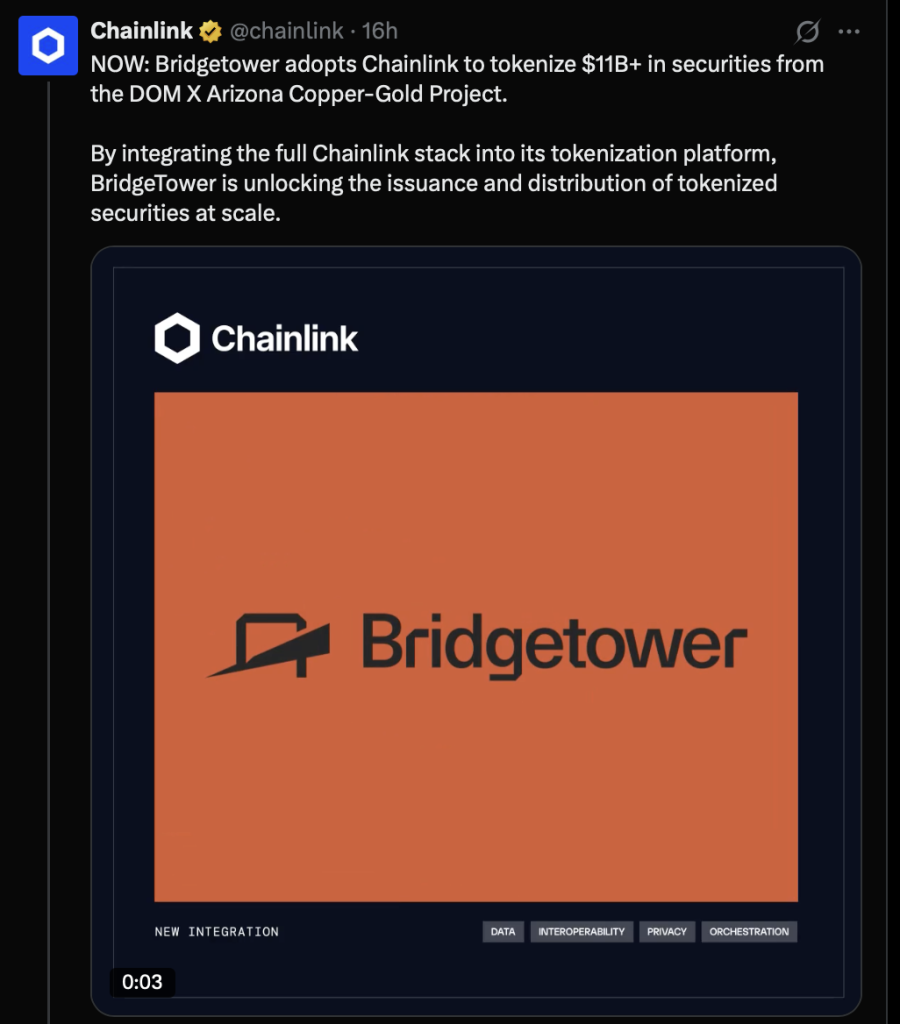
Something interesting just happened in the tokenization space, and it’s not small. Bridgetower has taken an $11 billion U.S. mining asset, specifically the DOM X Arizona copper-gold project, and pushed it closer to blockchain integration. The company teamed up with Chainlink to make it happen, and the system officially went live this week.
It’s not just a simple token launch either. The platform ties together asset verification, valuation, compliance, and even cross-chain settlement into one setup, which… sounds ambitious, but also kind of necessary if institutions are actually going to take this seriously.
Bridgetower Expands Into Tokenized Infrastructure
Bridgetower, which operates out of Boise, has been building around blockchain and AI infrastructure for a while now. For this project, they chose Chainlink as the backbone, which isn’t surprising given Chainlink’s role in data and interoperability. The DOM X project itself carries a reported valuation of $11 billion, but that’s only part of the picture.
The company says its broader pipeline of tokenized assets could reach around $25 billion, spanning natural resources, metals, and energy sectors. So this isn’t a one-off experiment, it looks more like the start of something bigger, or at least that’s the intention.
According to CEO Cory Pugh, this launch represents a shift from testing into actual production. In his words, it’s about pushing tokenized markets toward institutional scale, which, if it works, could change how these assets are accessed and traded.
Chainlink Powers the Core Mechanics
Under the hood, the system leans heavily on Chainlink’s suite of tools. CCIP handles cross-chain communication, which is key if assets are going to move across different blockchain networks. Then there’s Proof of Reserve, which helps verify that the assets backing these tokens actually exist, something that’s… pretty important in this space.
NAVLink is used to keep valuation data updated on-chain, while Chainlink’s Runtime Environment acts as the coordination layer, basically tying everything together. It manages compliance checks, valuation updates, and settlement processes, all in one place.
The idea here is to create a full workflow, not just issuing tokens but managing them across their entire lifecycle. That includes tracking, updates, and interactions across networks, which gets complex quickly if not handled properly.
Payments, Compliance, and Privacy Come Into Play
Beyond the core infrastructure, the platform also integrates payment systems. Investors can use both traditional and crypto rails, with MoonPay’s Iron handling those flows behind the scenes. It’s a practical addition, especially if the goal is to onboard institutional participants who might not operate purely in crypto.
There are also built-in compliance layers, identity verification, anti-money laundering checks, all embedded directly into the onboarding process. It’s not optional either, it’s part of the system from the start.
Interestingly, the companies are also working on privacy-focused features. Ownership data can remain confidential, while compliance checks still run on-chain, which tries to balance transparency with institutional requirements. Not an easy balance to strike, honestly.
A Signal That Tokenization Is Moving Forward
This isn’t Bridgetower’s first step with Chainlink. They started experimenting with the Runtime Environment back in 2025, but this marks a move into a live deployment, which is a different level entirely. It’s no longer theoretical, it’s operating.
From Chainlink’s side, there’s a clear message here too. According to their leadership, major financial institutions are paying attention to tokenization right now, watching closely to see how these systems perform in real conditions.
Whether this becomes a broader trend or just an early attempt that needs refining… that’s still unclear. But it does feel like a step forward, even if it’s just one piece of a much larger shift.
Disclaimer: BlockNews provides independent reporting on crypto, blockchain, and digital finance. All content is for informational purposes only and does not constitute financial advice. Readers should do their own research before making investment decisions. Some articles may use AI tools to assist in drafting, but every piece is reviewed and edited by our editorial team of experienced crypto writers and analysts before publication.






 English (US) ·