
 1 month ago
31
1 month ago
31
- Circle declined to freeze $230M USDC tied to Drift exploit
- CEO says only courts or law enforcement can trigger freezes
- Firm pushes for legal clarity while expanding in Asia
Circle just made a call that’s getting a lot of attention, and not all of it positive. After a $280 million exploit hit DeFi protocol Drift, with around $230 million in USDC involved, the company chose not to freeze the funds. For many in crypto, that looked like inaction. For Circle, it was something else entirely.
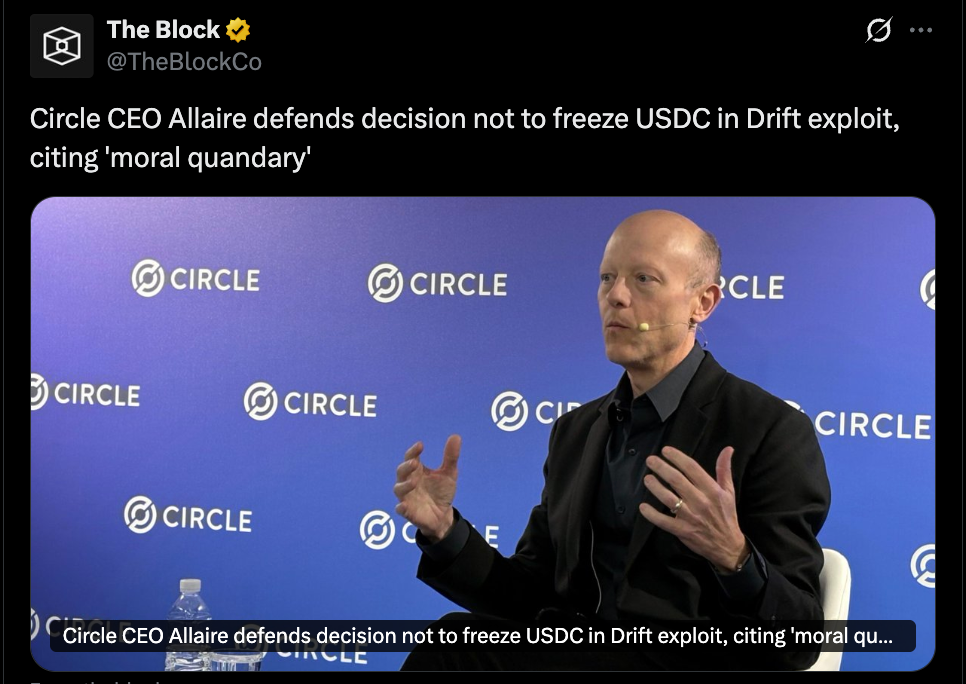
Jeremy Allaire’s position is pretty clear, even if it’s not popular. Freezing funds isn’t something the company decides on its own. It only acts when there’s a legal order, not based on internal judgment or public pressure. That might sound rigid, but it’s intentional, and maybe necessary, depending on how you see it.
The Drift Exploit Sparked the Debate
The situation itself was already messy. The exploit, reportedly tied to a long-running social engineering attack, moved funds across chains, eventually landing a large portion in USDC. When Circle didn’t intervene, criticism came fast, especially from on-chain investigators who expected action.
Part of the frustration comes from past behavior. Circle has frozen wallets before, but without always providing full public context. That makes the current stance feel inconsistent to some, even if the company argues the underlying legal conditions were different.
Circle Says It Can’t Act Without Orders
Allaire’s defense centers on one idea, responsibility. If a private company starts deciding which funds to freeze and when, it takes on a level of control that could quickly become problematic. That kind of discretion might solve some cases, but it also opens the door to others, bias, pressure, or even mistakes.
So instead, Circle sticks to a stricter framework. Courts and law enforcement make the call, and Circle executes it. Nothing more, nothing less. It’s slower, definitely, but it avoids turning the company into an arbiter of what counts as legitimate or not.
Legal Clarity Could Change the Rules
That said, Circle isn’t completely comfortable with the current setup either. Allaire has been pushing for a “safe harbor” provision in upcoming legislation, specifically the Clarity Act, that would allow the company to act in extreme cases without legal risk.

Right now, acting too early could expose Circle to liability. Acting too late creates backlash. The goal seems to be finding a middle ground, but that line hasn’t been clearly drawn yet, which leaves situations like this in a gray zone.
Expansion Continues Despite Controversy
While the debate played out online, Circle was also making moves elsewhere. The company signed agreements with South Korea’s exchanges, Upbit and Bithumb, signaling a push into one of the most active crypto markets globally.
South Korea is working on its own regulatory framework, including stablecoin rules, and Circle wants to be part of that infrastructure layer. Not necessarily issuing local stablecoins, but enabling them, which is a different kind of positioning.
Stablecoin Control Remains an Open Question
This situation highlights something bigger than a single exploit. It raises the question of who should control stablecoins in moments of crisis. Should it be companies, regulators, or some mix of both?
For now, the answer leans heavily toward legal systems. If funds need to be frozen, a judge has to say so first. That may not satisfy everyone, especially in fast-moving exploits, but it’s the framework Circle is choosing to operate within.
Disclaimer: BlockNews provides independent reporting on crypto, blockchain, and digital finance. All content is for informational purposes only and does not constitute financial advice. Readers should do their own research before making investment decisions. Some articles may use AI tools to assist in drafting, but every piece is reviewed and edited by our editorial team of experienced crypto writers and analysts before publication.








 English (US) ·