
 1 hour ago
15
1 hour ago
15
The final implementation of all MiCA provisions has created a regulatory sandbox that leaves Europe disconnected from major stablecoin providers. Circle’s Senior Director, EU Strategy & Policy, Patrick Hansen, stressed that a review is necessary to make the framework more competitive and globally aligned.
Published: Aug 6, 2026, 5:01 PM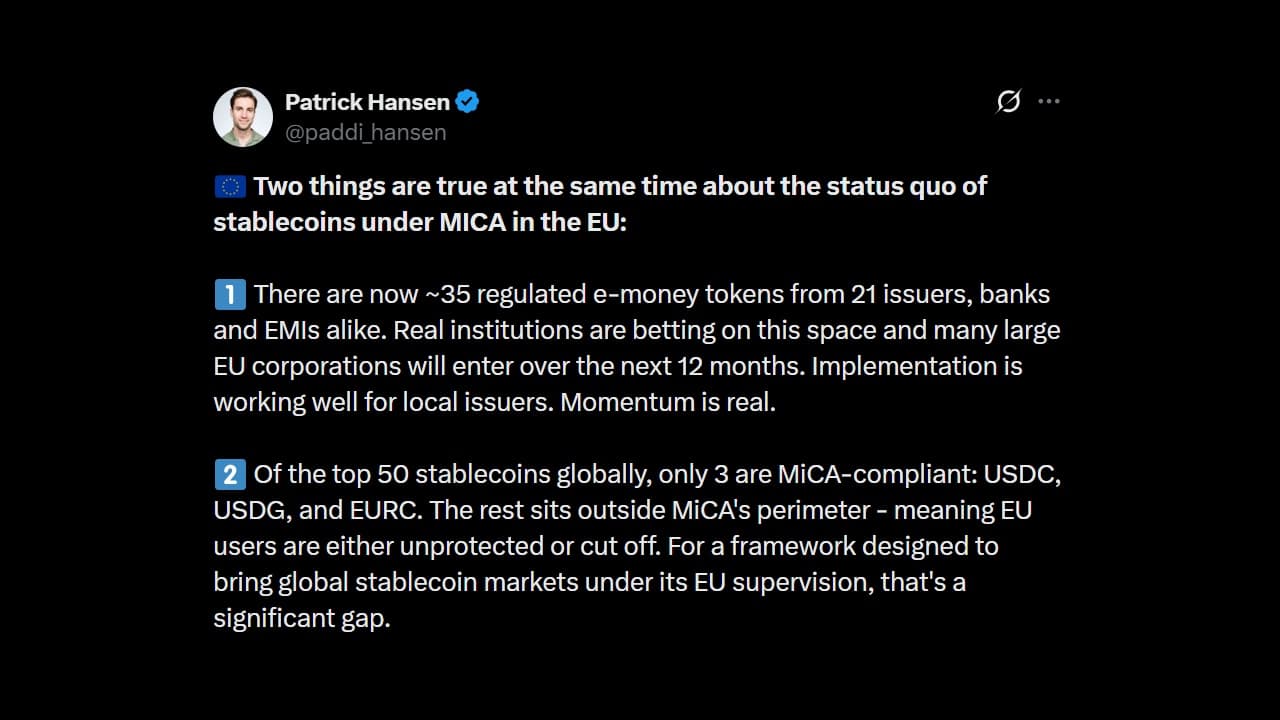
Key Takeaways
- MiCA licensed 35 tokens, but excluded major issuers like Tether, leaving many EU users unprotected.
- Strict MiCA rules cut off EU users from global stablecoins, limiting market access for major tokens.
- The EU opened a public consultation through September to revise MiCA and accommodate foreign issuers.
MiCA’s Current Implementation Leaves EU Users ‘Unprotected or Cut Off’
While the implementation of full Markets in Crypto Assets (MiCA) provisions has closed the gap regarding the operation of unlicensed exchanges in Europe, it has also brought major disruptions to the stablecoin ecosystem due to its restrictive licensing approach for issuers.
Patrick Hansen, Senior Director of EU Strategy & Policy at Circle, raised concerns about the state of the regulated stablecoin ecosystem in Europe and how the current framework leaves European customers outside the safety nets that MiCA provides.
Hansen explained that MiCA has led to the licensing of 35 e-money tokens from 21 issuers, showing that interest in the space is there, with companies ready to invest a nd bring stablecoins to the table. “Real institutions are betting on this space and many large EU corporations will enter over the next 12 months. Implementation is working well for local issuers. Momentum is real,” he stressed.
Nonetheless, MiCA’s stringent provisions have left most of the top stablecoin issuers, including Tether, unable to comply with its operating requirements, with only USDG, USDC and EURC passing the framework’s bar.
“The rest sits outside MiCA’s perimeter – meaning EU users are either unprotected or cut off. For a framework designed to bring global stablecoin markets under its EU supervision, that’s a significant gap,” he assessed.
Hansen believes that an upcoming review of MiCA should address this issue, as the framework should gather the global stablecoin activity under its umbrella and allow local e-money token issuers to scale beyond Europe’s borders. He suggests a more pragmatic approach to open a path for foreign issuers to operate without facing the same rules as their local counterparts.
On May 20, the EU’s Directorate-General for Financial Stability, Financial Services and Capital Markets Union opened a public consultation to review whether “the current framework remains fit for purpose.” The process will remain open until September 30 and specifically addresses electronic money tokens and their issuers in one of its parts.






 English (US) ·