
 4 months ago
62
4 months ago
62
Most AI crypto trading bots run a single algorithm, fire trades on one signal, and call it automation. When Consensus Miami 2026 opens its doors at the Miami Beach Convention Center on May 5, one of the exhibitors plans to demonstrate why that model is already obsolete. NeuroTrader — a multi-model AI trading intelligence system — is showing a live preview of its ensemble consensus architecture, and the timing says something about where the industry is headed.
Consensus 2026 draws over 20,000 attendees from more than 100 countries, with dedicated programming tracks for AI, DeFi, and trading. It’s the conference where institutional capital, builders, and retail traders collide. And this year, the conversation around AI in crypto has shifted from speculative novelty to practical infrastructure. The question isn’t whether AI should trade — it’s how it should decide.
Why Consensus Miami 2026 Is the Inflection Point for AI Trading
The AI-crypto intersection has matured faster than most analysts predicted. In 2025, the AI-driven blockchain sector crossed a $25 billion market cap. Regulatory frameworks are crystallizing — South Korea’s Financial Supervisory Service deployed AI-powered detection tools to combat market manipulation, and institutional allocators now hold over $146 billion in Bitcoin ETF products alone. The backdrop for Consensus 2026 isn’t hype. It’s infrastructure.
Against that backdrop, Consensus features early-stage and growth-stage projects demonstrating live systems. NeuroTrader is exhibiting at Consensus with a live preview of the system in action — showing how six independent AI engines form consensus before any trade signal fires.
For traders evaluating the next generation of AI crypto trading bots, this is the kind of transparency that has been conspicuously absent from the market.
What Is NeuroTrader, and How Does It Differ from a Standard Trading Bot?
NeuroTrader is a decision intelligence system for trading — not a bot, not a signal group, not blind automation. It uses six AI engines running in parallel, each analyzing the market independently. Their outputs are combined through weighted ensemble consensus: a trade only executes when sufficient multi-model agreement is reached on direction, confidence, and timing. .
The six engines each serve a distinct analytical function:
| Engine | Function |
| Decision Engine | Reinforcement learning for optimal buy/hold/sell behavior under uncertainty |
| Signal Engine | Primary signal generation across multiple time horizons |
| Coherence Engine | Cross-validation of signal alignment across engines |
| Quantum Engine | Probabilistic modeling of market state uncertainty |
| Temporal Engine | Time-series pattern analysis across variable horizons |
| Pattern Engine | Technical and structural pattern recognition |
The critical architectural difference: no single engine can trigger a trade on its own. The ensemble weighs each engine’s output, and weak or contradictory signals are filtered out, meaning trades that lack sufficient multi-model agreement simply don’t execute.
Here’s a concrete example of what that looks like in practice. Imagine the Signal Engine detects a bullish BTC entry signal on the 4-hour chart, but the Coherence Engine flags a divergence — the Temporal Engine sees the pattern as late-stage, and the Quantum Engine assigns low probability to continuation. In a conventional bot, the signal fires and the trade opens. In NeuroTrader, the system stands down. The user sees the disagreement, the confidence score, and the reasoning — logged in full.
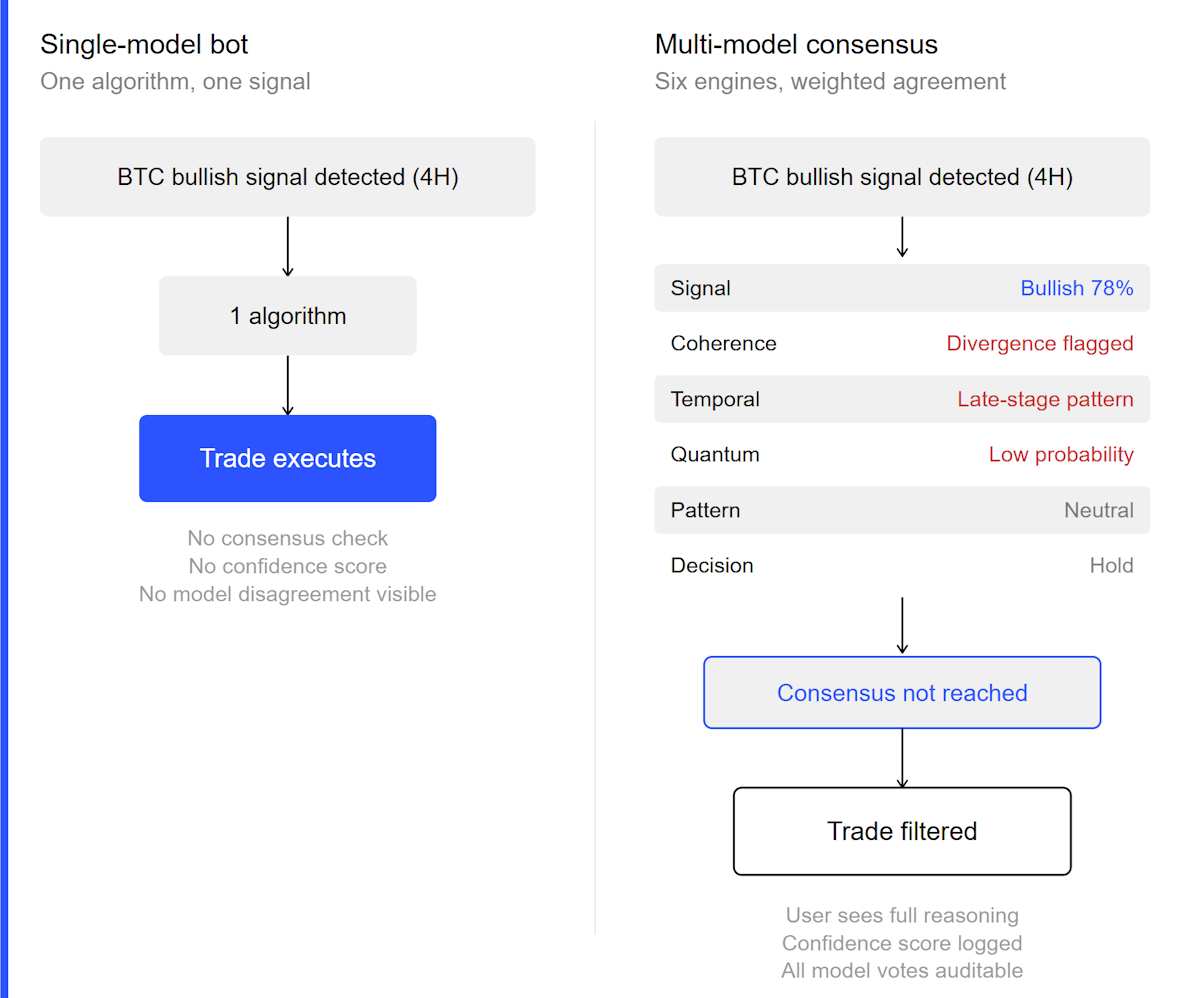
Alt text: Infographic comparing a single-model trading bot that executes on one signal with NeuroTrader’s multi-model consensus system where six AI engines — Signal, Coherence, Temporal, Quantum, Pattern, and Decision — must agree before a trade fires. The example shows a BTC bullish signal that executes immediately in a single-model bot but gets filtered in NeuroTrader when four of six engines disagree.
How Does NeuroTrader Handle Security and Custody?
Non-custodial architecture means NeuroTrader never holds user funds. API keys are configured as trade-only with zero withdrawal access. Assets remain on the exchange at all times — NeuroTrader sends trade signals, nothing more.
All API credentials are encrypted at rest using AES-256, with per-user key isolation. A three-tier emergency system — Pause AI, Soft Exit, Full Shutdown — gives users layered control over execution. Every AI decision is logged with full model votes and reasoning, so users can audit the logic behind any trade after the fact.
This matters in a landscape where Kraken trading bot users, Coinbase API integrators, and Binance power traders are all evaluating platforms that connect to their exchange accounts. The security model isn’t a feature. It’s the custody architecture.
Which Exchanges and Markets Does NeuroTrader Support?
NeuroTrader is targeting a live trading launch on June 1, 2026 with three initial exchange integrations, with additional platforms planned for August.
| Phase | Exchanges | Timeline |
| Launch | Coinbase, Binance, Alpaca | June 1, 2026 |
| Expansion | Kraken, Gemini | August 1, 2026 |
Crypto is the launch market, but the roadmap extends into equities, ETFs, futures, forex, and commodities — each phase expanding the intelligence layer’s reach across asset classes.
For traders currently using a Kraken trading bot through third-party platforms like 3Commas, Bitsgap, or Gunbot, the planned Kraken integration would offer a direct alternative — one that doesn’t rely on simple grid strategies or single-indicator triggers, but on multi-model ensemble consensus.
What Does the Pricing Architecture Look Like?
NeuroTrader uses a tiered access model ranging from free observation to full system operation. The structure is designed to let cautious newcomers observe before committing, while giving active traders granular control over execution depth.
| Tier | Role | Price | Executions | Key Capabilities |
| Free | Signal Access | $0/mo | Paper trading only | Market state visibility, read-only SignalFlip, limited assets |
| Defense | Controlled Entry | $10/mo | 25/mo | Decision Governor active, stand-down alerts, failure explanations |
| Core | Active Trader | $35/mo | 125/mo | Multi-horizon SignalFlip, confidence filtering |
| Pro | Multi-Market Operator | $60/mo | 400/mo | Multi-asset scanning, full signal grid, advanced filtering |
| Elite | System Operator | $100/mo | 1,000/mo | Model transparency, portfolio heatmaps, advanced analytics |
The free tier includes paper trading and market state visibility — a functional sandbox, not a crippled teaser. Users can evaluate signal quality, observe consensus behavior, and understand the system’s logic before any capital is at risk.
How Does NeuroTrader’s Approach Compare to Existing AI Trading Bots?
Most platforms marketed as AI crypto trading bots in 2026 share a common architecture: one algorithm, one strategy type, minimal transparency. Grid bots trade within price ranges. DCA bots average into positions. Momentum bots chase trends. Each operates on a single model with fixed logic.
NeuroTrader’s architecture diverges in three structural ways:
Multi-model agreement over single-signal execution. Six engines weigh in before execution. This is closer to how institutional quant desks operate — with model arbitration and ensemble methods — than to the retail bot paradigm.
Decision visibility over black-box automation. Every trade includes the confidence score, the model votes, and the reasoning. Users see why a trade was taken — or, more importantly, why it wasn’t.
Trade filtering over trade volume. The system actively blocks weak signals. In conventional bot logic, more trades means more opportunity. In NeuroTrader’s framework, fewer, higher-confidence trades means better risk-adjusted outcomes.
What’s on the Roadmap Beyond Launch?
NeuroTrader’s development roadmap spans seven phases, moving from system activation through multi-market coordination and into immersive interface layers.
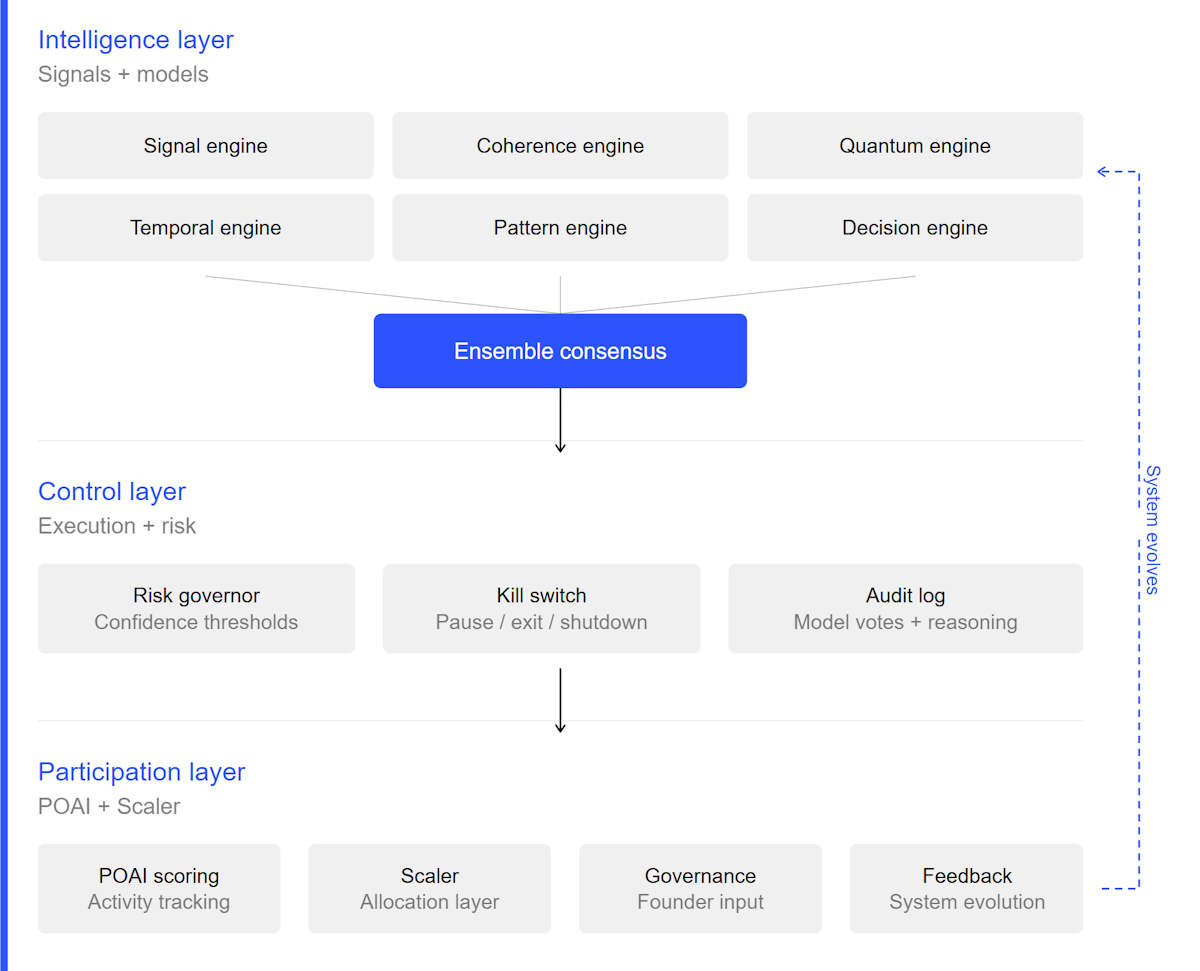
Alt text: NeuroTrader system architecture diagram showing three layers: the Intelligence layer with six AI engines feeding into ensemble consensus, the Control layer with risk governor, kill switch, and audit log, and the Participation layer with POAI scoring, Scaler allocation, governance, and feedback. A return loop shows how participation feeds back into the intelligence layer as the system evolves.
Phase 0 — currently active — includes the Consensus Miami 2026 live preview. Phase 1 activates live trading in early summer. By fall, the system enters adaptive intelligence territory: confidence-weighted capital allocation, regime-adaptive behavior, and model arbitration. Phases 5 and 6 introduce what NeuroTrader calls the Experience Layer — VR strategy rooms, simulation labs, market replay environments, and wearable systems delivering real-time alerts through intelligent glasses.
It’s ambitious. And it’s worth noting that the platform is pre-full-launch. The live preview at Consensus is exactly that — a preview. But the architecture is functional, exchange integrations are in progress, and the intelligence layer is already running.
What Should Traders Watch for at Consensus Miami 2026?
Consensus 2026 will host sessions on algorithmic intelligence, decentralized market structures, and the rise of agentic AI systems that transact autonomously on-chain. NeuroTrader’s live booth demonstration gives attendees a chance to see an ensemble AI system in action — to watch how six engines interact, disagree, converge, and ultimately form a unified decision.
For active crypto traders evaluating their next tool, for tech-forward investors watching the AI-trading convergence, and for newcomers trying to separate substance from noise, the live demo offers something most AI platforms don’t: a system that shows its work.
Traders interested in evaluating the platform before committing capital can start with NeuroTrader’s free tier, which includes paper trading and full signal visibility — a low-commitment entry point for testing the intelligence layer firsthand. Visit neurotraderai.com to explore the system.
The post Consensus Miami 2026: NeuroTrader Is Bringing AI Trading Intelligence to the Floor appeared first on Blockonomi.





 English (US) ·