
 5 months ago
65
5 months ago
65
Key Highlights
- Brent crude climbed to $112.87 per barrel on Tuesday; WTI reached $102.49
- Iranian forces allegedly attacked a Kuwaiti oil tanker near Dubai, igniting the vessel
- President Trump may halt military action despite the Strait of Hormuz remaining partially blocked
- March is seeing a historic 50–54% surge in both Brent and WTI crude prices
- U.S. gasoline prices exceeded $4 per gallon, the highest level since August 2022
Crude oil markets maintained their position above $110 per barrel on Tuesday as ongoing Middle Eastern hostilities continued to rattle global energy supply chains.
Brent crude, the international pricing standard, edged up 0.1% to reach $112.87 per barrel. West Texas Intermediate experienced a modest decline to $102.49. Both oil benchmarks are positioned to close out March with extraordinary gains ranging from 50% to 54%, marking one of the most dramatic monthly increases in petroleum market history.
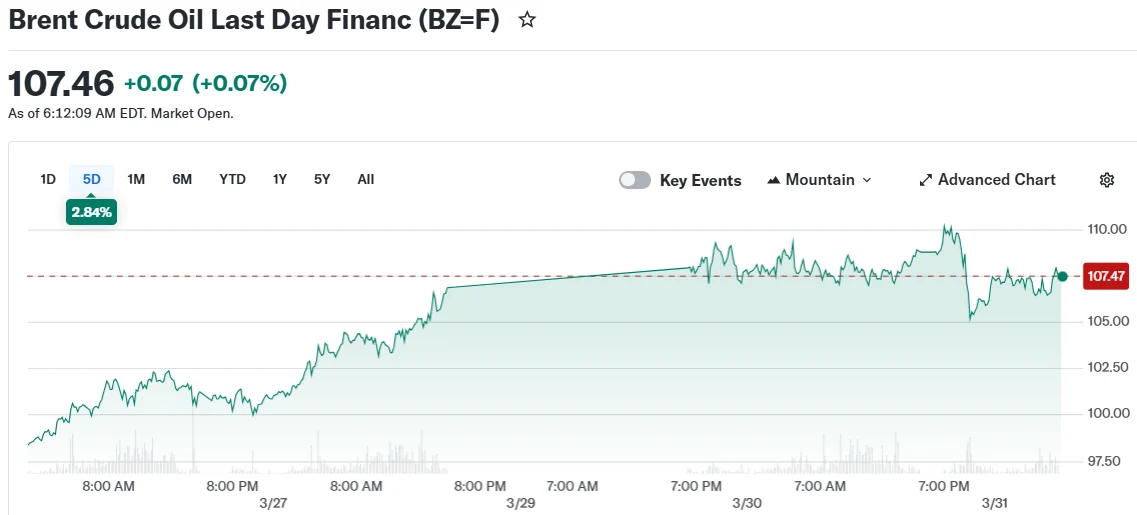 Brent Crude Oil Last Day Financ (BZ=F)
Gas prices nationwide surpassed the $4 per gallon threshold for the first time since August 2022, based on AAA tracking data.
The initial price spike followed reports that a Kuwaiti petroleum tanker caught fire near Dubai’s port facilities. According to the vessel’s ownership company, Iranian forces were behind the assault.
JUST IN: 
 President Trump tells aides he's willing to end Iran war even if Strait of Hormuz remains closed, WSJ reports. pic.twitter.com/gXBqJ3hZ25
— BRICS News (@BRICSinfo) March 31, 2026
Market sentiment shifted moderately after the Wall Street Journal published a report indicating President Trump informed his team he’s prepared to conclude military operations against Iran, regardless of whether the Strait of Hormuz is fully operational again.
Trump and senior advisers have determined that clearing the strait would require significantly more time than the originally projected four-to-six week period. The current strategy involves scaling back U.S. military engagement after degrading Iran’s naval forces and missile infrastructure, followed by intensified diplomatic pressure on Tehran.
The Critical Role of the Strait of Hormuz
Prior to the outbreak of conflict, approximately 20% of global world’s oil and liquefied natural gas transited through the Strait of Hormuz. This vital shipping channel remains at least partially obstructed.
Iranian lawmakers have authorized a new policy to impose transit fees on ships passing through the strategic waterway, according to statements from Iranian government media outlets.
While the strait remains compromised, oil prices in the triple-digit range are likely to persist, creating additional headwinds for equity markets worldwide.
Asian nations heavily reliant on Persian Gulf petroleum have begun implementing energy conservation measures. Bangladesh ordered universities to close temporarily. Both Pakistan and the Philippines have mandated reduced working schedules.
Additional Conflict Zones Adding to Market Uncertainty
Yemen’s Houthi militant faction joined the conflict during the weekend, launching strikes against Israel. The Houthis have demonstrated their capacity to target commercial shipping in the Red Sea previously, intensifying concerns about the conflict expanding to multiple theaters.
Iran has mostly rejected claims of conducting direct diplomatic engagement with the United States, contradicting American officials who have characterized negotiations as progressing positively.
The United States has positioned thousands of military personnel throughout the region. Trump has reiterated warnings about potential strikes on Iran’s energy facilities and water supply systems if the Strait remains closed beyond April 6.
Pakistan has proposed serving as a neutral venue for peace negotiations in Islamabad. Defense Secretary Pete Hegseth and the Chairman of the Joint Chiefs had a press briefing scheduled for Tuesday morning.
Multiple Persian Gulf states have suspended oil extraction and export activities during the past month as a result of the ongoing conflict.
The post Crude Oil Surges 50% in March as Middle East Conflict Chokes Supply Routes appeared first on Blockonomi.





 English (US) ·