
 2 hours ago
30
2 hours ago
30
Key Takeaways
- Brent crude futures advanced 2% to reach $107.83 per barrel while WTI gained 2.1% to $103.50 on Tuesday
- Houthi forces captured Perim Island in the Bab al-Mandeb Strait following their takeover of Mokha port
- Saudi Arabia’s critical East-West Pipeline remains out of service, requiring six to eight weeks for complete restoration
- Diplomatic negotiations between Iran and Gulf nations regarding Strait of Hormuz access have been postponed without a rescheduled date
- Energy experts caution that worldwide crude stockpiles may provide only five to eleven weeks of coverage
Oil prices surged past the $107 per barrel threshold on Tuesday as renewed military actions by Houthi forces targeting Saudi Arabian infrastructure and a major pipeline disruption intensified worries about global crude availability.
Brent crude futures climbed 2.0% to settle at $107.83 per barrel during early European market hours. West Texas Intermediate registered a 2.1% increase to $103.50 per barrel. Both benchmark contracts reached elevated levels on Monday, with Brent momentarily trading at $109.80 before retreating.
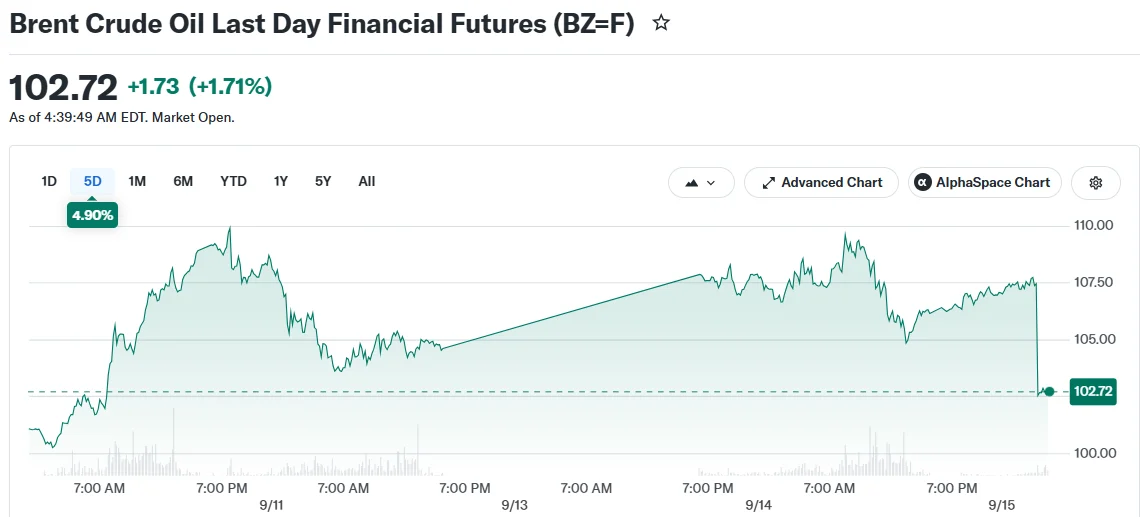 Brent Crude Oil Last Day Financial Futures (BZ=F)
Critical Infrastructure Outage Intensifies Supply Concerns
The East-West Pipeline operated by Saudi Arabia was forced offline following Houthi missile strikes that inflicted damage on pumping facilities last week. This 750-mile conduit possesses the capacity to transport as much as 7 million barrels daily from Saudi Arabia’s eastern oil fields to Yanbu, a Red Sea export terminal.
 Saudi Arabia's oil problem just multiplied.
What looked like a single Houthi hit on the East-West pipeline is now looking like a coordinated hammering of the whole system.
Fresh satellite imagery shows Pump Station 9 badly damaged, with Pump Station 8 possibly hit too, both…
— Mario Nawfal (@MarioNawfal) September 15, 2026
Saudi officials are attempting to bring partial pipeline capacity back online in the coming days. Nevertheless, comprehensive repairs to the compromised pumping stations are projected to require six to eight weeks, as reported by the Wall Street Journal.
This pipeline serves as a vital alternative route enabling Saudi crude shipments to circumvent the Strait of Hormuz. Its current inoperability eliminates a primary safeguard against regional supply interruptions.
Crude oil loadings from Yanbu had exceeded 4 million barrels daily during the April through June period. That volume plummeted to merely 1.1 million barrels per day by August as heightened Houthi military activity increased hazards for Red Sea maritime traffic, based on LSEG shipping data.
Janiv Shah, an analyst with Rystad Energy, calculates that Saudi Arabia maintains approximately two to six days worth of crude reserves at Yanbu. Accessing additional stockpiles positioned in Egypt could potentially extend that timeframe by a minimum of one additional week.
Militant Group Expands Control Over Strategic Maritime Corridor
Houthi militants, who maintain alignment with Iran, took control of Perim Island located in the Bab al-Mandeb Strait during the weekend following their seizure of Mokha port. These territorial gains provide the organization with enhanced capabilities to interfere with petroleum shipments traversing the Red Sea passage.
ING analysts noted that oil markets maintain strong price support and this foundation appears unlikely to erode until traders receive more definitive information regarding Saudi supply capacity after the pipeline closure.
Diplomatic discussions between Iranian officials and Gulf state representatives concerning the reopening of the Strait of Hormuz have experienced delays. Omani authorities announced during the weekend that a meeting scheduled for Monday had been pushed back indefinitely. Officials did not establish an alternative date.
Prior to the U.S.-Iran military conflict that commenced in late February, the Strait of Hormuz facilitated approximately one-fifth of global oil transit. Petroleum flows through this waterway have remained substantially diminished since the strait was essentially closed at the conflict’s onset.
Vivek Dhar, who analyzes energy markets for Commonwealth Bank of Australia, indicated that market-stabilizing factors are deteriorating. Chinese crude purchases are gradually increasing, while additional non-OPEC production capacity outside the Middle East region is not anticipated before 2027.
Dhar emphasized that CBA’s conservative projection, suggesting global petroleum inventories provide coverage for merely five to eleven weeks of consumption, is becoming progressively more realistic.
On Monday, U.S. President Donald Trump reiterated assertions that Iran was pursuing a peace agreement. Iranian officials rejected this characterization, stating they would not participate in negotiations until their preconditions were satisfied.
The post Crude Oil Surges Past $107 Amid Saudi Infrastructure Damage and Regional Conflict appeared first on Blockonomi.



 English (US) ·