
 4 months ago
52
4 months ago
52
Quick Summary
- Brent crude surged past $111 per barrel, recording gains of almost 6% for the week
- Washington dismissed Tehran’s proposition to restore access to the Strait of Hormuz
- President Trump’s non-negotiable demands focus on halting Iran’s nuclear enrichment activities
- Pakistan-mediated diplomatic efforts collapsed during the weekend
- Tehran faces critical oil storage capacity shortages and potential production shutdowns
Energy markets experienced significant upward momentum this week as diplomatic negotiations between Washington and Tehran regarding the Strait of Hormuz reached an impasse.
Brent crude futures climbed beyond $111 per barrel during London market hours. Meanwhile, West Texas Intermediate surged past the $98 threshold. Both benchmark contracts had already registered gains of 2% to 3% during the previous trading session.
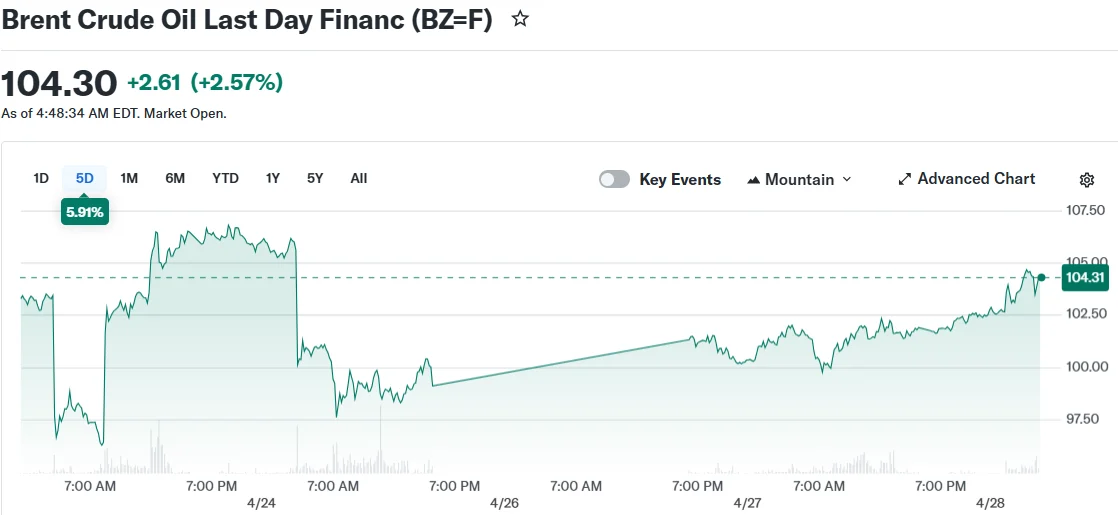 Brent Crude Oil Last Day Financ (BZ=F)
Tehran presented a comprehensive proposal aimed at resolving the ongoing standoff and restoring operations through the strategic waterway. The Iranian plan included provisions for Washington to withdraw its naval blockade, establish a fresh legal framework governing maritime passage through the corridor, and provide assurances against future military operations targeting Iranian interests.
US President Donald Trump assembled his security advisors to evaluate the Iranian proposition. However, sources from the Wall Street Journal and Reuters indicated that Trump and his national security apparatus rejected the terms as insufficient.
The central obstacle centered on Tehran’s desire to postpone discussions regarding its nuclear capabilities. Terminating uranium enrichment activities and blocking Iran’s path to nuclear weapons development constitute Washington’s primary objectives in this confrontation.
Secretary of State Marco Rubio stated that Iran continues to seek dominance over the Strait of Hormuz, characterizing such ambitions as unacceptable. His remarks came during a Monday broadcast interview with Fox News.
Strategic Waterway Blockage Strains Worldwide Energy Markets
The Strait of Hormuz has remained essentially closed since early April. Prior to the escalation, approximately 20% of global petroleum and liquefied natural gas shipments traveled through this critical maritime chokepoint each day.
Vessel traffic through the strait has plummeted to virtually nothing. This disruption has severely constrained international crude oil and natural gas distribution, elevated energy costs, and amplified inflationary pressures.
Two Iranian-affiliated oil tankers that were intercepted by American naval forces near Sri Lanka last week have reversed course in the Indian Ocean. The US maritime blockade targeting Iranian shipping commenced on April 13 and has redirected dozens of commercial vessels.
Florence Schmit, an energy strategist with Rabobank, observed that Iran’s diplomatic offer seemed destined for failure. She highlighted that financial markets were transitioning from a cautious stance toward what she described as a “bleaker risk-on outlook.”
Tehran’s Petroleum Sector Faces Mounting Challenges
According to data from analytics provider Kpler, Iran is experiencing critical shortages in crude oil storage infrastructure. With export channels blocked by the American naval cordon, available storage facilities are reaching maximum capacity.
US Treasury Secretary Scott Bessent revealed that Iran’s petroleum industry has “starting to shut in production.” In a social media statement, he projected that production levels would “soon collapse” and warned that Iran would likely encounter domestic gasoline supply disruptions.
Pakistan has served as an intermediary in peace negotiations between the United States and Iran. Plans for additional diplomatic sessions failed to materialize over the weekend, creating uncertainty about when parties might reconvene.
The confrontation between the US-Israel alliance and Iran is nearing the two-month milestone. Market analyst Linh Tran from XS.com observed that any substantive diplomatic breakthrough could precipitate a dramatic price correction.
Monetary policy decisions from central banking authorities in Japan and the United States are drawing attention this week, with elevated oil prices likely to intensify concerns regarding energy-fueled inflation.
The post Crude Oil Surges to Three-Week Peak Amid Failed US-Iran Negotiations appeared first on Blockonomi.





 English (US) ·