
 6 months ago
81
6 months ago
81
Quick Summary
- Brent crude tumbled 6–7% to approximately $92 per barrel Tuesday following Monday’s spike above $119
- President Trump indicated the Iran military campaign was “very complete” and progressing faster than his projected 4–5 week timeframe
- The Islamic Revolutionary Guard Corps disputed Trump’s assessment and warned of potential blockades on regional oil shipments
- G7 finance leaders announced readiness to tap strategic petroleum reserves without committing to immediate action
- Goldman Sachs maintained its Brent projection at $66/barrel for Q4 2026, acknowledging ongoing uncertainty
Energy markets experienced dramatic volatility this week following contradictory messaging from Washington and Tehran regarding the ongoing military confrontation. Brent crude prices collapsed approximately 7% Tuesday, settling near $92 per barrel—a stark reversal from Monday’s climb above the $100 threshold for the first time since the middle of 2022.
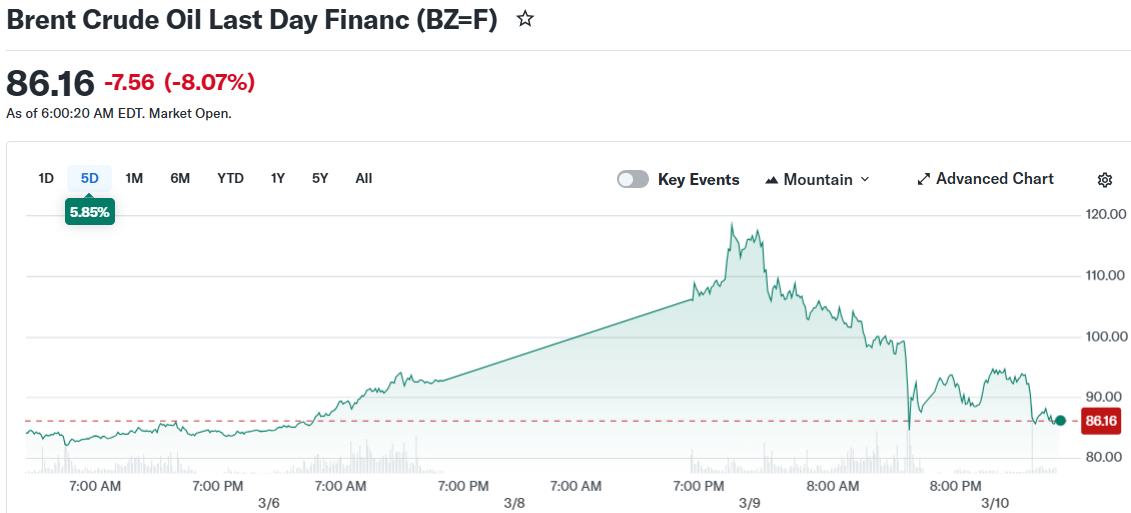 Brent Crude Oil Last Day Financ (BZ=F)
Monday’s surge was fueled by supply disruption concerns. Production cuts from Saudi Arabia and fellow producers, combined with the intensifying U.S.-Israeli military operations against Iran, drove Brent to an intraday peak of $119.50 while West Texas Intermediate touched $119.48. Dow Jones Market Data identified this as the most significant single-day intraday fluctuation ever recorded.
The dramatic turnaround occurred following Trump’s Monday interview with CBS News, where he characterized the war as “very complete” and stated operations were progressing “very far ahead” of his original four-to-five week projection. This single statement provided sufficient reassurance to markets, initiating a substantial oil selloff.
Russian leader Vladimir Putin also engaged with Trump on Monday, presenting proposals aimed at achieving a rapid resolution. These diplomatic overtures reinforced the de-escalation narrative and intensified downward pressure on prices.
However, not all parties accepted that the confrontation was approaching conclusion.
Tehran Rejects U.S. Narrative
The Islamic Revolutionary Guard Corps announced Tuesday that Iran—not Washington—would “determine the end of the war.” The military organization additionally warned it would halt all petroleum exports from the region should American and Israeli attacks persist.
Iran’s top diplomat, Foreign Minister Abbas Araghchi, independently dismissed any possibility of negotiations with the United States during a PBS News interview, according to Wall Street Journal reporting.


 Trump threatens to hit Iran "TWENTY TIMES HARDER" if they disrupt oil in the Strait of Hormuz, then calls the entire operation "a gift from the United States to China."
Keeping the Strait open was always the real objective.
And now he's leveraging it as a bargaining chip… https://t.co/eyhWHSlL2G pic.twitter.com/4BgTk5ar3E
— Mario Nawfal (@MarioNawfal) March 10, 2026
Trump issued a direct response via Truth Social, cautioning Iran that any attempt to obstruct the Strait of Hormuz would prompt U.S. retaliation “twenty times harder than they have been hit thus far.”
Market observers suggested traders may have overreacted in both directions. “While there was an overreaction to the upside yesterday, we think there is an overreaction to the downside today,” stated Suvro Sarkar, who leads the energy sector team at DBS Bank.
Sarkar highlighted that Murban and Dubai oil grades continued trading above $100 per barrel, indicating physical market fundamentals remained largely unchanged despite price swings.
Government Response Measures
G7 finance ministers convened Monday to evaluate releasing strategic petroleum reserves. While they declined to implement such measures immediately, their joint statement confirmed they “stand ready to take necessary measures,” explicitly including potential stockpile releases.
Reports indicate Trump is weighing reduced oil sanctions on Russia as part of a comprehensive strategy to moderate petroleum prices. Multiple informed sources have verified this option remains under active consideration.
Priyanka Sachdeva, analyst at Phillip Nova, suggested the convergence of these developments—potential Russian sanctions modification, G7 reserve release readiness, and Trump’s optimistic war assessment—provided sufficient justification for traders to retreat from panic-driven purchasing.
Goldman Sachs confirmed it would maintain existing price projections. The investment bank continues forecasting Brent at $66 per barrel and WTI at $62 per barrel for Q4 2026, attributing this unchanged outlook to the rapidly evolving situation.
The IRGC’s defiant Tuesday statement represents the latest concrete indication that hostilities remain far from resolution.
The post Crude Oil Tumbles 7% Following Trump’s De-escalation Remarks on Iran Conflict appeared first on Blockonomi.






 English (US) ·