
 1 month ago
51
1 month ago
51
The cryptocurrency industry has spent $189 million influencing the 2026 U.S. midterm elections, making it the single largest source of corporate political money in the country.
Key Takeaways
- Watchdog group Public Citizen says crypto firms have spent $189 million on the 2026 midterms, topping their full 2024 total of $170 million.
- Fairshake holds a $193 million war chest, funded largely by Coinbase, Ripple, and a16z, to sway key House and Senate races.
- With four months to November, unspent super PAC funds could decide control of crypto’s legislative future.
Crypto Outspends Its Entire 2024 War Chest
The figure already exceeds the roughly $170 million the industry deployed across the entire 2024 election cycle, Public Citizen said. Crypto now accounts for more than one-third of all corporate political spending tied to this year’s congressional races and primaries, a concentration the group warned could distort the coming votes.
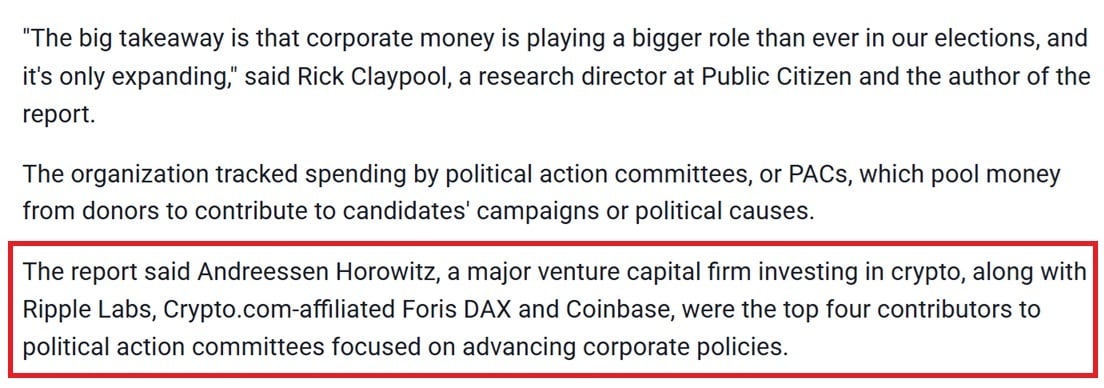 Image source: USNews
At the center is Fairshake, the industry’s flagship super political action committee (super PAC), which entered the cycle with a $193 million war chest and has already spent more than $82 million. Its largest backers are exchange Coinbase, which contributed $56 million; payments firm Ripple, at $48 million; and venture capital firm Andreessen Horowitz (a16z), at $24 million.
Where the Money Is Going
Fairshake spends only on outside advertising that is not formally coordinated with candidates, and its ads rarely mention crypto at all. Instead, the group targets specific House and Senate races, rewarding lawmakers seen as friendly to digital-asset legislation and threatening opponents with well-funded attack ads.
Other vehicles add to the total, with MAGA Inc., a super PAC largely backed by an affiliate of exchange Crypto.com, having spent more than $56 million this cycle. When combined with spending from the artificial intelligence (AI), technology, and online gambling sectors, the broader group has directed roughly $294 million toward the 2026 races.
Fairshake’s model is built on a simple message to lawmakers, i.e. those backing friendly legislation can expect campaign support, while those opposing it may face millions of dollars in opposition ads.
A Bet on Regulatory Payback
The surge follows a year in which Washington advanced several of the industry’s long-sought priorities, from market-structure legislation to a friendlier posture at federal regulators. Critics, including Public Citizen and campaign-finance reform advocates, warn that the concentration of money risks drowning out other voices and effectively purchasing favorable rules.
Some of the spending has already stirred controversy in Democratic primaries, where crypto-backed ads have been accused of obscuring their industry origins. In this regard, proponents argue the sector is simply defending itself after years of what it called regulatory hostility, and note that its candidates span both parties. Even so, the war chest has tilted increasingly Republican heading into November.
With four months until the November midterms, Fairshake and its allied committees are sitting on hundreds of millions of dollars in unspent funds, a reserve that could reshape competitive House and Senate races and, with them, the balance of power over crypto’s regulatory future.
The Abolish Super PACs Act, introduced in the House and Senate, would cap individual super PAC donations at $5,000 amid…
Crypto-Backed Super PACs in Focus as Lawmakers Push $5,000 Donation Cap
The Abolish Super PACs Act, introduced in the House and Senate, would cap individual super PAC donations at $5,000 amid…
Crypto-Backed Super PACs in Focus as Lawmakers Push $5,000 Donation Cap
The Abolish Super PACs Act, introduced in the House and Senate, would cap individual super PAC donations at $5,000 amid…


 English (US) ·