
 3 hours ago
19
3 hours ago
19
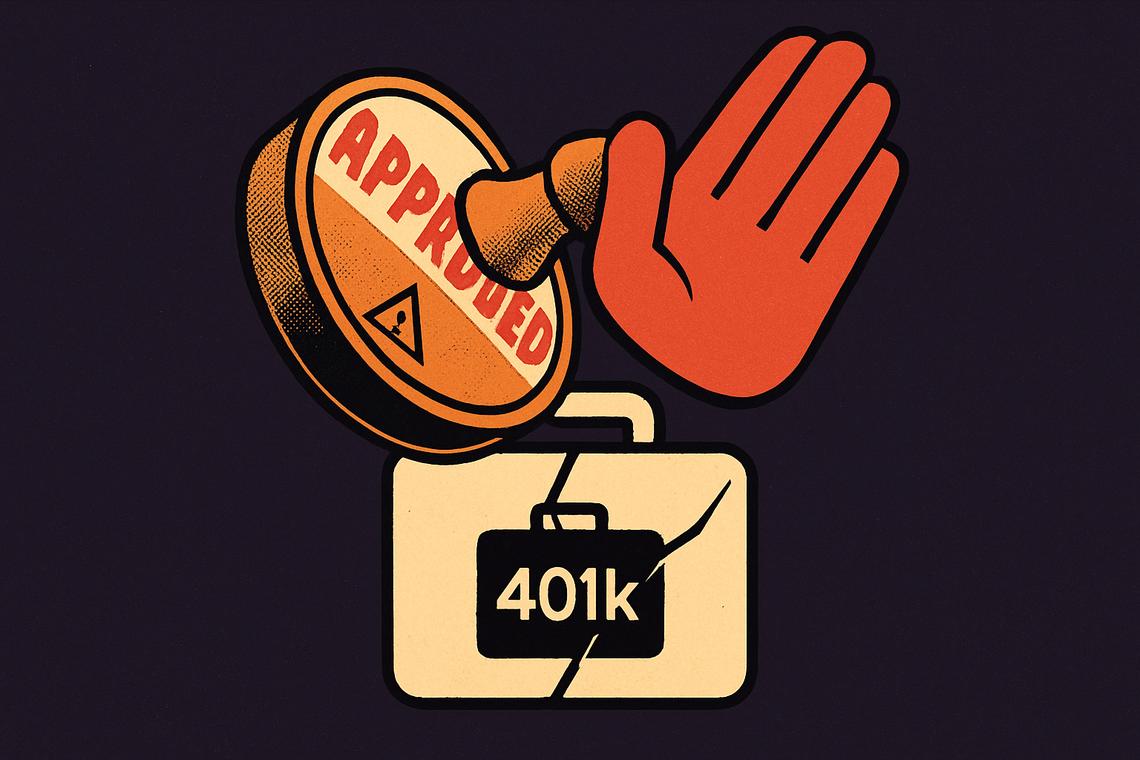
Most Americans want nothing to do with cryptocurrency inside their 401(k). A new national survey shows that public resistance to crypto in retirement plans runs deep, even as federal regulators move to open the door wider for digital assets and other alternative investments in workplace savings accounts. The tension between what regulators are enabling and what savers actually want is shaping up to be one of the more consequential fights in retirement policy.
Key takeaways
- 53% of Americans oppose employers offering cryptocurrency in workplace retirement plans, according to the National Institute on Retirement Security.
- 77% consider crypto investments in retirement accounts risky, with 46% calling them “very risky.”
- 80% of respondents believe the US faces a retirement crisis, up sharply from 67% in 2020.
- The median retirement savings balance for American workers sits below $1,000, and only about 17% of workers have access to a traditional pension.
- The Labor Department rescinded guidance discouraging crypto in retirement plans in 2025, and a March 2026 proposal now sets rules for how fiduciaries can add alternative assets.
Widespread Public Opposition to Cryptocurrency in Retirement Plans
A majority of Americans simply don’t trust digital assets with their nest eggs. The National Institute on Retirement Security found that 53% of respondents opposed letting employers offer cryptocurrency as an investment option inside workplace retirement plans, a figure that signals resistance well beyond people who already dislike crypto on principle.
Survey findings on risk perception and opposition
Risk perception drives much of that skepticism. Seventy-seven percent of Americans described cryptocurrency investments in retirement plans as risky, and 46% went further, calling them “very risky.” The institute’s poll, conducted by Greenwald Research between Oct. 24 and Nov. 14, 2025, surveyed 1,203 US residents aged 25 and older, with results weighted by age, gender and income to reflect the national adult population.
Notably, this wariness doesn’t line up neatly with who actually owns crypto. A separate Federal Reserve survey found that just In 2025, cryptocurrency was used or held by 10% of US adults, representing an increase from 7% recorded in 2024, with roughly 7% holding it purely as an investment. In other words, opposition to crypto in retirement plans extends far beyond the small slice of the population that currently owns any.
Context of retirement insecurity and low savings
The crypto question landed inside a retirement system many Americans already view as broken. Eighty percent of respondents said the country faces a retirement crisis, a jump from 67% who said the same in 2020. Another 61% said they were worried about achieving financial security once they stop working.
Money troubles compound the anxiety. Sixty-eight percent said preparing for retirement has gotten harder, and 77% said debt is actively preventing them from saving enough. The institute’s separate February 2026 analysis, based on US Census Bureau data, found the median retirement savings balance across the American workforce was below $1,000, with many employees lacking access to any employer-sponsored plan at all.
Structural gaps make the stakes higher. According to the same analysis, older Americans relied on Social Security for approximately 52% of their retirement income, whereas only around 17% of workers had access to a defined-benefit pension as of December 2022. That leaves most workers relying on defined-contribution plans like 401(k)s, which shift investment decisions and market risk directly onto employees rather than guaranteeing a fixed payout. The Government Accountability Office has previously flagged crypto’s unusual volatility and the limited reliability of methods for projecting its future returns, a caution that helps explain why so many savers hesitate.
Federal Regulatory Developments on Crypto and Alternative Assets in Retirement Plans
While public opinion has cooled on digital assets, federal policy has warmed considerably. Regulators have spent the past year systematically clearing away rules that once discouraged fiduciaries from considering cryptocurrency and other alternative investments for workplace retirement plans.
Department of Labor’s rescinded guidance and new proposals
The shift began in May 2025, when the Department of Labor withdrew guidance that had told retirement-plan fiduciaries to exercise extreme caution before adding cryptocurrency to investment menus. Officials said the earlier standard broke from the agency’s usual neutral posture toward different asset types. After the rescission, the department said fiduciaries should base decisions on their duties under the Employee Retirement Income Security Act (ERISA) without government pressure pushing them toward or away from crypto.
Presidential executive order and SEC involvement
President Donald Trump reinforced that direction on Aug. 7, 2025, by signing an executive order on alternative assets covering digital-asset investment vehicles alongside private equity, private credit, real estate and other holdings not typically found in defined-contribution plans. The order directed the Labor Department to review its fiduciary guidance and consider changes that could open these assets to retirement savers, while instructing the Securities and Exchange Commission to consult with the department on regulatory changes affecting participants in employer-sponsored plans.
Five days later, the Labor Department rescinded a separate 2021 statement that had discouraged fiduciaries from considering private equity and similar alternative investments, again framing the move as a return to a neutral, principles-based approach. None of these rollbacks required employers to actually offer crypto; plan sponsors and fiduciaries still had to evaluate each investment’s costs, risks and structure under ERISA.
Details of the March 2026 Labor Department proposal
The regulatory picture sharpened further in March 2026, when the Labor Department proposed a new rule spelling out how fiduciaries could evaluate alternative assets for workplace retirement plans. As crypto.news reported at the time, the The framework encompassed over 90 million retirement savers and mandated that fiduciaries assess performance, fees, liquidity, valuation, redemption terms, and whether participants could reasonably understand the investment.
Crucially, the proposal included regulatory safe harbors designed to reduce litigation exposure for fiduciaries who follow the specified review standards. Plan sponsors still wouldn’t be forced to add cryptocurrency, private equity or private credit to their lineups; those who chose to would need to document an objective review showing the options met ERISA’s prudence requirements. Department officials described the rule as replacing blanket restrictions based on asset type with case-by-case reviews conducted by the fiduciaries responsible for selecting and monitoring plan investments.
Political opposition from Democratic lawmakers
Not everyone in Washington is on board. The proposal now sits inside the standard federal rulemaking process, meaning the Labor Department could still revise, finalize or withdraw the framework after reviewing public comments. That leaves employers, fiduciaries and savers watching a rulemaking track that could reshape how — or whether — cryptocurrency ever becomes a mainstream option inside America’s retirement accounts.
The gap between regulatory momentum and public sentiment is the real story here. Federal policy has spent more than a year dismantling the guardrails that once kept crypto out of 401(k)s, even as most Americans say they don’t want it there and describe the broader retirement system as being in crisis. Whichever way the March 2026 rule ultimately lands, it will test whether opening the door to alternative assets actually helps a workforce that, by the numbers, is struggling just to save anything at all.
FAQ
What percentage of Americans oppose the inclusion of cryptocurrency in workplace retirement plans?
53% of Americans oppose employers offering cryptocurrency in workplace retirement plans, according to the National Institute on Retirement Security.
How risky do Americans perceive cryptocurrency investments in retirement plans?
77% of Americans consider cryptocurrency investments in retirement plans to be risky, with 46% describing them as “very risky.”
What recent regulatory changes have affected cryptocurrency in retirement plans?
In 2025, the Department of Labor rescinded prior guidance that discouraged crypto investments, and in March 2026 it proposed new rules requiring fiduciary review for alternative assets, including cryptocurrency.
Why are some lawmakers opposing the Labor Department’s proposal on alternative assets in retirement plans?
Some lawmakers have raised concerns about cryptocurrency’s price volatility, fraud potential and investor protections.
Article produced with the assistance of artificial intelligence and reviewed by the editorial team.





 English (US) ·