
 4 months ago
58
4 months ago
58
- Kraken gains direct access to Federal Reserve payment rails
- Lawmakers question transparency and consistency of approval process
- Move signals structural shift in how crypto integrates with banking
Crypto may have just crossed a line that once felt untouchable. Kraken has secured a “limited-purpose” Federal Reserve master account, becoming the first crypto-native firm to plug directly into the same payment infrastructure used by traditional banks. That’s not just symbolic, it changes how settlement, access, and trust can work for crypto institutions going forward.
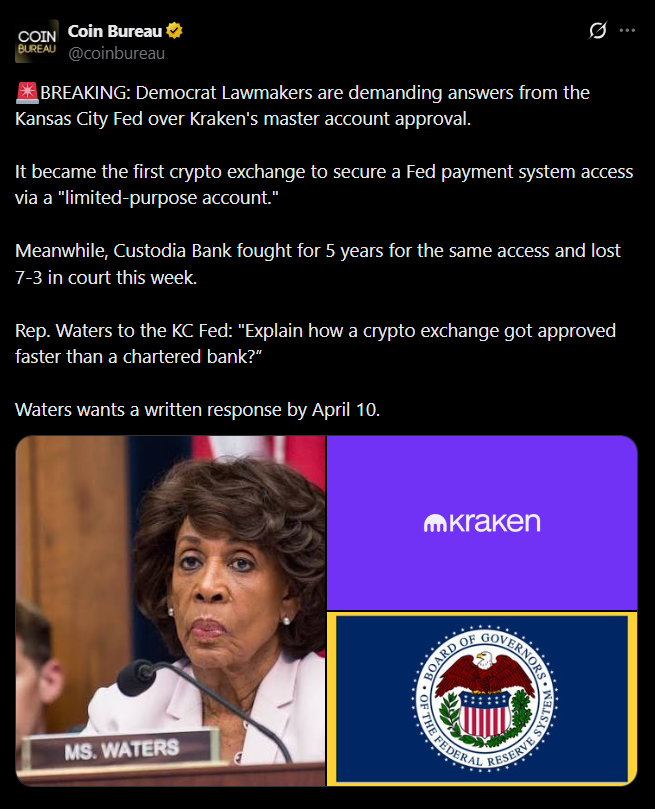
But almost immediately, questions started surfacing. Lawmakers, including Rep. Maxine Waters, are now asking what exactly Kraken was approved for. The details around restrictions, safeguards, and operational scope haven’t been fully disclosed, which leaves a bit of uncertainty hanging over what this access really means in practice.
A System That Wasn’t Built for Crypto
To understand why this matters, it helps to look at what happened before. Custodia Bank, a Wyoming-chartered institution, spent five years trying to get similar access through the traditional route. It followed regulatory processes, pushed through legal battles, and ultimately lost in a 7–3 appellate decision.
That outcome reinforced something important, the Federal Reserve has broad discretion over who gets access and who doesn’t. And for a long time, that discretion effectively kept crypto-native players outside the system. So seeing Kraken move through, and relatively quickly, raises some obvious questions.
Kraken Didn’t Break the Rules, the Rules Shifted
At first glance, it might look like inconsistency, or even preferential treatment. But the reality feels a bit more nuanced. Kraken didn’t necessarily succeed where others failed under the same framework. Instead, it appears to have entered through a different one entirely.
This “limited-purpose” account structure seems closer to a sandbox than full banking access. It allows participation in payment rails without granting the full range of services that traditional banks receive. In that sense, it’s not a shortcut, it’s a newly created lane.
Lawmakers Want Clarity Before It Expands
Still, the lack of transparency is drawing attention. If access to the Fed system is expanding, even in a limited form, regulators want to understand the boundaries. What risks are being managed, what safeguards are in place, and who else might qualify under similar conditions?

Those questions matter because once one institution gains access, others will likely follow. And if the framework isn’t clearly defined, it could create uneven expectations across the industry.
A Quiet Rebuild of Financial Infrastructure
What’s really happening here may be bigger than a single approval. Instead of forcing crypto into existing banking rules, the system itself appears to be evolving. New categories, new access points, and new definitions are being introduced to accommodate digital asset firms.
That kind of shift doesn’t happen loudly. It happens in pieces, through approvals like this, policy adjustments, and regulatory experiments. Over time, those pieces start to form a new structure.
Crypto Is Moving Closer to the Core System
Kraken’s access doesn’t mean crypto has fully merged with traditional finance, not yet. But it does suggest that the boundary between the two is starting to blur. Direct access to payment rails reduces friction, increases legitimacy, and opens the door for deeper integration.
And maybe that’s the real signal here. Crypto isn’t being pushed into the system anymore. The system, slowly and a bit quietly, is beginning to reshape itself around crypto.
Disclaimer: BlockNews provides independent reporting on crypto, blockchain, and digital finance. All content is for informational purposes only and does not constitute financial advice. Readers should do their own research before making investment decisions. Some articles may use AI tools to assist in drafting, but every piece is reviewed and edited by our editorial team of experienced crypto writers and analysts before publication.







 English (US) ·