
 2 months ago
77
2 months ago
77
- A $1,000 investment in Dogecoin currently buys roughly 10,000 DOGE at today’s prices.
- Potential 2027 price targets range from $0.15 in a bearish scenario to $0.40 in an optimistic one.
- Bitcoin’s performance, market sentiment, and DOGE adoption will likely determine which scenario becomes reality.
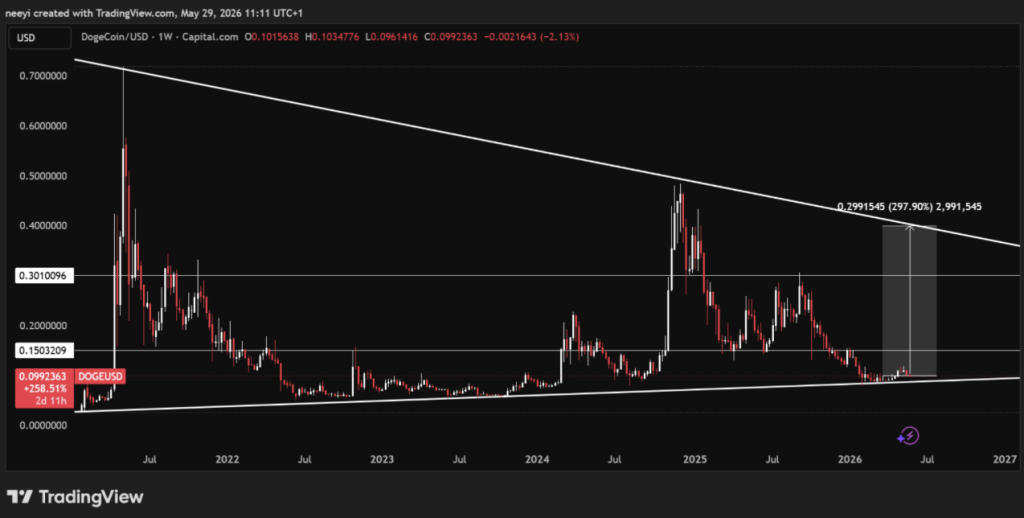
Dogecoin has spent the last few years moving inside a massive triangle formation that first emerged after its historic 2021 rally. Since then, every major price swing has remained confined within that structure, creating a framework many traders now use to estimate where DOGE could head during the next market cycle. While meme coins are often viewed as unpredictable, long-term chart patterns can sometimes provide useful clues about potential future price ranges.
At current prices, a $1,000 investment would buy roughly 10,000 DOGE. The exact amount may vary slightly depending on fees and market fluctuations, but it’s a reasonable benchmark for evaluating future returns. The bigger question isn’t how many tokens an investor can buy today. It’s whether Dogecoin can generate meaningful gains over the next two years while facing a much different market environment than the one that fueled its explosive rise in 2021.
That answer depends on several moving pieces. Bitcoin remains the dominant force across crypto markets, and DOGE has historically followed broader market trends more often than it creates its own. Unfortunately for bulls, Bitcoin has struggled through much of 2026, and many altcoins have suffered alongside it. Dogecoin itself has remained under pressure since late 2025, with buyers repeatedly failing to establish a sustained recovery.
Dogecoin’s Strengths and Weaknesses Remain Closely Linked
Owning 10,000 DOGE provides exposure to one of the most recognizable cryptocurrencies ever created. Few digital assets enjoy the same level of brand recognition, and despite countless predictions of its demise over the years, Dogecoin has survived multiple bull and bear markets.
However, recognition alone doesn’t guarantee appreciation. One of DOGE’s defining characteristics remains its volatility. Unlike traditional companies, Dogecoin doesn’t generate revenue or earnings that investors can use to estimate value. Instead, price movements are heavily influenced by sentiment, social media attention, broader market conditions, and occasionally high-profile endorsements from figures such as Elon Musk.
Supply dynamics also deserve attention. Bitcoin benefits from a fixed supply cap, but Dogecoin operates under a different model. Approximately 5 billion new DOGE enter circulation every year. That constant issuance means demand must continue growing simply to absorb incoming supply. If interest stagnates, upward price movement becomes significantly harder to sustain over long periods.
Still, there’s another side to the story. DOGE remains roughly 86% below its all-time high near $0.73. That leaves substantial room for recovery should crypto markets regain momentum. Increased adoption, clearer regulation, stronger payment utility, or simply a renewed speculative cycle could all help drive prices higher over time.
Why Bitcoin’s Next Move Could Decide DOGE’s Future
Looking ahead, Dogecoin’s outlook remains tightly connected to Bitcoin and the broader crypto market cycle. Historically, major altcoins rarely sustain strong rallies without Bitcoin leading the way. When BTC enters prolonged periods of weakness, speculative assets often struggle even more.
Current market conditions haven’t been especially encouraging. Previous cycles typically experienced extended corrections after peak enthusiasm faded, and much of 2026 has felt consistent with that pattern. Bitcoin continues facing resistance, risk appetite remains fragile, and capital has flowed more cautiously into crypto than during prior bull runs.
The long-term triangle pattern that has guided Dogecoin since 2021 offers additional perspective. Based on the structure, a breakout toward the upper boundary would likely require unusually favorable conditions. That doesn’t make it impossible, but it does raise the bar considerably. Under current circumstances, many analysts view the $0.40 region as one of the most realistic upper-end targets for DOGE by 2027.
Important resistance levels also remain in place near $0.15 and $0.30. These areas may act as stepping stones if a recovery develops, helping define potential scenarios over the next couple of years.

Three Possible Outcomes for a $1,000 DOGE Investment
One way to evaluate Dogecoin’s future is by examining multiple market scenarios rather than relying on a single prediction.
In a pessimistic outcome, Bitcoin remains weak, institutional demand stays limited, and Dogecoin fails to attract a meaningful catalyst. Under those conditions, DOGE could reach approximately $0.15 by 2027. A holding of 10,000 DOGE would then be worth around $1,500. While that still represents a gain, it would be relatively modest considering the risks involved.
A more balanced scenario assumes Bitcoin stabilizes and eventually regains some strength. Crypto markets recover gradually, but enthusiasm remains well below the extremes witnessed during previous cycles. Dogecoin benefits from improving sentiment without receiving a major catalyst of its own. In that case, a move toward $0.30 becomes more realistic, valuing a 10,000 DOGE position at roughly $3,000. That outcome would effectively triple the original investment.
The most optimistic scenario requires several bullish factors to align simultaneously. Bitcoin would need to recover strongly, crypto adoption would likely need to expand, and Dogecoin might require additional utility or payment-related developments to strengthen its narrative. If all of those conditions materialize, the upper boundary of the long-term triangle suggests a target near $0.40. At that level, a 10,000 DOGE holding would be worth approximately $4,000.
The Road to 2027 May Be Less About Hype and More About Market Conditions
Dogecoin remains one of crypto’s most recognizable assets, but its future won’t be determined by popularity alone. The next two years will likely depend on a combination of Bitcoin’s performance, overall market liquidity, investor appetite for risk, and Dogecoin’s ability to remain relevant as the industry evolves.
What’s interesting is that even the optimistic scenario remains well below the type of market conditions seen during the peak of 2021. That reflects a more cautious outlook rather than blind optimism. Markets have matured, institutional participation has changed the landscape, and investors are increasingly focused on utility alongside speculation.
For now, the triangle pattern continues serving as a useful roadmap. While no chart can predict the future with certainty, current evidence points toward three important price levels: $0.15, $0.30, and $0.40. Whether Dogecoin reaches one of those targets, or surprises everyone entirely, will depend on how the next phase of the crypto market unfolds.
Disclaimer: BlockNews provides independent reporting on crypto, blockchain, and digital finance. All content is for informational purposes only and does not constitute financial advice. Readers should do their own research before making investment decisions. Some articles may use AI tools to assist in drafting, but every piece is reviewed and edited by our editorial team of experienced crypto writers and analysts before publication.




 English (US) ·