
 8 months ago
109
8 months ago
109
- Ethereum’s Fusaka hard fork merges the Fulu and Osaka layers, introduces PeerDAS with up to 8x data throughput, and improves user experience with features like R1 curve support and pre-confirmations.
- Treasury firm BitMine added another $150M in ETH as part of its long-term goal to control 5% of Ethereum’s circulating supply, reinforcing institutional conviction in ETH as core infrastructure.
- ETH has bounced from ~$2,630 and is now testing the $3,050–$3,150 zone; holding this level could open a move toward $3,650–$3,700, while failure risks a drop back toward $2,630 or even $2,400.
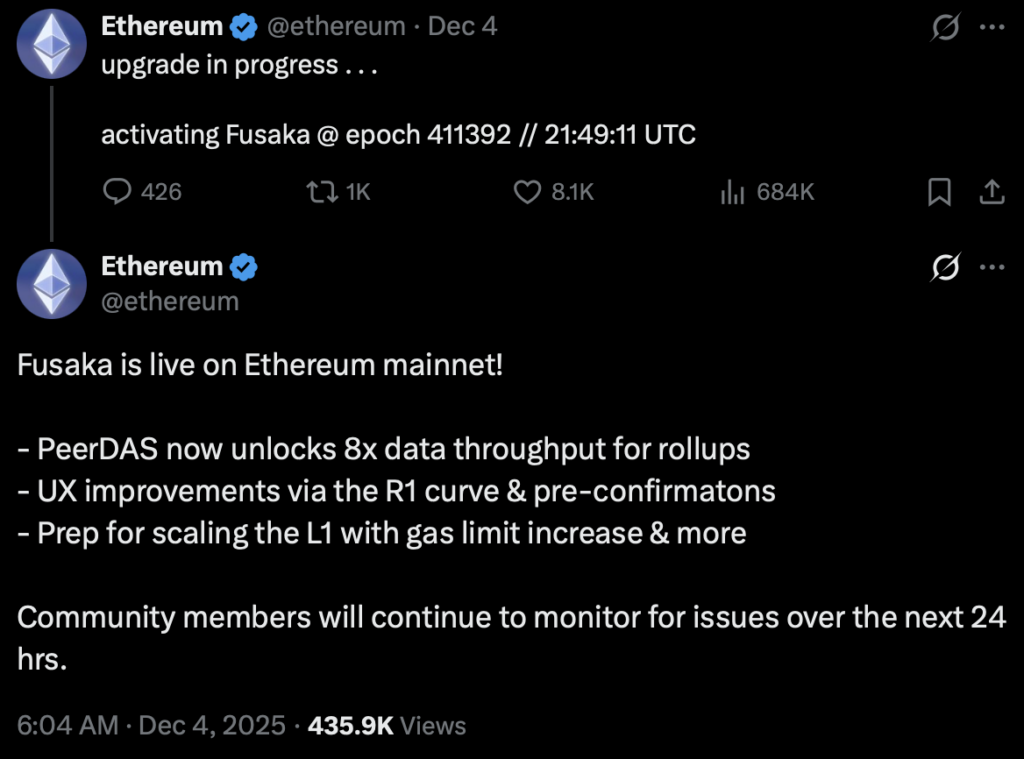
Ethereum just switched on its most important capacity upgrade of the year, officially activating the Fusaka hard fork, and the network didn’t need long to show a reaction. Price jumped, sentiment shifted, and developers immediately started digging into what the new tools mean for the ecosystem.
Fusaka merges two major components — the Fulu consensus layer and the Osaka execution layer — basically changing how Ethereum moves and stores data behind the scenes. The whole point is to let Ethereum handle more activity without sacrificing decentralization or security, which is always the tricky balancing act.
PeerDAS: The Upgrade That Quietly Changes Everything
Fusaka ships with two huge improvements. The first and biggest is PeerDAS, a redesigned system for handling network data. Developers say it can boost Ethereum’s data throughput by up to 8x. That’s not a small number; it’s a fundamental shift in how much blockspace the network can supply.
And this matters most for rollups — the scaling systems that run on top of Ethereum. More space means cheaper fees, smoother performance, and far more users being able to interact with apps without feeling punished for it. The entire L2 ecosystem benefits from the extra room.
Faster, Simpler, More Predictable Transactions
The second upgrade focuses on user experience — the part of Ethereum most people interact with daily.
Tools like the R1 curve, pre-confirmations, and simplified verification processes are meant to make everything feel lighter:
- Faster wallet actions
- Clearer confirmation signals
- Less guesswork for users on mobile
- More predictable transaction finality
Ethereum isn’t trying to reinvent itself — just remove friction without compromising the qualities that make it censorship-resistant.
Together, these upgrades try to make Ethereum cheaper, easier, and more scalable, while keeping the network just as hard to stop.
Why Is BitMine Buying Another $150M in ETH?
Right alongside the Fusaka activation, Ethereum got another surprise: BitMine purchased $150 million worth of ETH, adding it to its already massive treasury position.
BitMine has a public goal — control 5% of Ethereum’s circulating supply. With each new acquisition, the firm moves a little closer. They didn’t reveal the average buy-in price or how many desks executed the purchase, but the intent is obvious: long-term accumulation, not trading.
The company has been framing its Ethereum strategy as a multi-year bet on ETH becoming core infrastructure for payments, finance, and digital systems. This latest purchase feels like a continuation of that thesis.
Where Ethereum’s Price Stands After the Dip
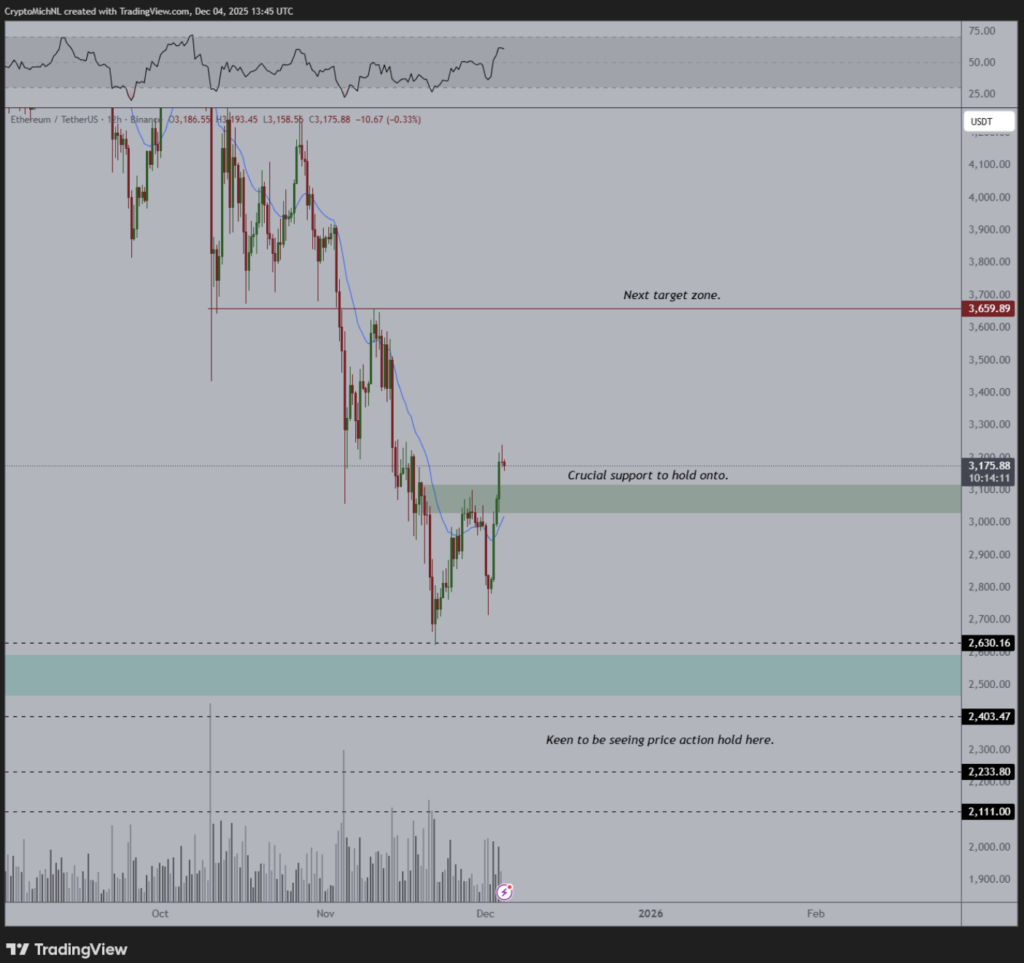
A new analyst chart shows ETH working to regain its footing after the latest correction wiped out nearly a month of gains.
On the 12-hour timeframe, Ethereum bounced cleanly from the late-November low around $2,630 and is now pushing into the $3,050–$3,150 zone — an area that has blocked several rallies before. Bulls now want it to flip to support.
Early signals look mixed:
- Short-term averages are trending upward, hinting at stabilization
- But the RSI remains below 50, showing bulls haven’t fully taken control
If ETH holds this zone, analysts expect a move toward $3,650–$3,700, a region stacked with sell orders. A push into that zone could trigger liquidations, forcing shorts to exit and adding fuel to the next leg up.
If the level fails, ETH could slide back toward $2,630 — and below that, stronger support sits around $2,400.
Ethereum now sits at a crossroads:
- A massive upgrade that boosts capacity eightfold
- A major treasury buying another $150M in ETH
- A technical setup that’s trying to flip resistance into support
If the market cooperates, this could set the early stage for Ethereum’s next 2025 run.
The post Ethereum Activates Fusaka — Its Biggest Upgrade of 2025 — And the Market Reacts Fast first appeared on BlockNews.







 English (US) ·