
 3 months ago
82
3 months ago
82
- Ethereum remains under pressure near $2,000 as ETF outflows and weak network activity weigh on sentiment.
- Technical charts suggest downside risks could increase if key support levels fail.
- Slowing stablecoin activity, weaker DeFi participation, and declining ETF demand continue challenging Ethereum’s recovery prospects.
Ethereum remains under pressure after extending its decline from the highs reached earlier this month. The second-largest cryptocurrency by market capitalization is currently trading near $2,016, hovering just above a psychological support zone that traders have been watching closely. While ETH has not suffered a complete technical breakdown yet, the broader mood surrounding the asset has clearly cooled as ETF flows weaken and on-chain activity continues losing momentum.
The recent decline has left many investors questioning whether Ethereum can stabilize before additional selling pressure emerges. For now, the asset remains above several important support levels, but confidence has become increasingly fragile. Markets tend to move on expectations as much as fundamentals, and right now neither side is offering bulls much comfort.
What’s perhaps most concerning is that the weakness isn’t isolated to price action alone. Several key indicators across Ethereum’s ecosystem have also started flashing warning signs, creating a more challenging backdrop for any meaningful recovery attempt.
Technical Structure Suggests Bears Still Have the Upper Hand
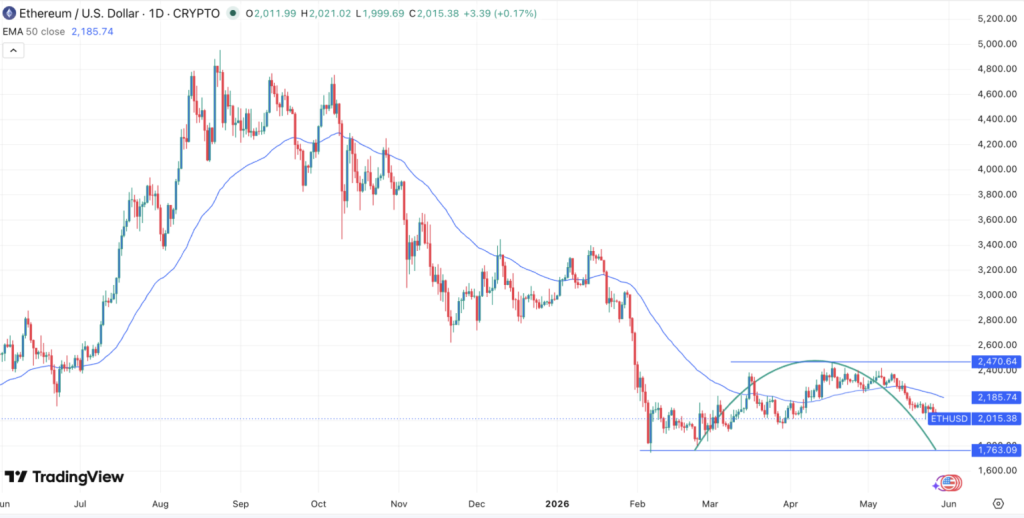
Ethereum’s daily chart has begun forming a pattern that technical analysts often associate with downside risk. After peaking near $2,470 earlier in May, the asset started retreating and appears to be developing what resembles an inverted cup-and-handle formation.
While chart patterns should never be viewed as guarantees, they often provide insight into market psychology. In this case, the structure reflects fading buying momentum following an unsuccessful recovery attempt. The most important level within the pattern sits near $1,763, a support area that played a major role during previous market declines.
For now, Ethereum remains above both the $2,000 threshold and the lower boundary of the developing formation. That’s significant because support levels only become problematic after they break. As long as buyers continue defending these zones, the bearish scenario remains unconfirmed.
However, if ETH loses the $2,000 region and begins moving toward the lower boundary of the structure, market participants would likely shift their attention toward deeper downside targets. Until then, traders remain caught between caution and hope, waiting for the next decisive move.
Investors Rotate Away From Ethereum ETFs
Beyond the charts, another trend has been quietly developing. U.S. investors appear to be pulling capital from Ethereum exchange-traded funds and redirecting it toward sectors delivering stronger returns.
The shift isn’t happening in a vacuum. Technology-related investments, particularly those tied to artificial intelligence, memory chips, and data infrastructure, have significantly outperformed many crypto assets this year. Companies such as Micron and Sandisk have attracted considerable investor interest, while newer thematic investment products have gathered billions of dollars in assets within a relatively short period.
The same story is unfolding in the space sector. Firms like Rocket Lab, Planet Labs, and Intuitive Machines have generated substantial returns, drawing capital toward growth-oriented opportunities outside the cryptocurrency market. Meanwhile, major equity benchmarks such as the S&P 500 and Nasdaq continue pushing toward record highs, creating additional competition for investor attention.
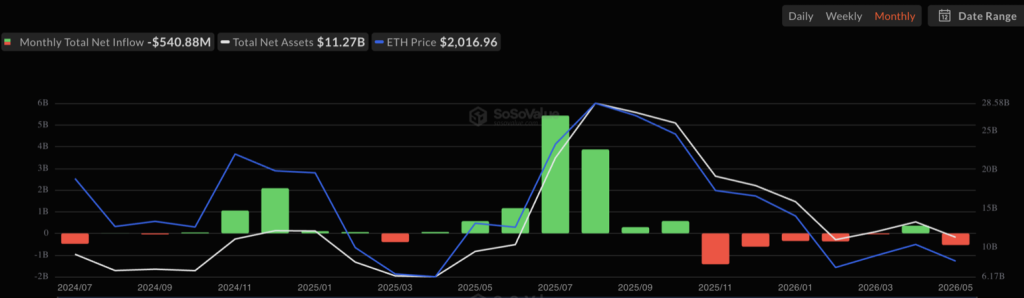
Against that backdrop, Ethereum has struggled to remain attractive. Data from SoSoValue shows spot Ethereum ETFs have experienced three consecutive weeks of net outflows. Monthly withdrawals exceeded $540 million after the previous month recorded inflows of roughly $355 million. On a year-to-date basis, total ETF outflows have approached $1 billion, highlighting the growing reluctance among investors to maintain exposure.
Ethereum’s Fundamental Metrics Continue Slowing
ETF weakness is only part of the story. A closer examination of Ethereum’s underlying network activity reveals a broader slowdown occurring across several important areas of the ecosystem.
According to Artemis data, the total value of stablecoins operating on Ethereum has declined by more than 2% over the last month. While the network still hosts approximately $165 billion in stablecoin assets, the decline suggests activity is no longer expanding at the pace many investors had hoped for.
Transaction activity paints a similar picture. Stablecoin transfers have fallen nearly 20% during the same period, indicating reduced usage across parts of the network. The real-world asset sector, often highlighted as one of Ethereum’s major growth opportunities, has also experienced weaker activity. Transfer volume within the segment reportedly dropped by roughly 32%, falling to $14.4 billion.
Even distributed asset values have declined, slipping approximately 2.1% over the past month. Individually, these numbers may not appear alarming. Collectively, however, they point toward a network that is currently growing more slowly than expected.
DeFi Weakness Adds Another Layer of Pressure
Ethereum’s decentralized finance ecosystem has not escaped the slowdown either. Total value locked across DeFi protocols has fallen to approximately $40 billion, reflecting reduced capital participation throughout the sector.
A significant portion of that decline has been linked to AAVE, one of Ethereum’s largest lending protocols. Assets within AAVE have dropped substantially from previous highs, with the retreat accelerating after concerns emerged following the recent KelpDAO exploit. Security incidents, even when isolated, often affect broader investor confidence across decentralized finance markets.
The result is a market facing pressure from multiple directions simultaneously. ETF investors are withdrawing funds, network activity is slowing, DeFi participation has weakened, and technical indicators remain fragile.
That doesn’t necessarily mean Ethereum is destined for further declines. Crypto markets have a habit of changing direction quickly when sentiment shifts. However, at the moment, bulls have yet to present a compelling reason for investors to return aggressively.
For Ethereum, the battle around $2,000 may prove critical. Hold the line, and confidence could gradually rebuild. Lose it, and the market may start preparing for a much deeper correction.
Disclaimer: BlockNews provides independent reporting on crypto, blockchain, and digital finance. All content is for informational purposes only and does not constitute financial advice. Readers should do their own research before making investment decisions. Some articles may use AI tools to assist in drafting, but every piece is reviewed and edited by our editorial team of experienced crypto writers and analysts before publication.








 English (US) ·