
 22 hours ago
28
22 hours ago
28
- Ethereum’s total value locked has climbed above its fully diluted valuation, a rare milestone that suggests the network may be undervalued.
- Institutional demand continues building as Ethereum ETFs record another streak of inflows, removing more ETH from the open market.
- Robinhood’s new Layer-2 network could strengthen Ethereum’s long-term role as the security layer behind tokenized finance.
Ethereum may be creating more value than its current market price reflects.
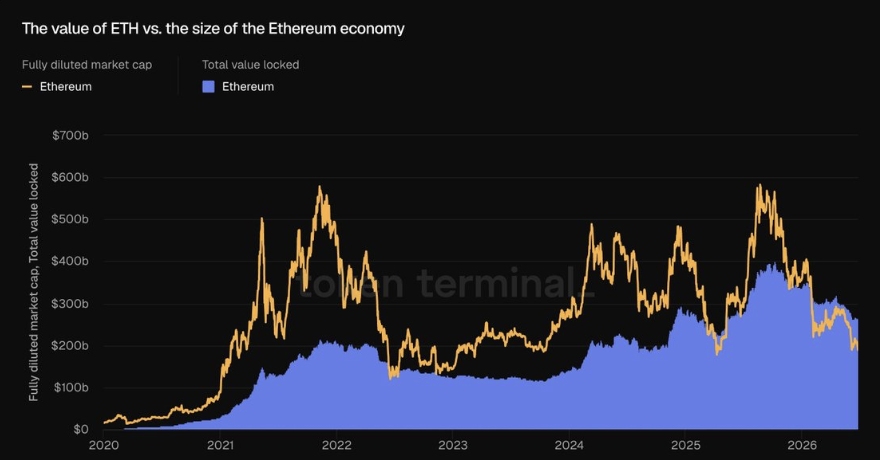
New data shared by researcher and analyst Leon Waidmann suggests something unusual is happening beneath the surface. According to figures from Token Terminal, Ethereum’s fully diluted valuation (FDV) now sits around $210 billion, while the network’s total value locked (TVL) has climbed to roughly $260 billion.
That’s not something investors see very often.
For the first time, the value of assets secured across Ethereum’s ecosystem has grown larger than the theoretical value of every ETH that will ever exist. Historically, TVL has almost always remained below Ethereum’s FDV—even during previous crypto bull markets.
To Waidmann, that raises an interesting question.
Either Ethereum’s ecosystem has expanded much faster than its market valuation… or ETH itself simply hasn’t caught up yet.
Ethereum ETFs Continue Pulling in Fresh Capital
At the same time, institutional demand appears to be strengthening.
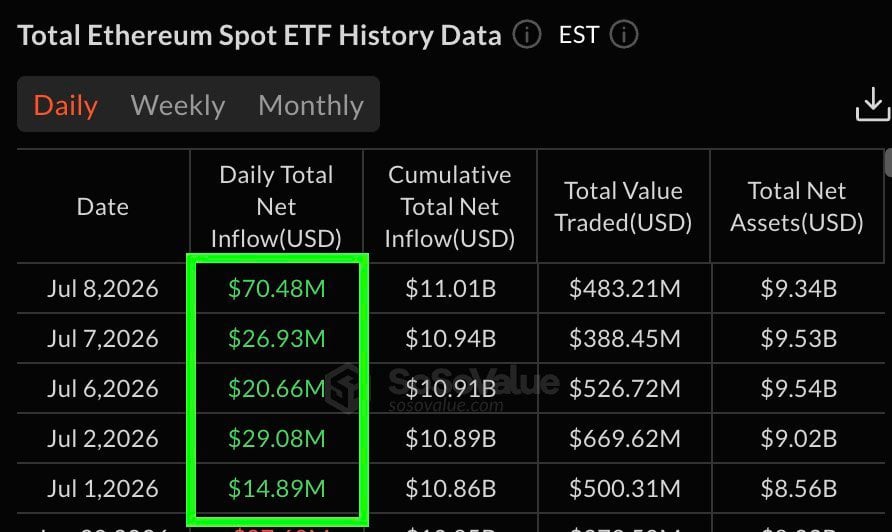
On July 8 alone, spot Ethereum ETFs attracted roughly $70 million in net inflows, marking their strongest single day in nearly a month. Even more notable, the products have now posted five consecutive days of positive flows, bringing in approximately $162 million during that stretch.
Those inflows matter for more than just headlines.
Whenever investors purchase ETF shares, the fund manager acquires real ETH to back those holdings. Those coins are then placed into long-term institutional custody, effectively reducing the amount of ETH circulating on exchanges and available for everyday trading.
If demand continues building while available supply gradually shrinks, it creates real spot-market buying pressure rather than purely speculative activity.
Robinhood’s Layer-2 Launch Could Add Even More Demand
Another development attracting attention is Robinhood’s move deeper into Ethereum.
On July 1, the brokerage officially launched the public mainnet for Robinhood Chain, its Ethereum Layer-2 blockchain built using Arbitrum technology.
The network is designed to support decentralized finance applications while also handling tokenized real-world assets such as stocks and other financial products.
Some analysts believe this could become much bigger than a simple Layer-2 launch.
According to commentary shared by Ethereum Daily on X, if Robinhood succeeds—and if more banks, brokerages, and fintech companies choose similar infrastructure—Ethereum could quietly become the settlement layer underneath a massive portion of future financial markets.
Layer-2 networks process transactions independently but ultimately settle them back onto Ethereum.
That relationship is critical.
While L2s improve speed and reduce costs, they still rely on Ethereum for security, consensus, and final transaction settlement. Without Ethereum anchoring everything underneath, those networks lose much of the trust they’re built upon.
In other words, every major institution that chooses an Ethereum Layer-2 potentially strengthens Ethereum itself.
Ethereum’s Security Could Become Even More Valuable
If tokenized finance continues expanding, ETH’s role may evolve beyond simply being another cryptocurrency.
Instead, it could increasingly function as the economic collateral securing trillions of dollars worth of financial activity.
The Ethereum Foundation estimates that roughly $76 billion worth of ETH is currently staked across the network.
That enormous amount of locked capital forms the backbone of Ethereum’s proof-of-stake security model.
According to the Foundation, successfully attacking Ethereum’s finality would require extraordinary financial resources. Under current assumptions, an attacker would need access to roughly $50 billion to fraudulently finalize transactions, making such an attack economically unrealistic for almost any adversary.
It’s one reason many institutions continue viewing Ethereum as the foundation for long-term blockchain infrastructure.
Is ETH Falling Behind Its Own Ecosystem?
None of this guarantees Ethereum’s price is about to surge.
Markets rarely move in straight lines, and valuation gaps can persist far longer than many investors expect.
Still, the latest data paints an interesting picture.
The value flowing through Ethereum’s applications continues climbing. Institutional investors are steadily accumulating ETH through ETFs. Major financial platforms are building directly on Ethereum’s Layer-2 ecosystem. And billions of dollars remain locked to secure the network itself.
Whether that eventually translates into a higher ETH price remains to be seen.
But one thing is becoming harder to ignore: Ethereum’s ecosystem appears to be growing faster than the market currently values the asset at its center.
Disclaimer: BlockNews provides independent reporting on crypto, blockchain, and digital finance. All content is for informational purposes only and does not constitute financial advice. Readers should do their own research before making investment decisions. Some articles may use AI tools to assist in drafting, but every piece is reviewed and edited by our editorial team of experienced crypto writers and analysts before publication.









 English (US) ·